

LONGVIEW — Nippon Dynawave kept a tank of caustic white liquor operating for 43 weeks after consultants warned that its walls had corroded far below the minimum safe thickness, a decision that state investigators say made catastrophic failure inevitable and led to the deaths of 11 workers on May 26.
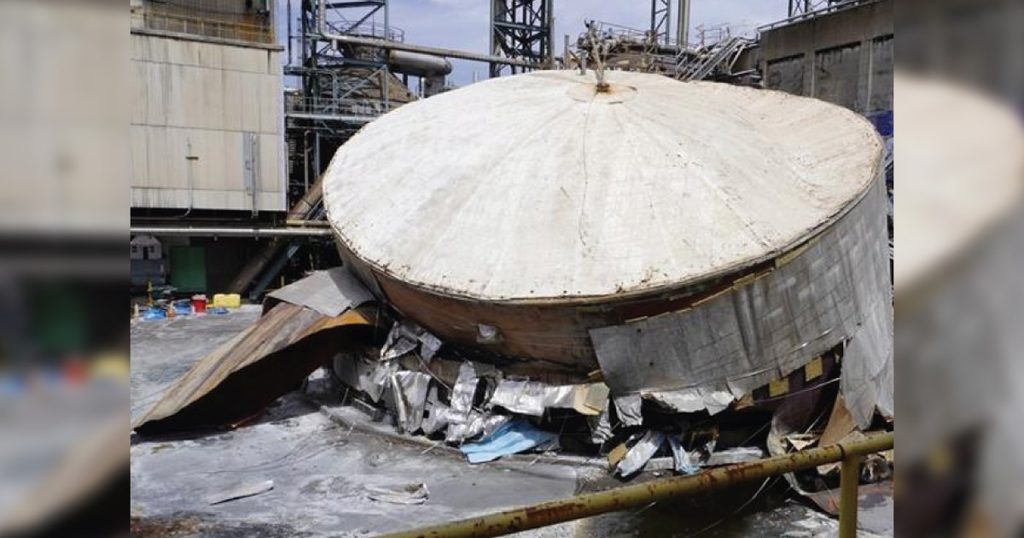
The Washington State Department of Labor & Industries and the Department of Ecology announced Friday that the Nippon Dynawave faces a combined $10,138,127 in penalties and cost recovery — the largest workplace safety and health fine in state history and additional environmental sanctions — following a six-month investigation into the rupture of the structure known as G-tank at the Longview mill. The investigation involved more than 70 witness interviews and review of more than 40,000 documents.
Every ounce of our sympathy is with those families, the injured workers, and the Longview community, and it was with them, foremost in our minds, that our teams went about their work every day for the last six months,” said Matt Ross with the Public Affairs Program at the Washington State Department of Labor and Industries. “Today we are announcing that Nippon Dynawave is facing a combined total of $10,138,127 and penalties and cost recovery from the state stemming from violations of state safety and health and environmental regulations.”
At 7:08 a.m. on the morning of May 26, 2026, roughly 900,000 gallons of the highly caustic white liquor burst from the tank, flooding the courtyard and into the electrical and mechanical maintenance shops. The force knocked down walls, crushed vehicles and shifted heavy equipment. Eight workers in the electrical shop, two in the maintenance shop and one in the courtyard were killed. At least 12 others were injured seriously enough to require medical care, with some injuries still being treated months later. Investigators described it as the worst industrial accident in Washington’s modern history.


“L&I says the tank kept operating without restriction for 43 weeks after a written warning that parts of its wall were likely below the minimum safe thickness,” said Josh Estes, Association of Western Pulp and Paper Workers (AWPPW) spokesperson. “As a union, we’re deeply troubled and angry that a warning this serious went unaddressed. Eleven workers are gone. Their families deserve to know who got those warnings, who had the authority to act, and why the tank was still in service on May 26.”


L&I cited the company for 75 violations totaling $9,177,127. The previous state record was a $2.9 million penalty issued after the 2010 Tesoro refinery explosion in Anacortes. Ecology assessed a $296,500 penalty for 34 air, water and dangerous-waste violations and is seeking $665,000 in reimbursement for response costs incurred by the agency and the Washington State Military Department, for a combined Ecology total of $961,000.
Repeated warnings ignored
Under the American Petroleum Institute’s API 653 standard — which Nippon Dynawave cites in its own procedures — when ultrasonic testing shows a tank wall has fallen below the calculated minimum safe thickness (T-min), the operator must repair the tank, reduce the liquid level to lower wall stress, or take it out of service. Monthly monitoring is not an accepted substitute.
A consultant’s July 2025 ultrasonic inspection, received by the company in August, documented that Course 2 was on average below T-min and that many readings on Course 3 were also too low. The report stated the tank was not fit for continued service and carried a high likelihood of failure unless corrected. A second round of testing in October confirmed the findings. A third set of measurements in February 2026 showed corrosion had continued; in one section, all 36 readings were below the safe minimum.
Internal emails and documents show plant managers understood the severity. They discussed taking the tank out of service or running it at lower levels, solicited bids for replacement and told the parent company the tank had reached the end of its safe service life. One presentation noted that without replacement they would need to reduce capacity or shift liquor to another tank for two to three months while repairs were made. Instead, after being told in April 2026 to reduce capital spending, managers prioritized other projects and explored ways to keep G-tank in service until 2028. No monthly inspections occurred in most of the intervening months.
On the morning of the failure the digester was down, so white liquor continued to fill G-tank to nearly full capacity. At that level the outward pressure on the lower courses was more than twice what the thinned walls could safely handle, based on the February measurements. Post-failure examination found an exposed section of Course 2 along a vertical seam measured just 0.07 inches thick — roughly 12.5 times thinner than the 0.875-inch thickness to which that course had been rebuilt in 2011, and about seven times thinner than the calculated safe minimum.
L&I issued 43 egregious willful serious violations — one for each week the tank remained in normal service after the August 2025 report. “Egregious willful serious” is the agency’s highest classification; it allows each instance to be counted separately when the employer knowingly failed to comply or acted with plain indifference and there was a substantial probability of death or serious harm. Those 43 citations alone account for more than $7.1 million of the L&I total.
Other tanks and emergency-response failures
Investigators found parallel problems at 13 additional tanks on the site. The company lacked proper documentation of required internal inspections (due at least every 10 years) and external inspections with ultrasonic thickness testing (every five years). In three tanks that already had identified deficiencies, no required fitness-for-service evaluation was documented before continued operation. L&I issued 14 egregious willful serious violations and three willful serious violations related to inspection and follow-up failures, carrying roughly $1.5 million in penalties.
“Workers should never have to wonder whether a serious safety warning was acted on,”Estes said. “The people whose lives depend on these safeguards need to help shape them. We’re committed to closing the gaps that leave workers at risk and preventing another tragedy like Longview.”
L&I also cited four egregious willful serious, three willful serious and five serious violations for emergency-response shortcomings, totaling more than $560,000. For several hours after the rupture there was effectively no employer-led incident command; outside agencies had to establish overall command upon arrival. The company did not effectively notify other employers on the same property, failed to establish adequate boundaries around the spill, and left workers and responders without sufficient training, planning or personal protective equipment. Investigators concluded these failures contributed to serious injuries among four of the 12 workers who were hurt.
Environmental impacts and criminal referral
The white liquor spread across the industrial site, entered storm drains and the sanitary wastewater system, reached a nearby ditch and entered the Columbia River. Larger volumes caused widespread fish die-offs; impacts continued for a week or more. Ecology’s $296,500 penalty addresses those 34 violations of air, water and dangerous-waste rules, some of which lasted as long as eight days. The $665,000 cost-recovery figure covers Ecology’s 47-day on-scene presence and support from the Military Department.
Because the safety and health violations were willful and contributed directly to the fatalities, L&I will refer the case to prosecutors under a state statute that allows such referrals when a fatality results from a contributing violation. Agency officials said the referral itself is for a misdemeanor-level offense under their statute; any further charging decisions rest with prosecutors. The referral is expected in the coming weeks; officials had not yet determined whether it would go to Cowlitz County or the Attorney General’s Office.
Joel Sacks, L&I director, called the findings “shocking and heartbreaking.” “Nippon Dynawave had all the information they needed to act, but they didn’t listen to the alarms their consultants and staff were raising,” he said. “Tragically, there are 11 families whose loved ones never came home.”
Heather Bartlett, Ecology’s deputy director for environmental programs, offered condolences and noted that the environmental penalties and cost recovery form only one part of the state’s overall response. Dan Pitts, L&I’s manager of statewide compliance, walked through the technical details of wall-thickness calculations, the three inspection reports and the company’s internal discussions.
What happens next
The company was informed of the citations Friday morning, November 20, and has 15 days to file an appeal with the Board of Industrial Insurance Appeals. Under state law, abatement of the cited hazards is required even while an appeal is pending. L&I said it will conduct follow-up inspections and can issue stop-work orders if necessary. Officials noted that the company has already begun draining some tanks and bringing in engineers during the investigation, but stressed that all required repairs, inspections and emergency-response improvements must still be documented and verified.
Nippon Dynawave has indicated plans to restart pulp production next month. L&I officials said they cannot guarantee the mill’s safety before reopening but will monitor abatement closely and retain the authority to inspect without advance notice. Two additional open inspections at the Longview site — unrelated to tank integrity — are expected to produce results in December. A broader targeted enforcement program covering other craft and non-craft paper mills in the state is ongoing, with results expected in February; preliminary reviews have not identified comparable imminent-danger conditions elsewhere.
Money collected from the safety and health penalties goes into the workers’ compensation supplemental pension fund. Ecology may still pursue a Natural Resource Damage Assessment for the environmental impacts of the release.

Author: Mario Lotmore