


LYNNWOOD—The Lynnwood City Council on Monday approved an expansion of the city’s automated traffic safety camera program, authorizing modifications to existing school-zone systems and the addition of new speed cameras on a high-crash corridor. The action included adoption of Resolution 2026-12, Ordinance 3525 amending the municipal code, and a $450,000 amendment to the professional services agreement with Verra Mobility that extends the contract through January 20, 2032.

The automated traffic safety camera program, in place since 2007, currently operates red-light cameras at nine intersections and two school-zone speed cameras in the Meadowdale area and at Lynnwood Elementary.
The expansion establishes two “school walk zones” under recent state law, allowing the existing cameras on 44th Avenue West from Maple Road to 188th Street SW (serving Lynnwood Elementary) and on 168th Street SW from Olympic View Drive to 56th Avenue West (serving Meadowdale Elementary, Beverly Elementary, Meadowdale Middle School and Meadowdale High School) to enforce the regular posted speed limit 24 hours a day, seven days a week.
Deputy Chief Steichen shared that ticketing thresholds for the cameras are set at 9 mph over the limit: 39 mph when school beacons are not flashing on the 30 mph arterials, and 26 mph and above when beacons are active.


The city will also add two new speed safety cameras on 44th Avenue West between 164th Street SW and 168th Street SW, an area known as the “S-curves” that staff identified as having higher crash risk due to excessive speeds.


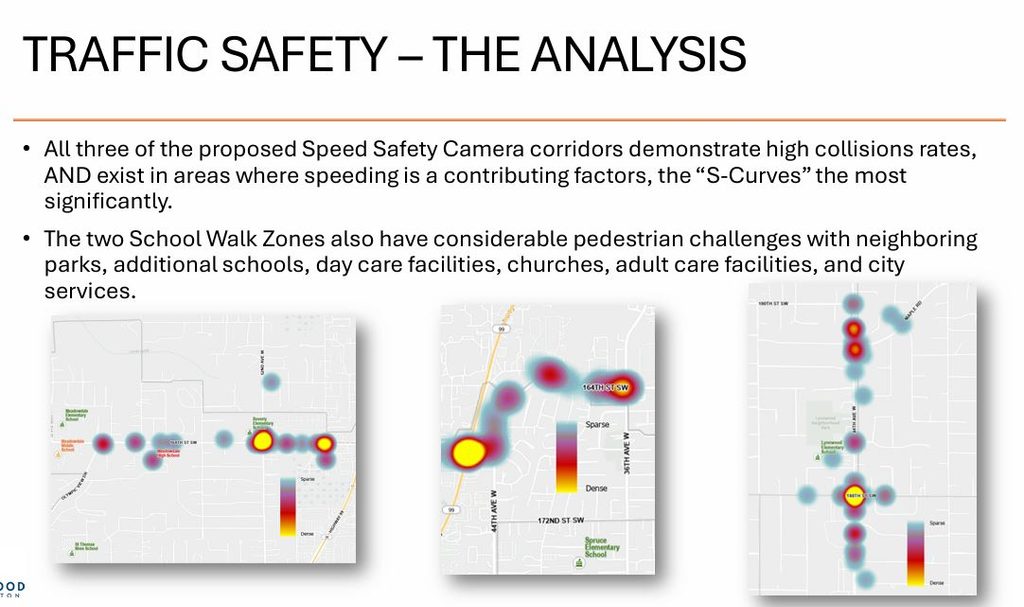
Deputy Chief Chuck Steichen told the council that analysis of accident and speed data showed significant collision rates and a clear nexus to speeding at all three locations, with the S-curves the most pronounced.
“The cameras aren’t the solution,” Steichen said. “They’re just one mechanism to getting speeds down.”
Under the ordinance, all revenue from the new systems will go into a dedicated Traffic Safety Fund usable only for camera administration and operation or for traffic-safety projects that reduce speeds or improve conditions for pedestrians and cyclists, as required by state law.
The City projects $8.2 million—$3.7 million in revenue for 2027 and $4.5 million for 2028—from the full expansion which were built into the 2027-28 biennium budget assumptions.
The two new speed safety cameras proposed for 44th Avenue West in the S-curves would each carry a fixed monthly fee of $4,150 under the amended agreement with Verra Mobility, or roughly $99,600 per camera over a two-year biennium. These systems are not covered by the city’s existing payments for the four school-zone cameras, which would continue at no added monthly charge even after being switched to 24/7 school-walk-zone operation.
On top of the fixed fee, the contract adds an $8 charge for every citation issued above 800 per camera per month. City staff described that variable cost as difficult to project until the cameras are operating and real volumes are known.
Staff projected that the fees would be offset by the revenues the cameras generate, yet the police department still sought explicit budget authority to cover the potential expense so it would not have to absorb an unbudgeted hit later—an additional $250,000 in its general operating budget (Fund 011) for the contract costs and an overall $450,000 increase to the Verra Mobility professional services agreement.
The $450,000 figure covers the base monthly fees for the new cameras plus a cushion for the excess-citation charges.
Councilwoman Mata voiced strong frustration that the proposal had become a budget conversation rather than a pure public-safety discussion.
“It really feels as though we are being pushed to make a decision for the sake of the revenue health of our city without having all of the information,” she said, repeatedly asking for a contingency plan if the cameras fail to generate the projected $8.2 million.
Assistant City Administrator Monesha Harrell responded by urging the council to evaluate the proposal on its public-safety merits.
“If you don’t want to do it and you want to turn that down, that’s fine. Evaluate it on the public safety merits,” Harrell said. “And if we get to the point where it is not a part of the budget because you’ve rejected it on the public safety merits, then we will have that discussion next on the budget.”
Mata supported activating the existing school-zone cameras but preferred pursuing a grant-funded road diet on the S-curves before adding new technology at that location.
“I want us to follow through on that solution and then reassess,” Mata said.
Public Works Director Jared Bond said a road diet and cameras would complement each other rather than serve as alternatives, and that diversion onto residential streets would likely add travel time to a commuter rather than save it.
Council Member David Parshall agreed with Bond stating that drivers will reach their destinations faster by simply staying on the main corridor and obeying the posted speed limit rather than diverting onto side streets with excessive speed.
“I think a really important point did come up tonight from all of you that going the speed limit and staying on that main road is going to get you where you want to go faster than going on those back roads and speeding,” Parshall said. “So that’s an important point for everyone out there listening, and I hope we will really popularize that point going forward, maybe with some of that additional patrol work that will be available.”
Also addressing concerns about possible traffic diversion onto side streets, Steichen and Police Chief Cole Langdon outlined monitoring options using existing traffic data, neighborhood complaints and the traffic unit, which is being restored to a full staff of four officers and a sergeant by reallocating a position.
Council Vice President Derica Escamilla questioned the timing of the analysis—authorized in November 2025 and delivered in late January 2026—asking why it was not brought forward sooner amid ongoing Vision Zero discussions, and sought clearer numbers for a partial approval excluding the S-curves.
“So, we had a new administration coming in,” Chief Langdon responded. “I met with the mayor early on and let him know that this work was being done. It, again, came back in late January. We were trying to get settled, and we’ve been operating in a crisis mode of just trying to maintain our staffing higher up and deal with the ongoing budget crisis during that time. So this is something that was put on a back burner. Absolutely a safety issue and that’s what was brought forward to us by our traffic unit. They identified these as areas that they were having difficulty working and they were continuing to see a high level of violations taking place there. And that’s where they approached me and said, we’d like to do a study in this area and I authorized it.”
The council approved Resolution 2026-12 and Ordinance 3525 with 5-2 votes on both—Councilwomen Chelsea Wright and Escamilla dissented.
A subsequent motion introduced by Councilwoman Mata to reconsider the resolution that was just passed, amid procedural confusion under Robert’s Rules about whether the ordinance or resolution was the proper subject, failed 3-4.
The council then approved the amendment for an overall increase of $450,000 to the Verra Mobility contract with a vote of 6-1, with Councilwoman Wright dissenting. The approval also extended the agreement through January 20, 2032.

Author: Mario Lotmore



2 Responses
Good! This is the future. Speeders in Seattle know NO consequences. They think they can just speed EVERYWHERE… because by and large they can. Not enough traffic cops in enough areas at all times. Human behavior dictates that they will just keep doing it as long as they can get away with it.
This is simply entrapment.