

MUKILTEO—Mukilteo Council members Tom Jordal and Jason Moon had the opportunity to visit Gwacheon ahead of the City of Mukilteo officially forming a sister city relationship with the South Korean city.
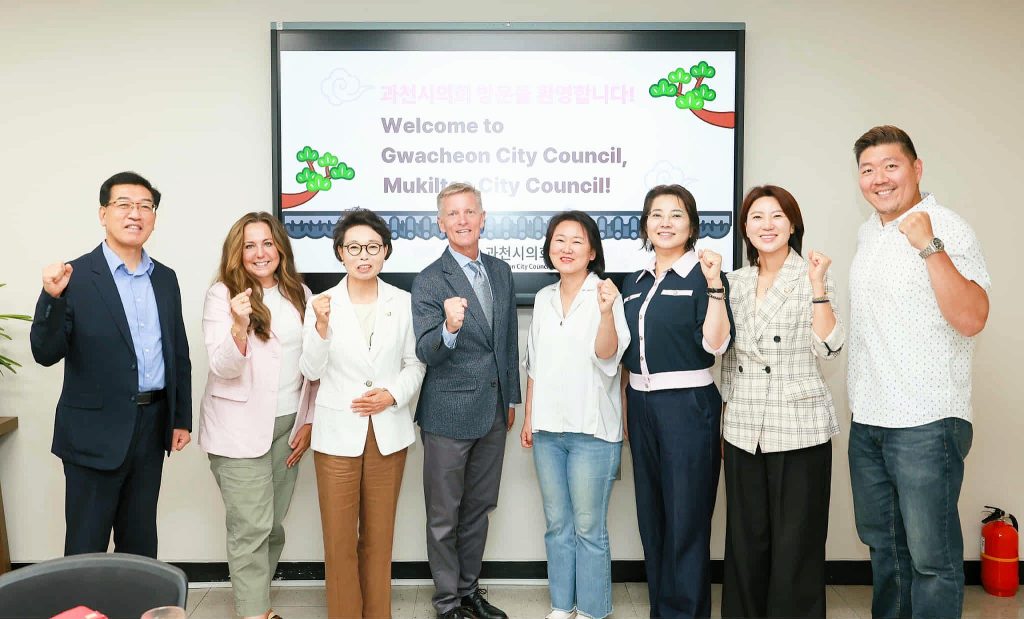
Both Moon’s and Jordal’s trips were personal and not on the city’s dime. Jordal’s trip spanned from August 31 through September 3 and Moon’s stretched a little longer. When the two met in Gwacheon on September 1, they met with Gwacheon’s leadership and saw everything it had to offer including the Grand Seoul Park Zoo, and taking a gondola ride at the Seoul Land amusement park.



Mukilteo’s has been in conversation to establish a sister city relationship with a South Korean city since 2022, given it’s high Korean population (At 8.2% of Mukilteo’s total population, the largest Korean American population of any city in Washington), to bolster its social and economic partnerships, as well as its cultural education efforts.
The idea is, according to Council member Jason Moon, who in many ways is spearheading the program, to market Mukilteo out to Korean tourists as a homebase for Seattle visits, establish economic relationships, and host more events and ceremonies educating the City of Mukilteo about Korean culture. All these things are further down the pipeline, he added, as the city has had its hands full balancing its budget lately.




“Mukilteo has a lot of Korean Americans so the idea would be to have cultural events where a resident may want to learn more about their neighbor,” said Moon. “That, and possibly trading exchange students, and foster business opportunities.”
The first South Korean city Mukilteo had its eyes on was Daeseong-dong, a small village just south of the North Korean border and within the Korean Demilitarized Zone (DMZ). However, after further research, and considering its proximity to North Korea, the city ultimately decided it wasn’t a good fit.
Daeseong-dong and North Korea have been in an ongoing, non-military, competition since the early 1980’s for example where the cities of Kijŏng-dong, in North Korea, and Daeseong-dong, in South Korea, have been consistently trying to “one up” each other by building, and erecting, larger, and taller, flagpoles.
Through a friend of Moon’s in Tacoma, Yuni Cobb, Moon was introduced to Gwacheon for its similar land size, agriculture, and population to Mukilteo, setting up a call between its leadership and Mukilteo Mayor Joe Marine, and Mukilteo Council members Tom Jordal, Jason Moon, and Steve Schmalz. According to Moon, that call went satisfactorily, and the city decided to move forward from there.
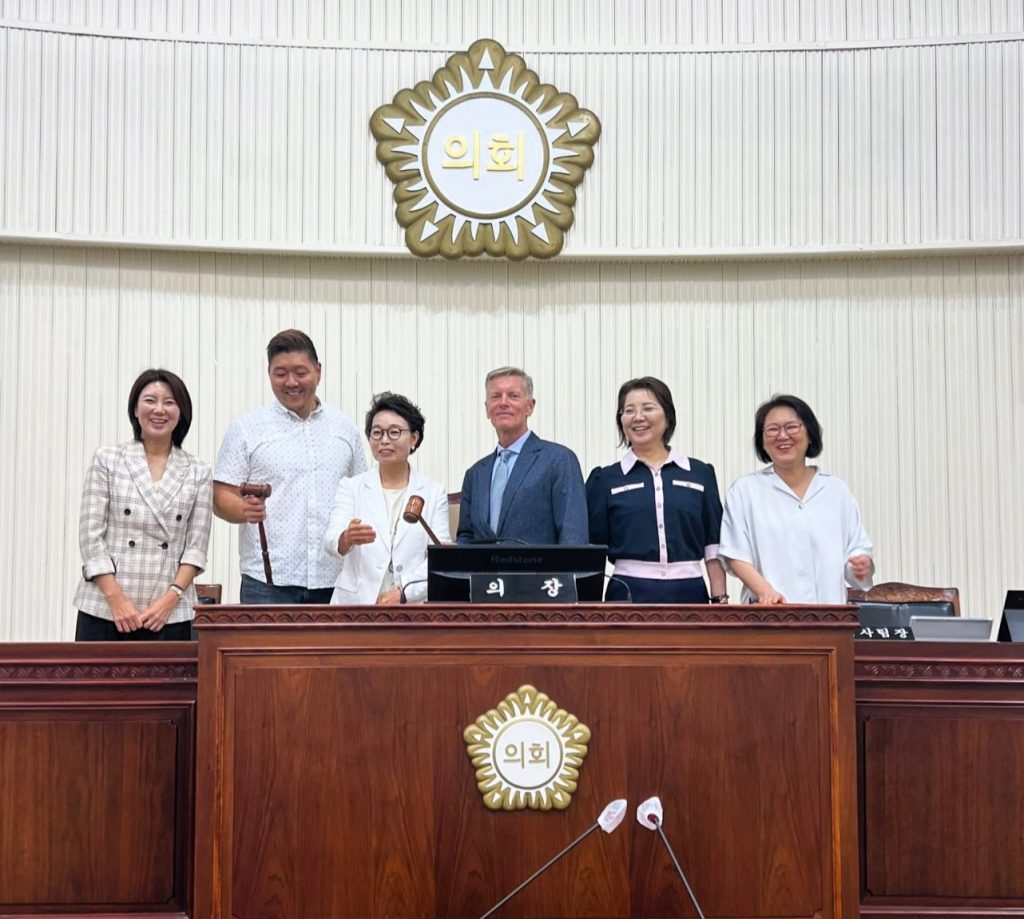
Gwacheon is a city of about 80,000 within the Seoul metropolitan area known as being the headquarters of Korean video game company Net Marble and the home to K-Pop singers Jin (from BTS) and Lee Hoe-taek (Hui, from Pentagon). Aside from its economic and pop culture significance, Mukilteo was attracted to Gwacheon for dedicating approximately 80% of its city to green spaces and having a similar Mayor-City Council leadership model.
Gwacheon’s City Council has nine members, which is very similar in number to Mukilteo’s seven. What differs, according to Moon, is in Gwacheon a City Council position is a full-time job so the council members take their role very seriously. It was one of the biggest takeaways he shared, from visiting with them, something he plans to bring to his approach to his own role in City Council. Despite a Mukilteo Council member position being part-time, the passion for working full-time for your city remained to be something to reflect upon.
Though council members Jason Moon and Tom Jordal had the opportunity to visit Gwacheon back in September, the two found themselves there, and with each other, completely by happenstance.
Moon, for instance, was visiting friends and family in Korea and Jordal was in the Seoul area seeing his son off for a semester abroad through Seattle University. It just so happened, the council members said that their trips overlapped and the two thought it would be an excellent opportunity to visit Gwacheon together, meet with its political leadership, and tour the city ahead of Mukilteo finalizing its sister city partnership.
“Growing up in Mukilteo, my son had a really good friend who was Korean and he would always be over at his house, eating his food, and we always joked that he grew up half-Korean,” Jordal told the Lynnwood Times. “He studied a little Korean in school, and it had always been a dream of his to spend a semester abroad there.”
Though the City of Mukilteo has not officially established a sister city relationship with Gwacheon, at its October 20th City Council meeting the City signed a letter of intent to do so. The next steps are to draft an official Memorandum of Understanding (MOU), which will highlight the intent, goals, and scope of the partnership. That MOU then goes to both the councils of Mukilteo and Gwacheon for approval. Once both councils approve, a ceremonious signing of a Sister City Relationship often occurs.
So far, the timeline in which these next steps take place has not been determined by the Mukilteo City Council. When Mukilteo and Gwacheon officially become sister cities at a to-be-determined date they will be the eighth Washington city to have a sister city in South Korea, the closest and more recent example being nearby Lynnwood, who signed a sister city agreement with Damyang in 2016.
Cities establish Sister City relationships for strategic, cultural, and practical reasons. These partnerships foster mutual understanding and cooperation through opportunities such as cultural and artistic exchanges, educational and student collaborations, tourism promotion, and economic or trade partnerships, according to the City of Mukilteo.
When selecting a potential Sister City, a community typically looks for shared characteristics such as population size, industries, academic and cultural institutions, pre-existing relationships, or corporate, historical, or ancestral ties.

Author: Kienan Briscoe