


WASHINGTON, D.C—The United States Senate voted 60-40, in a first step, to approve H.R. 5371, the Continuing Appropriations and Extensions Act, 2026, which funds the government through early 2026. The resolution now heads to a floor vote on Monday. If the bill passes with no changes to the House’s Bill, then the bill moves to the president’s desk for signature. However, if amendments are approved, the bill goes back to the House for a vote to approve amendment(s).

Seven Democrats and 1 independent joined 52 Republicans to pass the cloture vote.



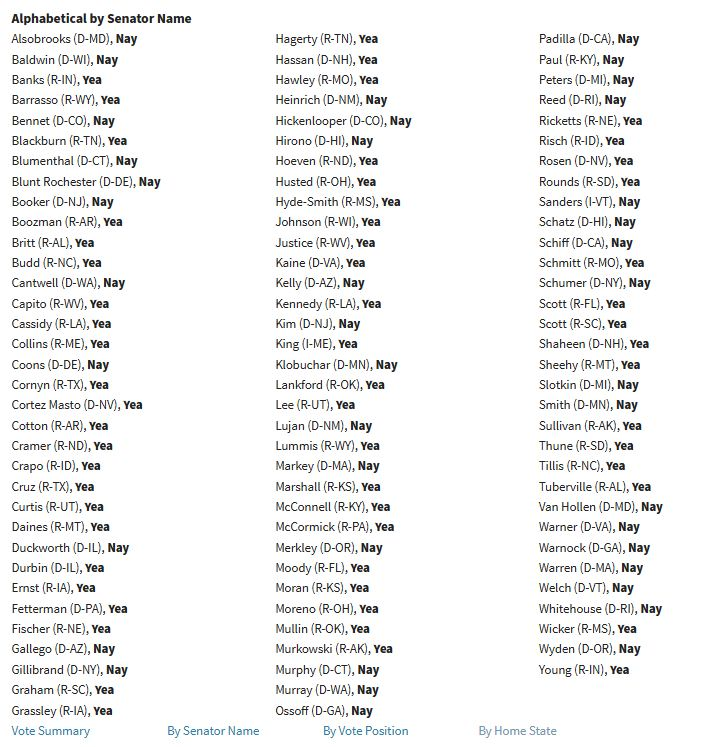
I voted NO. As long as there is still any time left to reverse the MAGA health care hike, I believe we should do everything we can to force Republicans to the negotiating table.
The fight for health care does not end tonight. https://t.co/uzlSvHB43o— Senator Patty Murray (@PattyMurray) November 10, 2025
The Senate’s version of the bill includes a restrictive hemp provision that redefines federal hemp to exclude most intoxicating cannabinoid products (e.g., delta-8 THC, THCO), effectively banning their production and sale nationwide after a one-year grace period.

The provision targets the hemp-derived cannabinoid sector, which has boomed since the 2018 Farm Bill legalized hemp with <0.3% delta-9 THC. While non-intoxicating uses like fiber, grain, and pure CBD would persist, the ban would gut the high-value consumable cannabinoid market—estimated at $13-28 billion annually—leading to widespread economic disruption in the industry. Intoxicating hemp products comprises over 80% of the industry’s revenue.


Industry groups like the U.S. Hemp Roundtable warn of a “collapse” that punishes farmers, small businesses, and consumers by eliminating jobs, revenue, and innovation. By banning these cheaper, unregulated alternatives, however, it could actually increase demand for state-legal marijuana products, potentially boosting their market without altering THC’s psychoactive potency (typically 10-30% in pot vs. <0.3% in compliant hemp).
However, cannabis trade groups like the National Cannabis Industry Association support such measures, viewing hemp THC as an existential threat that diverts ~20-30% of potential customers. By banning intoxicating hemp-derived products like delta-8 THC (which are currently sold cheaply and unregulated in convenience stores, gas stations, and online), this would eliminate a major gray-market competitor that undercuts licensed dispensaries. This could redirect billions in consumer spending toward state-regulated cannabis products, boosting sales, tax revenue, and market stability in states like Washington state.



Championed by Senator Mitch McConnell (R-KY), the restrictive hemp provision targets unregulated delta-8 products and derivatives that previously legalized these in a loophole in the 2018 Farm Bill.
This language shifts from the 2018 Farm Bill’s focus on delta-9 THC alone to total THC, effectively banning the conversion of CBD into intoxicating isomers like delta-8 (which skirts the original limit via chemical processing). Non-intoxicating products like pure CBD (with negligible THC) would remain legal

The bill now redefines hemp as limited to the Cannabis sativa L. plant (and its parts, derivatives, etc.) with a total tetrahydrocannabinol (THC) concentration (including tetrahydrocannabinolic acid, or THCA) of not more than 0.3% on a dry weight basis.
Industrial Hemp is now narrowly defined to non-intoxicating uses only, such as stalks for fiber or other non-cannabinoid derivatives; seeds for grain, oil, cake, nuts, hulls, or other non-cannabinoid compounds; Immature plants for microgreens or edible leaves (from low-THC seeds); plants for research at higher education institutions or independent institutes (not entering commerce); and viable seeds solely for producing the above materials.
Hemp-Derived Cannabinoid Products is defined as any intermediate or final product from hemp (excluding industrial hemp) containing cannabinoids intended for human or animal use (e.g., via inhalation, ingestion, or topical application). Excludes FDA-approved drugs, but the overall effect is to regulate or ban most intoxicating versions under the exclusions in the hemp definition.
The new provision is part of the Senate’s version of H.R. 5371, which advanced via cloture on Sunday but could face opposition ahead of a potential final vote. If passed, implementation could begin in late 2026.

Author: Mario Lotmore




10 Responses
Just legalize and stop beating around the bush. Big pharma, alcohol and tobacco don’t want the competition is why pot is still illegal. Every state that has legalized has fewer people buying alcohol, tobacco and pills that they don’t need anymore. Since the Marijuana relaxes them and eases the aches and pains.
Jeffrey Dorr – The above comment is the most ridiculous excuse to legalize a drug nationwide. No, it should not be legalized.
Ok do you have a explanation for why what he said was ridiculous? because you don’t like it so you want to tell other people what they can do with their own body?
So then, why is alcohol and tobacco legal? It should be made illegal. Marijuana has not killed one person. You sound like an idiot that’s uneducated.
Samantha, why, because you don’t like it?
I have a problem with the people who want to mix Mary Jane with the booze and still think that they can drive responsibly on our streets and hi ways.
But driving around on alcohol is ok…? How about throwing some nyquil or benadryl into the mix? You can already do whatever you’re boogeymanning about…
How about mind your own f@^# buisness Karen. Don’t worry about law enforcement issues that do not concern your clearly non smoker a$$ . Aging asshats need term limits and age restrictions
Your clearly part of the racist , dogma that persists in individuals whom claim to be free but are clearly pick and choose villifying anything they don’t like. Well guess what, we are the majority now . Move your bum self to Senegal for a year if you last that long Sergent Sedanko lookin mofo
Ok do you have good argument for why what he said was ridiculous? because you don’t like it so you want to tell other people what they can do with their own body?
You people look at the math d9 cannabis dispensaries are looking to monopolize the industry . D9 hemp is a threat to their profits period, how many billions do they lose to hemp? It’s not hemp, it’s about the money. Dispensaries sell hemp to you as well every day. But it’s the cheap shit and you buy it. I sell d9 hemp and it’s much better than d9 cannabis as far as side effects like dry eyes, paranoia and so forth. And I don’t sell the cheaper shit I sell quality better than any dispensaries around. Don’t be led by your nose people use your brain it doesn’t hurt, just try it because it really doesn’t hurt Fu?k!!!