

WASHINGTON, D.C.—The United States Senate passed HR 5371 tiled, “Continuing Appropriations, Agriculture, Legislative Branch, Military Construction and Veterans Affairs, and Extensions Act, 2026,” on November 10 with a 60-40 vote, and now heads to the House of Representatives for consideration on Wednesday, November 12. The longest government shutdown in U.S. history could end Wednesday if the House concurs with the Senate’s amendments.
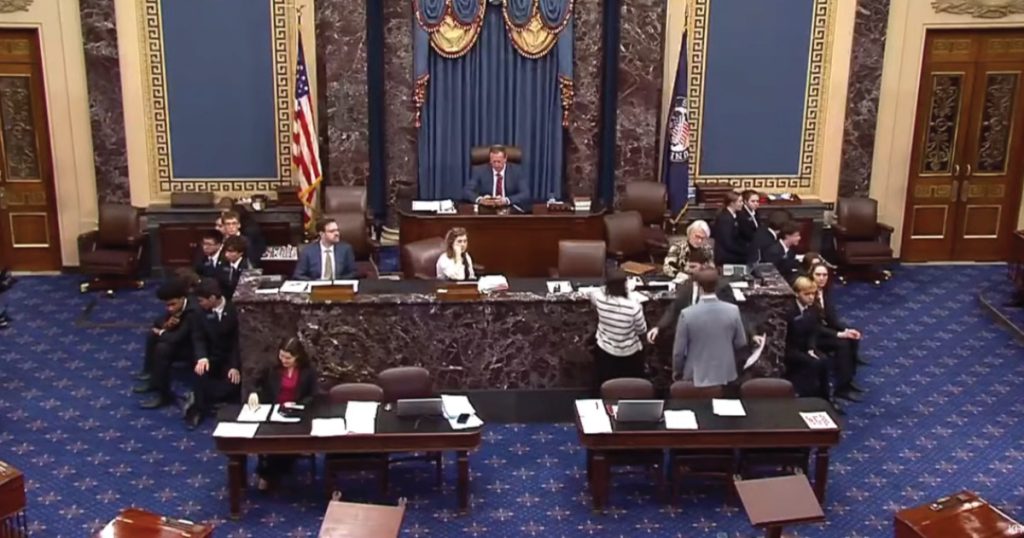
The bill’s passage required bipartisan support (at least 60 votes), as Republicans only hold a 53-47 majority in the Senate (including independents who caucus with Democrats). Seven Democrats and one independent voted with 52 Republicans to invoke cloture and pass the measure. The Democrats and independents who crossed the aisle include Senators Jeanne Shaheen (New Hampshire), Dick Durbin (Illinois), Tim Kaine (Virginia), Maggie Hassan (New Hampshire), Angus King (Maine), Jacky Rosen (Nevada), Catherine Cortez Masto (Nevada), and John Fetterman (Pennsylvania).


Sen. Fetterman stated that after 40 days of advocacy against the impasse, he voted yes to reopen the government and mitigate harm to constituents.
“After 40 days as a consistent voice against shutting our government down, I voted YES for the 15th time to REOPEN,” Sen. Fetterman wrote on X. “I’m sorry to our military, SNAP recipients, gov workers, and Capitol Police who haven’t been paid in weeks. It should’ve never come to this. This was a failure.”



Senator Cortez Masto echoed a similar sentiment posting to X: “I have consistently voted against shutting down the government because I know the pain it is causing working families, from TSA agents to government contractors. We must extend the ACA enhanced premium tax credits, but that can’t come at the expense of the millions of Americans across our country impacted by a shutdown.

“With the government open, we can focus on passing a full, bipartisan budget for 2026. That starts with a minibus that will restore funding President Trump cut, deliver millions of dollars in critical funding to Nevada, and block the Administration from future RIFs.


“We also have an opportunity now to put Republicans on the record on the ACA. If Republicans want to join us in lowering costs for working families, they have the chance to do so. And if they do not come to the table, they will own the premium increases they cause.”
However, some of their Democrat colleagues disagreed with the compromise. Washington Congresswoman Rep. Pramila Jayapal unleashed her dismay calling the Democrats lawmakers who “betrayed working people” on a “worthless pinky promise.” Rep. Jayal released an image displaying her edits to a New York Times article on the shutdown vote.
“There — I fixed the analysis so it is actually accurate to what happened when 8 Senate Dems caved instead of keeping up the righteous fight to deliver lower health care costs for Americans,” she wrote.
There — I fixed the analysis so it is actually accurate to what happened when 8 Senate Dems caved instead of keeping up the righteous fight to deliver lower health care costs for Americans. pic.twitter.com/W66TI693ei
Senator Patty Murray shared that she voted no because the bill did not address ACA subsidies wanting a one-year extension of the tax credits.
“I voted NO tonight—because we have to address the MAGA health care hike. By refusing to work with Democrats on a solution before open enrollment started, Republicans have already pushed millions of Americans off the health care cliff,” Sen. Murray wrote to X.
Approved Provisions in the Senate-Passed Version
The funding package provides essential funding to reopen government offices, pay federal workers, and support key programs, while extending various expiring authorities to prevent disruptions in agriculture, health, and veterans’ services.
The Senate-amended version of HR 5371 includes the following key provisions:
- Full-Year Appropriations for Specific Divisions:
- Agriculture, Rural Development, Food and Drug Administration, and Related Agencies: Allocates approximately $26 billion for programs including agricultural research, farm production, rural development loans and grants, food safety inspections, and nutrition assistance like SNAP and WIC.
- Legislative Branch: Funds operations for Congress, the Capitol Police, and related entities at about $7.5 billion.
- Military Construction, Veterans Affairs, and Related Agencies: Provides around $140 billion for military infrastructure projects, veterans’ health care, benefits, and housing programs.
- Continuing Resolution for Other Agencies: Extends funding at fiscal year 2025 levels for the remaining federal operations not covered by the full-year appropriations, effective through January 30, 2026, to allow time for negotiating comprehensive spending bills.
- Pay furloughed and “essential” employees with back pay.
- Reinstate ~800,000 federal workers laid off during the shutdown.
- Extensions and Additional Funding:
- Extends public health, Medicare, Medicaid, and veterans’ programs through various dates up to September 30, 2027.
- Allocates $30 million for enhanced security for U.S. Marshals Service protective operations, $28 million for Supreme Court protection, and $30 million for Capitol Police mutual aid.
- Includes provisions for rural economic development, such as grants for energy efficiency, broadband expansion, and healthy food financing.
- Authorizes reimbursements to states and grantees for costs incurred during the shutdown lapse.
- Commits to a Senate vote by mid-December on extending Affordable Care Act (ACA) premium tax credits that are set to expire December 31, 2025.
What the Funding Package Does and Does Not Include
The funding package includes full-year funding for agriculture, legislative operations, and military/veterans affairs to address immediate needs in food security (SNAP), rural communities, and national defense infrastructure. However, the funding package does not provide full-year appropriations for the other nine major spending categories, such as Defense, Energy and Water Development, Commerce-Justice-Science, Homeland Security, Interior-Environment, Labor-HHS-Education, State-Foreign Operations, Transportation-HUD, and Financial Services. These remain on a temporary CR, leaving them vulnerable to future negotiations.
The bill does incorporate extensions for programs like the Water Bank Act and FDA user fees. The Senate’s version of the bill also includes a restrictive hemp provision that redefines federal hemp to exclude most intoxicating cannabinoid products (e.g., delta-8 THC, THCO), effectively banning their production and sale nationwide after a one-year grace period.
The provision targets the hemp-derived cannabinoid sector, which has boomed since the 2018 Farm Bill legalized hemp with <0.3% delta-9 THC. While non-intoxicating uses like fiber, grain, and pure CBD would persist, the ban would gut the high-value consumable cannabinoid market—estimated at $13-28 billion annually—leading to widespread economic disruption in the industry. Intoxicating hemp products comprises over 80% of the industry’s revenue.
Industry groups like the U.S. Hemp Roundtable warn of a “collapse” that punishes farmers, small businesses, and consumers by eliminating jobs, revenue, and innovation. By banning these cheaper, unregulated alternatives, however, it could actually increase demand for state-legal marijuana products, potentially boosting their market without altering THC’s psychoactive potency (typically 10-30% in pot vs. <0.3% in compliant hemp).
However, cannabis trade groups like the National Cannabis Industry Association support such measures, viewing hemp THC as an existential threat that diverts ~20-30% of potential customers. By banning intoxicating hemp-derived products like delta-8 THC (which are currently sold cheaply and unregulated in convenience stores, gas stations, and online), this would eliminate a major gray-market competitor that undercuts licensed dispensaries. This could redirect billions in consumer spending toward state-regulated cannabis products, boosting sales, tax revenue, and market stability in states like Washington state.
Championed by Senator Mitch McConnell (R-KY), the restrictive hemp provision targets unregulated delta-8 products and derivatives that previously legalized these in a loophole in the 2018 Farm Bill.
This language shifts from the 2018 Farm Bill’s focus on delta-9 THC alone to total THC, effectively banning the conversion of CBD into intoxicating isomers like delta-8 (which skirts the original limit via chemical processing). Non-intoxicating products like pure CBD (with negligible THC) would remain legal
The bill now redefines hemp as limited to the Cannabis sativa L. plant (and its parts, derivatives, etc.) with a total tetrahydrocannabinol (THC) concentration (including tetrahydrocannabinolic acid, or THCA) of not more than 0.3% on a dry weight basis.
Below is a statement from Thomas Winstanley, EVP & GM, Edibles.com™ (part of Edibles Brands/Edible Arrangements) on the Senate’s provision to the Lynnwood Times:
Senator Mitch McConnell, architect of the 2018 Farm Bill, sowed the hemp seeds, and now seeks to scorch the soil, salting the fields of his own harvest. Since President Donald Trump signed the 2018 Farm Bill into law, hemp-derived products have evolved into a $28 billion industry, now found in liquor stores, grocery aisles, and independent retailers nationwide. The category supports 329,000 American jobs and contributes $1.5 billion annually in tax revenue, a rare bipartisan success story born of agricultural innovation and entrepreneurship.
In McConnell’s own state of Kentucky, hemp-derived products generated $301 million in revenue and 3,500 jobs in 2022, contributing roughly $18 million in annual state tax revenue. That income supports local schools, infrastructure, and rural communities — all of which would suffer overnight if this ban were enacted. That position aligns with public sentiment. A recent national poll by McLaughlin & Associates, a firm trusted by President Trump’s own team, found that 72 percent of Americans support a federal law allowing the sale and possession of hemp-derived products with strict safety regulations.
For months, industry and agricultural groups have been calling for those safety regulations, not prohibition. But banning legitimate hemp products won’t stop bad actors, it will only drive the market underground and further erode consumer safety. Hemp was meant to be a stabilizer — a modern crop for a modern economy. From Colonial America through World War II, hemp was a foundational American crop, woven into the fabric of our economy and our identity. Now Congress faces a choice: repeat the mistakes of prohibition or create a rational regulatory framework that ensures product safety, protects consumers, and preserves the economic promise of hemp. It’s time for Congress to stop one man’s reversal and stand up for the people, the farmers, and the freedom this industry represents.
Senator Rand Paul’s amendment to strike the provision modifying the definition of hemp for purposes of the Agricultural Marketing Act of 1946, failed after it was tabled with a vote of 76-24.
Industrial Hemp is now narrowly defined to non-intoxicating uses only, such as stalks for fiber or other non-cannabinoid derivatives; seeds for grain, oil, cake, nuts, hulls, or other non-cannabinoid compounds; Immature plants for microgreens or edible leaves (from low-THC seeds); plants for research at higher education institutions or independent institutes (not entering commerce); and viable seeds solely for producing the above materials.
Hemp-Derived Cannabinoid Products is defined as any intermediate or final product from hemp (excluding industrial hemp) containing cannabinoids intended for human or animal use (e.g., via inhalation, ingestion, or topical application). Excludes FDA-approved drugs, but the overall effect is to regulate or ban most intoxicating versions under the exclusions in the hemp definition.
Potential Hurdles in the House
While the House, under Republican leadership, originally passed a version of HR 5371 in September 2025, the Senate’s amendments could complicate swift approval. With the vote scheduled for Wednesday, any procedural objections or filibuster-like tactics could prolong the shutdown, especially if Speaker Mike Johnson struggles to unify the narrow Republican majority.
Members of the House Freedom Caucus may resist the bill for lacking deeper spending cuts or for including what they view as excessive funding for non-defense priorities, potentially demanding amendments or threatening to withhold votes.
House Democrats, already signally their objection to the bill, might push for additions like enhanced disaster relief or protections against future shutdowns, risking delays if negotiations stall.
If passed by the House without any changes, the funding package would head to President Donald J Trump’s desk for signature, potentially ending the shutdown by week’s end. However, debates over attached provisions, such as the hemp restrictions or security funding, could alienate factions on both sides, leading to a need for further compromises which may not be accepted by Senators if the bill is amended and returned to the Senate for concurrence.
Affordable Care Act Subsidies
One major issue of contention in the current government shutdown debate is over ACA exchange subsidies—premium tax credits set to expire at the end of 2025. The Senate’s version of the bill now in the House, contains a provision allowing a separate vote on the matter in December 2025.
Democrat lawmakers are pushing for a one-year or longer extension of these enhanced subsidies to maintain affordability for millions of enrollees, while Republican lawmakers are proposing to redirect the hundreds of billions of dollars in federal subsidies currently allocated to insurance companies under the Affordable Care Act (ACA, or Obamacare) directly to American individuals and households instead.
This shift aims to cut out what President Trump calls the “fat cat” insurance companies as middlemen in the subsidy process, which he describes as a corrupt system that props up “really bad Obamacare.”
Under the proposal, the money—previously paid as premium tax credits to insurers to reduce costs for enrollees—would go straight to consumers. People could then use these funds to purchase their own private health insurance policies on the open market, potentially selecting better and more affordable options than those mandated or available through ACA exchanges.
Specific mechanisms being discussed include depositing the subsidies into expanded Health Savings Accounts (HSAs) or pre-funded federal flexible spending accounts. HSAs, typically paired with high-deductible health plans, allow tax-deductible contributions, tax-free growth, and withdrawals for qualified medical expenses like doctor visits, prescriptions, or even insurance premiums.
The Trump administration said this would give individuals more direct control over their healthcare spending, bypassing insurers’ management of benefits and enabling shopping for coverage without relying on government-subsidized plans from large health insurance companies in the ACA.
The idea emerged amid government shutdown negotiations, where Democrats are demanding an extension of enhanced ACA tax credits (set to expire soon) in exchange for funding deals, while Republicans, encouraged by Trump, are pushing back to prioritize tax cuts, border security, and this redirection instead.
Proponents of the plan argue transparency, efficiency, and personal savings by empowering individuals to negotiate or choose alternatives like short-term plans or direct-pay arrangements with providers.
Critics, including Democrat lawmakers, warn that it could leave millions without adequate coverage, especially for pre-existing conditions, and disrupt the market without clear implementation details.
Research performed by the Lynnwood Times shows that the federal government has spent approximately $650 billion on ACA exchange subsidies (premium tax credits and cost-sharing reductions) from 2014 (when ACA exchanges officially launched) through 2024.
The major health insurance companies have seen enormous financial gains from the ACA’s structure, with federal subsidies (including those expanded under the Inflation Reduction Act) amounting to $92 billion for ACA exchange subsidies (premium tax credits) in 2023 alone—much of it flowing to insurers. These major insurers cover approximately 31 million enrollees as of September 2024.
Below are the major publicly traded health insurers participating in the ACA exchanges, along with their stock price increases since the ACA was signed into law on March 23, 2010:
INSURER STOCK INCREASE 2024 NET REVENUES ACA RECD CUMM. Centene Corporation (Ambetter) 519.8% $163B $162B Molina Healthcare 797.64% $41B $32B UnitedHealth Group 877.71% $400B $39B Elevance Health (formerly Anthem; operates many Blue Cross Blue Shield plans) 421.12% $177B $65B CVS Health (Aetna 119.91% $373B $26B Humana 414.16% $118B $32B Cigna 616.24% $247B $13B
The ACA received estimates calculated by the Lynnwood Times focus on federal premium tax credits and cost-sharing reductions for ACA marketplace plans, apportioned by approximate market shares derived from 2024 enrollment data. The total cumulative subsidies ($650 billion) is based on reported annual figures and calculations from CBO projections.

Author: Mario Lotmore