
EVERETT—At its November 21 meeting, the Washington State Transportation Improvement Board awarded 160 street and multi-modal improvement grants to local agencies totaling over $152 million. TIB received 330 applications from cities and counties, with requests for more than $335 million in funding.
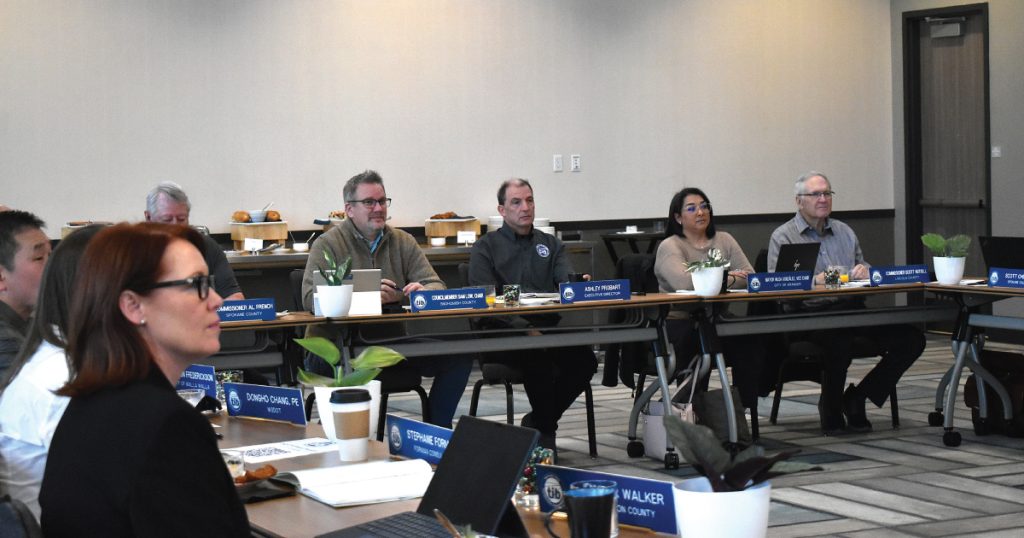
Rep. Jake Fey (D-Tacoma), Chair of the House Transportation Committee, attended Friday’s meeting where he thanked TIB Chair Snohomish County Councilman Sam Low (R-Lake Stevens) for inviting him to provide a legislative update. He also recognized TIB Executive Director Ashley Probart for his years of “good work.”
“I enjoy working with you,” Fey said to Low. “I appreciate Sam’s work, and of course, thank you for your service, but I also wanted to thank all of you for your service.”
Rep. Fey shared a sobering assessment of the state’s transportation finances to the Transportation Improvement Board and cautioned that last session’s major revenue package merely restored planned investments to 2022 levels while leaving limited options for future funding.


“In this last legislation, it may look like a lot of money, and it felt like a lot of taxes, but all that did was to get us back to where we were in 2022 in our planned investments,” Fey said.
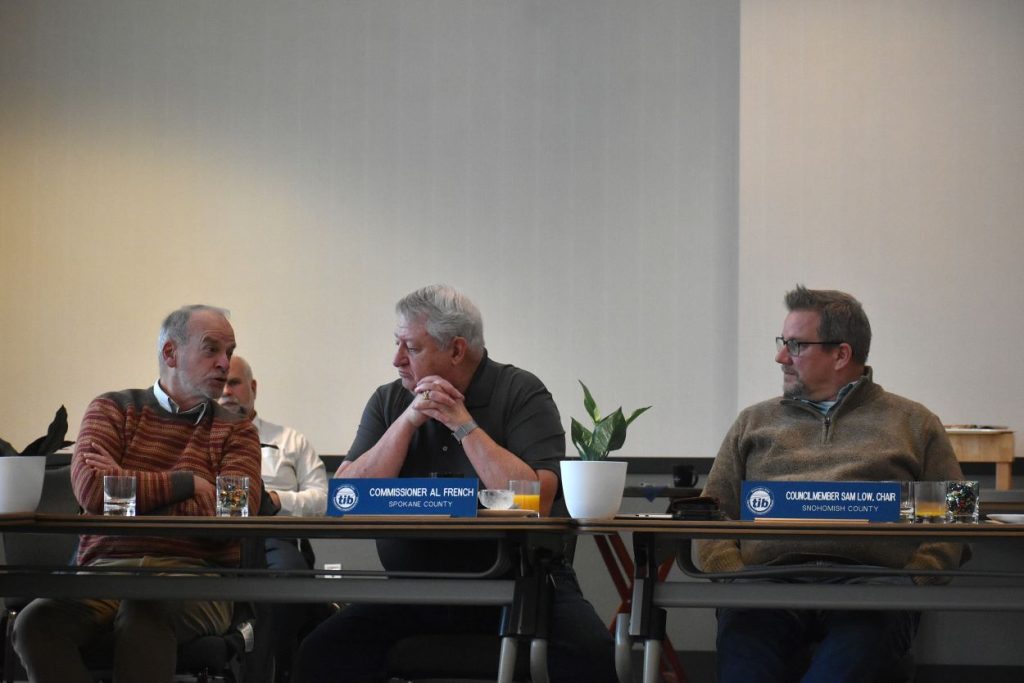
He stated that indexing vehicle fees, gasoline, and diesel taxes, along with the new one-tenth of 1% sales tax dedicated to transportation, simply offset construction cost inflation rather than provide available monies for new transportation projects.

A dilemma facing the upcoming 2026 legislative session, Fey said, is whether the state’s aggressive construction schedule is driving up costs by overwhelming contractor capacity.
“The way that people look at it is it’s always going to be cheaper to build now versus later,” he said. “Well, when you get a 70% increase on the bid, you’ve got to kind of ask yourself, maybe if we went a little bit slower, we wouldn’t get these high bids.”
Fey said, that for the 2026 session, his fellow lawmakers must decide “whether we kind of slow things down” or continue to accept higher bids and delay projects to cover earlier cost overruns.
Borrowing capacity remains constrained after Fey successfully resisted Senate proposals to begin bonding against 2025 revenue collections in the last session.
“We had enough to take care of this biennium. I was not persuaded that we should start using up bonding capacity we have going forward,” he told the board.
The Washington State Ferries system drew particular concern. Rep. Fey described the original electrification and vessel replacement plan as financially unattainable under current resources.
“There’s no way we can build out, do electrification of new ferries that are electric hybrids, put in the infrastructure for those ferries, convert ferries, build a new terminal in West Seattle,” he said, adding that ongoing culvert replacement negotiations involving the governor’s office, the attorney general, and tribal governments add further uncertainty.
Fey signaled that preservation and strategic prioritization—rather than expansion—will dominate the 2026 transportation budget discussion.
“If I had a description of this, that’s what I would have as a big caution sign about not overextending ourselves and making sure that we prioritize the investments and maybe we can slow things down,” he said.
On long-term revenue projections, Rep. Fey shared that the accelerating decline of gas tax receipts are projected to fall 50% over the next decade with revenue loss not from electric vehicles—which already pay registration fees—but from conventional vehicles achieving better than 25 miles per gallon—fuel efficient non-electric vehicles. He is looking into Virginia’s approach which is an escalating annual fee tied to fuel economy, with an optional mileage-reporting alternative for drivers who prefer to pay by actual road use.
“It addresses the users that contribute to the shortfall in revenue,” he explained. “And in their program… they put in an option for people down the road to track their miles, if they want to track their miles and report their miles.” He acknowledged privacy concerns with mandatory tracking but noted the Virginia model “gets rid of a lot of the ugly objection to it.”
SUMMARY OF FUNDING
Program # of Projects TIB Funds Total Project Cost Urban Arterial Program 29 $76,982,647 $212,683,721 Urban Active Transportation Program 17 $8,034,839 $11,853,848 Arterial Preservation Program 17 $11,660,164 $14,409,511 Small City Arterial Program 6 $5,242,062 $7,449,684 Small City Active Transportation Program 9 $3,045,713 $3,139,812 Small City Preservation Program 31 $15,649,344 $16,232,916 Small City Maintenance Program 14 $1,191,230 $1,260,320 Complete Streets Program 37 $30,265,535 $55,808,851 TOTAL 160 $152,071,534 $322,838,663
Snohomish County was awarded 19 projects totaling $22,638,624:
- Arlington: Island Crossing (SR 530) Roundabout (Smokey Point Blvd), $4,461,608
- Brier: Vine Road Overlay (Poplar Way to S C/L), $935,229
- Edmonds: Citywide Pedestrian Enhancements (96th Ave W to Five Corners 3rd Ave. S Giltner 76th Ave. W 236th St. SW), $679,639
- Everett: RRFB Crossing Improvements, $874,358
- Granite Falls: 2026 Pedestrian Improvement Program, $65,000
- Granite Falls: 2026 Crack Seal, $59,400
- Granite Falls: 2026 Overlay, $552,780
- Lynnwood: 2025 Curb Ramps Project (66th Ave W from Meadowdale Rd to 168th St SW and east along that through Olympic View Dr), $438,400
- Marysville: Ebey Waterfront Trail (NE 61st St from 53rd Ave NE to 47th Ave from NE 61st St NE to 1st St), $490,543
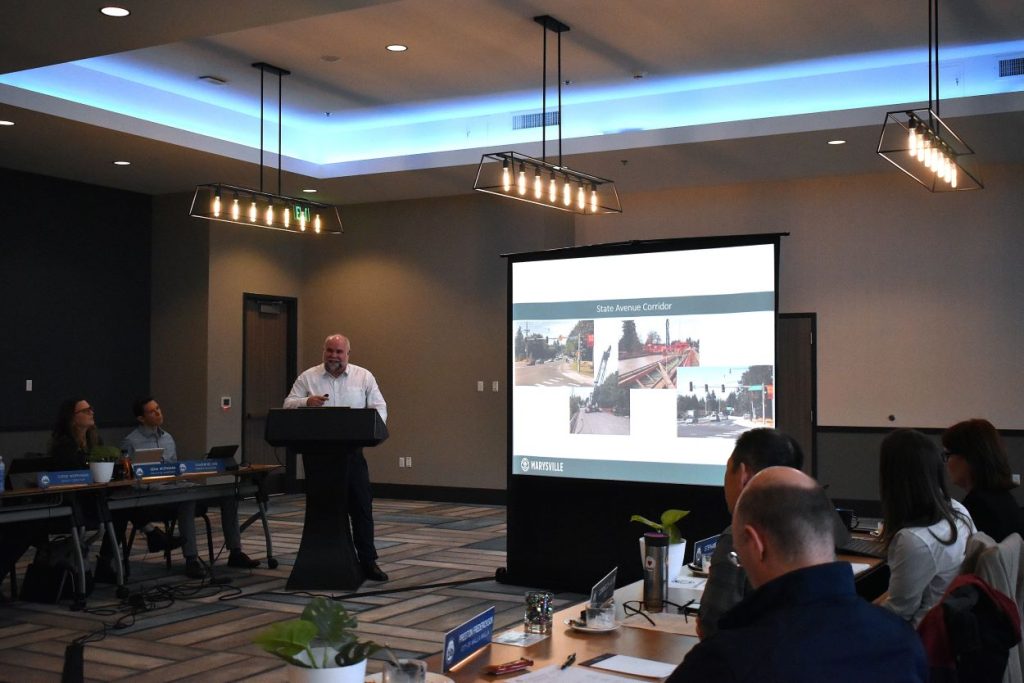
- Marysville: 88th Corridor Improvements Phase 1 (State Avenue to 55th Avenue), $3,947,343
- Monroe: 179th Ave Sidewalk (154th St to 15000 block), $684,200
- Mountlake Terrace: Main Street Revitalization Phase II (232nd St SW and 236th St SW), $5,000,000
- Mukilteo: Harbour Pointe Boulevard Paving (W/O SR 525 to Harbour Reach Drive), $1,428,131
- Snohomish: 2025 Bickford Sidewalk Gaps, $644,012
- Snohomish County: 18th Avenue W (151st St SW to Jefferson Way), $229,354
- Snohomish County: 2025 Crossing Improvements, $276,640
- Stanwood: 272nd Street NW and 72nd Avenue Sidewalk (276th St NW to 272nd St NW and 72nd Ave NW and 78th Ave NW), $490,467
- Woodway: 2026 Overlay, $581,520
“If you look back over the last 20 years, you know, TIB’s really invested heavily in the Snohomish County,” Councilman Low told the Lynnwood Times. “It’s getting a small portion of your gas tax revenue back into our local communities and road and sidewalk and transportation projects.”
Low shared that for big counties like Snohomish are awarded partial funding, but TIB realy helps smaller towns and cities where these would be shut out of grant processes.
“But like little, small towns of 100 or 200, TIB comes in and does everything. I mean, they funded 100%,” he said. “If we do a small community, we’ll resurface all the roads in that community if they need it.”
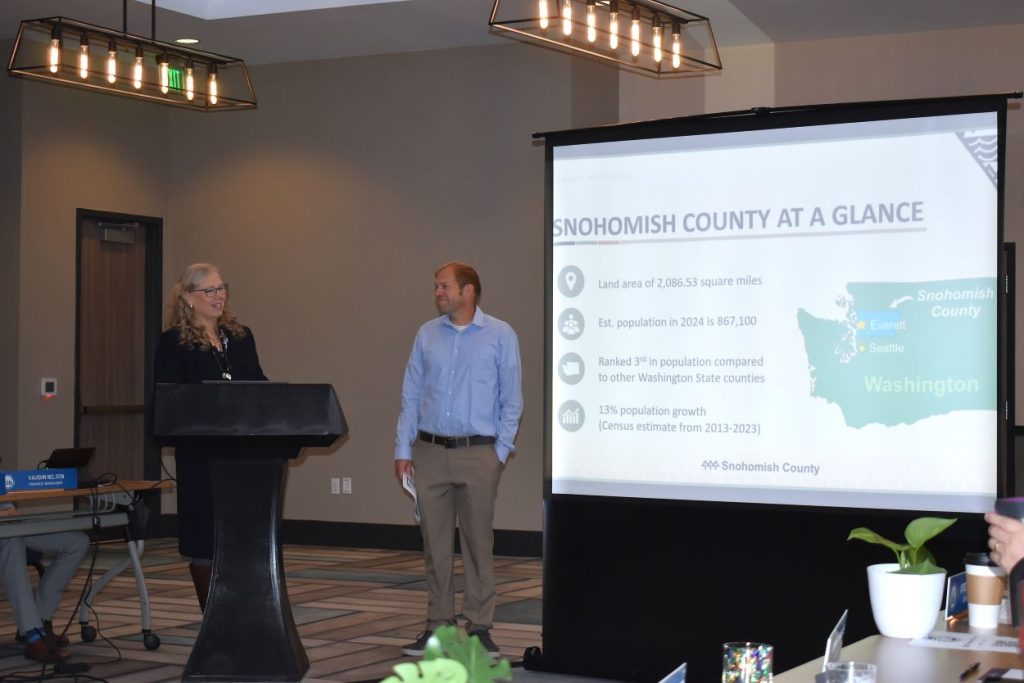
Friday’s meeting, held at Hotel Indigo in the Port of Everett Waterfront, was the first in five years to be hosted in Snohomish County. The meetings rotate locations throughout the state.
The Legislature created the Transportation Improvement Board to foster state investment in quality local transportation projects. According to its mission, the TIB funds high priority transportation projects in communities throughout the state to enhance the movement of people, goods and services. The funds come from the revenue generated by three cents of the statewide gas tax.
The 21-member TIB Board is composed of six city members, six county members (County Road Administration Board [CRAB] member is ex officio), two Washington State Department of Transportation (WSDOT) officials, two transit representatives, a private sector representative, a member representing the ports, a Governor appointee, a member representing non-motorized transportation, and a member representing special needs transportation. Board members are appointed by the Secretary of Transportation to four-year staggered terms apart from the CRAB representative and the Governor’s appointee.
Over its 37 years, TIB has disbursed $3.6 billion to 5,430 projects in Washington state.

Author: Mario Lotmore