
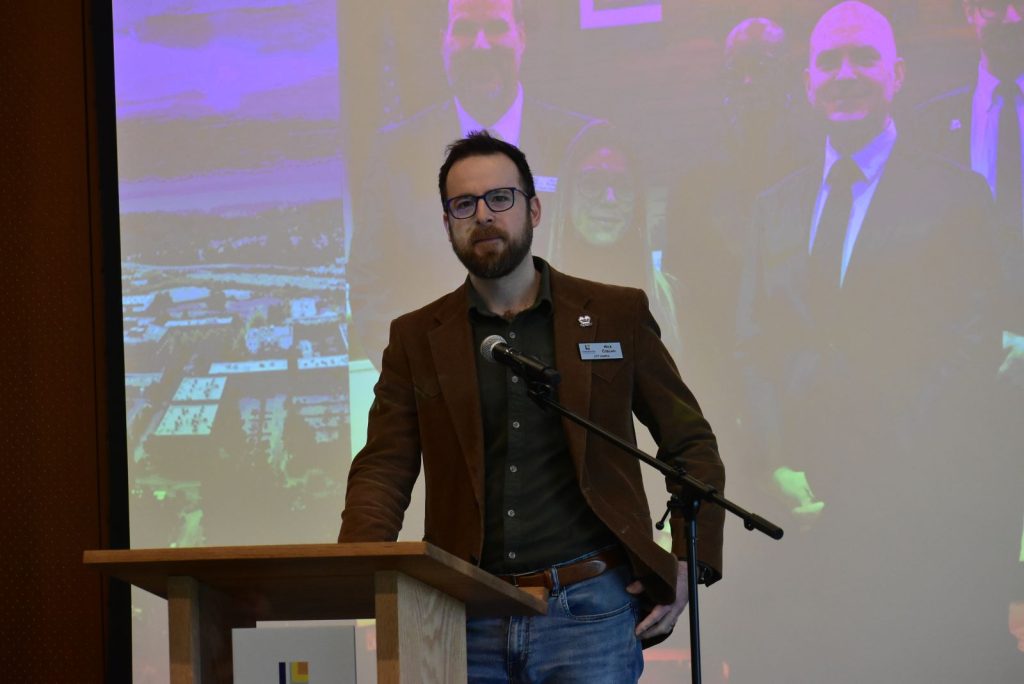
LYNNWOOD — Lynnwood Mayor George Hurst struck an optimistic tone in his first State of the City address, highlighting the elimination of a $25 million budget deficit, progress on long-anticipated infrastructure projects and new initiatives aimed at public safety, housing and immigrant support.
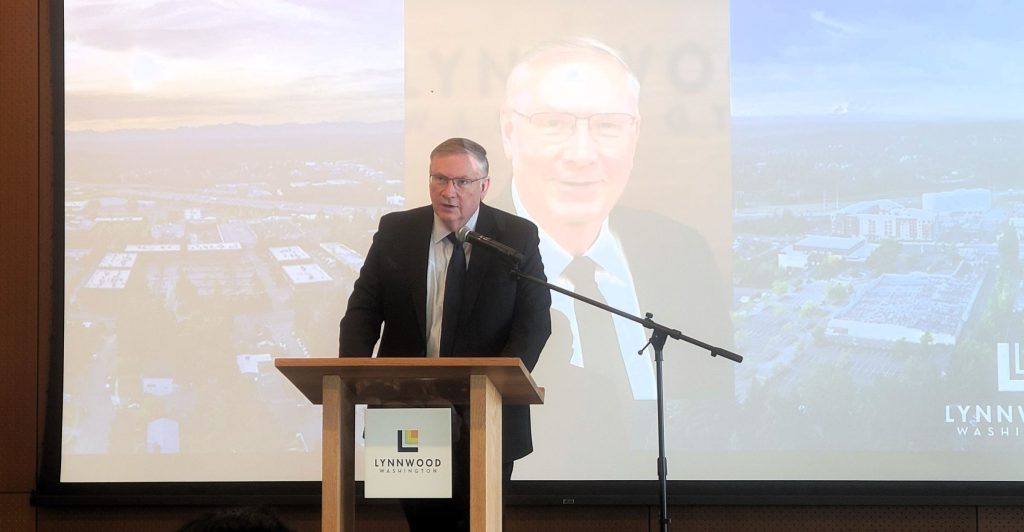
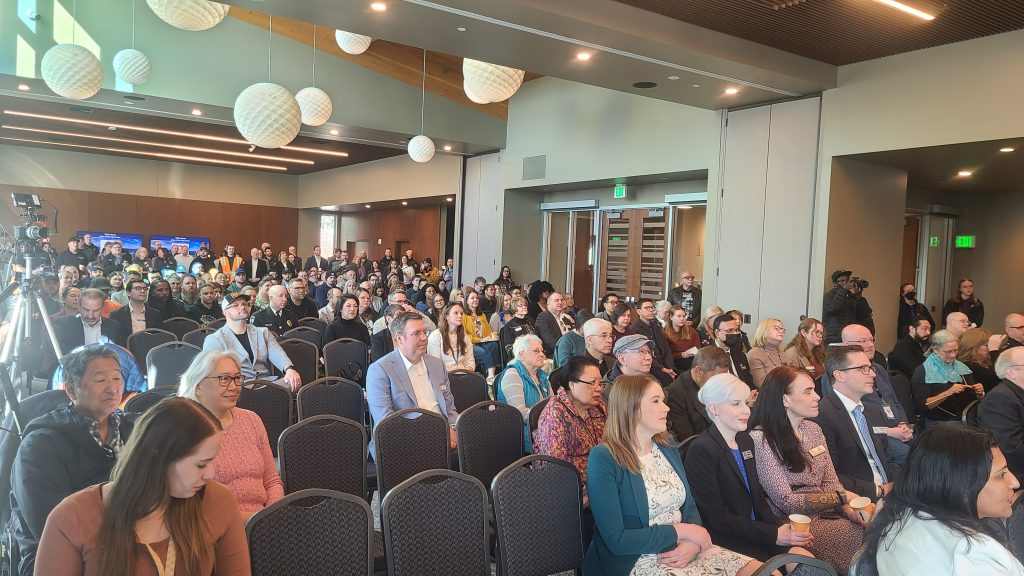
Speaking to a packed audience at the Lynnwood Neighborhood Center (approximately 200 people) on Thursday, March 26, the mayor framed the address as both a reintroduction and a forward-looking roadmap after roughly three months in office.
“I see my address as a way to reintroduce myself to some of you,” Hurst said, noting his decade of prior service on the City Council and more than three decades living in Lynnwood. “This is where we have been called to serve and where we raised our family.”
The speech blended personal reflections with policy priorities, underscoring what the mayor described as a pivotal moment for the city.




Budget deficit eliminated, but challenges remain
Hurst opened with what he called “the elephant in the room”: Lynnwood’s recent budget shortfall.

“In 2025, city staff and the City Council had to address a deficit of $25 million,” Hurst said. “Look at where we are now — zero. It’s time to celebrate … or is it?”
That deficit has since been eliminated through what he described as coordinated efforts between the city’s finance department, administrative staff and council members.
Despite the balanced budget, Hurst cautioned that financial pressures persist, particularly as the city prepares its 2027–2028 budget amid broader economic uncertainty.
“A budget year is always a challenge, but it feels even more daunting due to the uncertainty our country is facing,” Hurst said, pledging a transparent process that incorporates community input, citing a recent resident survey that identified public safety, parks, transportation and trust in government as top priorities. “We will make sure we listen to our residents and make sure their priorities are part of that process.:
Major infrastructure projects move forward
A significant portion of the address focused on two major capital projects: the long-awaited Poplar Way Bridge and a new wastewater treatment plant.
The Poplar Way Bridge, which will connect key corridors over Interstate 5, is set to break ground within weeks after years of planning.
“This project bridges the gap — literally — from Poplar Way and 196th Street, going north over Interstate 5,” Hurst said.
City officials say the bridge will reduce congestion, shorten travel times, improve safety and lower greenhouse gas emissions. The project has secured funding through federal and state partnerships, including support from members of Washington’s congressional delegation and state lawmakers.
The second project — a new wastewater treatment plant — represents the largest capital investment in Lynnwood’s history. Construction is expected to begin in 2028 in partnership with the neighboring city of Edmonds.
The existing facility already serves a significant portion of Edmonds, handling wastewater for more than 20% of its land area and 12% of its population.
“This collaboration is just a continuation of the fact that the two cities have been working together for decades,” Hurst said.
Public outreach has already begun, with multiple community meetings held to gather feedback and address concerns about the project.
Economic equity and labor policies
Beyond infrastructure, Mayor Hurst emphasized economic equity, particularly for lower-income residents.
Nearly 15% of Lynnwood households live at or below the poverty line, he said, framing that statistic as a call to action.
“We need to take advantage of opportunities to raise the level of incomes in Lynnwood,” Hurst said.
Hurst pointed to potential policy tools such as project labor agreements and community workforce agreements, which could prioritize hiring local workers for city-funded projects.
The mayor also announced plans to propose a wage theft ordinance aimed at ensuring workers are fully compensated.
“We want to make sure employers are paying their workers fairly and paying them for all the hours they work,” Hurst said, connecting economic stability to broader social issues, including youth violence. “Fair and good-paying jobs provide stability for households, which is an important part of addressing one of the root causes of youth gun violence.”
Addressing youth violence and housing instability
Mayor Hurst cited troubling statistics on youth violence in the region, including 11 reported shooting incidents involving teenagers since 2020, resulting in five deaths.
Two of these occurred this month during a single weekend.
To address the issue, Hurst called for increased support for community-based organizations, including those providing mental health services and peer counseling.
“We need to support organizations like the Access Project,” Hurst said.
Housing stability, he added, is another critical factor.
“My goal is to make sure that there is attainable housing throughout Lynnwood, especially housing that is built for homeownership,” Hurst said.
The city has already taken steps to reduce construction costs by improving its permitting process. An online system implemented in recent years has cut permit processing times by 30% to 40% and significantly reduced in-person traffic.
“The consensus among builders was that time had the greatest impact on the cost of building a house,” Mayor Hurst said.
Supporting small businesses
Hurst also highlighted efforts to strengthen Lynnwood’s business community, which includes more than 2,500 licensed businesses.
“These businesses are the economic lifeline for Lynnwood,” he said.
He praised city staff for initiatives such as hosting Small Business Administration office hours at City Hall — a service he said was the first of its kind in Washington state.
The program provides direct support to local entrepreneurs and has seen strong participation, according to the mayor.
Homelessness and community partnerships
Addressing homelessness, the mayor pointed to ongoing efforts to balance services for unhoused residents with neighborhood concerns.
He highlighted the role of philanthropist Rick Steves, who has donated millions of dollars to local housing and social service projects, including Trinity Place and the Dr. Jean Kim Foundation Hygiene Center.
The hygiene center, which serves unhoused individuals, has sparked concerns among nearby residents and businesses.
In response, the city convened a roundtable with more than 50 stakeholders to develop solutions.
“Because of that meeting, we will be creating a Good Neighbor Policy that will address the concerns brought up,” Hurst said.
He expressed a long-term vision of reducing the need for such services altogether.
“Someday I would like to close the Hygiene Center because no one will need those services since we have found housing for all,” Hurst said.
Immigration concerns and new support network
Mayor Hurst also addressed growing concerns over immigration enforcement, describing fear among immigrant communities as “real.”
“We are a city where all are welcome, but that phrase has come under threat,” Hurst said.
In response, the city has formed an “ICE Recovery Network,” a coalition of community organizations, city staff and law enforcement representatives aimed at supporting families affected by detentions.
The group is working on initiatives including informational resources, emergency planning and potential financial assistance.
“If a family vehicle is impounded, there will be money to get the car back,” Hurst said. “If the sole income for the family is detained, there may be a need for help with rent or a mortgage.”
The network includes representatives from organizations serving Latino, African and immigrant communities, as well as local schools and city departments.
“This is important work, and we are just getting started,” Hurst said.
A message of hope
Despite acknowledging significant challenges — from economic pressures to public safety concerns and national political tensions — the mayor closed his address on a note of optimism.
“It is obvious we are in challenging times,” Hurst said. “But I choose to believe in hope.”
He quoted the late Sen. Robert F. Kennedy, invoking the idea that individual acts of courage and compassion can create broader societal change.
“Those ripples build a current which can sweep down the mightiest walls of oppression and resistance,” Hurst said, urging residents to work together to shape Lynnwood’s future. “We as a city can work together and create a synergy of hope to make this a better city, a better nation, a better world.”
The address marked a defining moment early in the mayor’s tenure, outlining an agenda that blends fiscal responsibility, infrastructure investment and community-focused policies.
“I am optimistic about Lynnwood’s future,” Hurst said. “This city has been through a lot … and like we always have, we will continue to move forward and serve our community to the best of our abilities.”

Author: Kienan Briscoe