

WASHINGTON, D.C. — President Donald J Trump signed an executive order on March 31 directing federal agencies to compile lists of confirmed U.S. citizens for each state and to impose new tracking requirements on mail-in and absentee ballots sent through the U.S. Postal Service.
Washington Secretary of State Steve Hobbs responded the same day, saying the measure exceeds presidential authority and threatens the state’s vote-by-mail system that has delivered secure, high-turnout elections for nearly two decades.




“The President has no authority over elections; the United States Constitution grants that authority exclusively to states and Congress,” Hobbs said. “This latest federal executive order does nothing to improve that and would jeopardize citizens’ lawful right to vote. We are reviewing the executive order and will take any necessary action to protect Washington’s elections.”
The executive order, titled “Ensuring Citizenship Verification and Integrity in Federal Elections,” requires the Department of Homeland Security, working with the Social Security Administration, to create and transmit a State Citizenship List to each state’s chief election official at least 60 days before any federal election. The list draws from federal citizenship records, naturalization data and other databases to identify residents confirmed as U.S. citizens who will be 18 or older on Election Day. Individuals and states can request corrections or updates.


It also orders the Postmaster General to begin rulemaking within 60 days so that all outbound ballot mail uses secure envelopes marked “Official Election Mail” with unique Intelligent Mail barcodes. States must notify the Postal Service if they plan to send mail-in ballots and supply a list of eligible voters; the Postal Service would transmit ballots only to those enrolled on the approved list. The U.S. attorney general must prioritize prosecutions of officials or entities who distribute federal ballots to ineligible voters and can withhold funds from noncompliant states where authorized by law.
U.S. Sen. Maria Cantwell defended Washington’s current election system describing Tuesday’s executive order as “another alarming attack on Americans’ right to vote” and warned it could cause chaos for mail-in ballots just months before the midterms.

“Today’s executive order is another alarming attack on Americans’ right to vote,” Sen. Cantwell said. “Washingtonians cherish voting by mail because they know it is secure and convenient, but President Trump’s efforts to interfere with mail-in ballots could cause chaos and disenfranchise voters just months before the midterms. The framers were deliberate; the Constitution entrusts election administration to the states.”
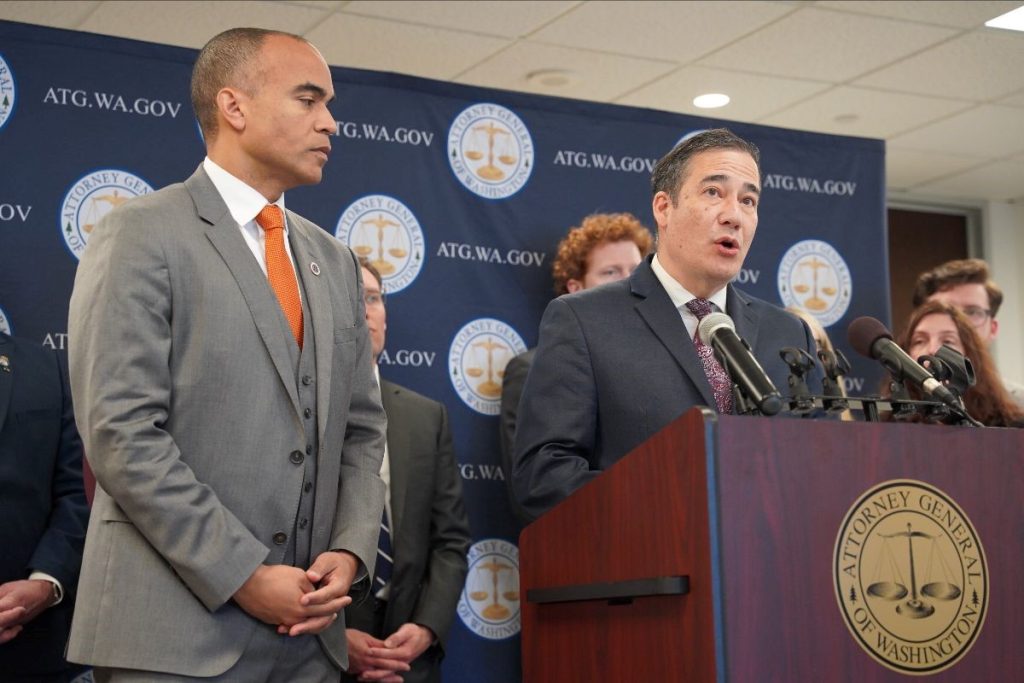
In response to Tuesday’s executive order, Attorney General Nick Brown called President Trump the Election-Denier-in-Chief who lacks authority and is attempting to seize total control over elections.
“It’s no surprise that the same man that claims he won the 2020 election and advances nonsense conspiracy theories now wants total control over elections, but he has no authority here – a fact already reaffirmed by the courts in this administration’s ongoing attacks on the right to vote,” AG Brown wrote. “In January, we successfully overturned a previous executive order by the president attempting to usurp the role of the states and Congress in elections. The law is on our side, there is nothing to support the Election-Denier-in-Chief’s voter fraud claims, and we are once again prepared to defend Washingtonians’ rights.”
In August 2025, Secretary Hobbs rebuked Trump’s public vow to end mail-in voting nationwide, calling it federal interference in state authority.
The Elections Clause in Article I, Section 4, Clause 1 of the U.S. Constitution grants states the initial responsibility for regulating federal elections for U.S. Senators and Representatives. It reads: “The Times, Places and Manner of holding Elections for Senators and Representatives, shall be prescribed in each State by the Legislature thereof; but the Congress may at any time by Law make or alter such Regulations, except as to the Places of choosing Senators.”
States handle the “manner” of elections broadly, including recent topics like mail-in ballots and voter ID requirements. However, Congress has the authority to intervene to create uniform standards, such as through laws like the Voting Rights Act of 1965 or the Help America Vote Act of 2002, but states retain primary control unless overridden.
While states have broad constitutional authority to determine election processes, this is not absolute—federal intervention ensures national standards and protects voting rights. This is the argument President Trump made in an August 2025 Truth Social post stating, “Remember, the States are merely an ‘agent’ for the Federal Government in counting and tabulating the votes.”
President Trump signed a broader election integrity executive order a year earlier on March 25, 2025, titled, “Preserving and Protecting the Integrity of American Elections,” in what his administration considers multiple “gaps” in election security. According to this E.O.:
- Election Assistance Commission must add documentary proof of citizenship to the national mail voter registration form.
- Federal agencies (DHS, SSA, State Dept.) must give states access to databases for verification.
- Strict Election Day receipt deadline for ballots (no counting late arrivals in federal races).
- Voter-verifiable paper records required for voting systems.
- DOJ prioritizes prosecutions and information-sharing agreements.
- Federal funding conditioned on state compliance.
Secretary Hobbs objected then that strict receipt deadlines and documentary proof requirements conflicted with state practices. He said that the requirements clash with Washington law, which automatically mails ballots to all registered voters and counts those postmarked by Election Day even if they arrive later—over 250,000 such post marked ballots arrived after Election Day in the 2024 general election. The March 2025 executive order, Hobbs added, risked disenfranchising eligible citizens who lacked passports or enhanced driver’s licenses and could expose the state to loss of federal funding or enforcement actions.
Recent legislation passed regarding Washington state elections
In May 2023, Hobbs praised bipartisan Washington state laws signed by then-Governor Jay Inslee that improved election security and access. The legislation included:
- House Bill 1241, sponsored by Rep. Mari Leavitt (D-University Place), makes harassing election workers a class C felony and allows harassed election officials to apply for the Address Confidentiality Program.
- House Bill 1962, requested by Secretary Hobbs and sponsored by Rep. Sam Low (R-Lake Stevens), helps maintain accurate voter lists and streamlines registration updates for voters moving from one Washington county to another.
- Senate Bill 5843, requested by Secretary Hobbs and sponsored by Sen. Joe Nguyen (D-White Center), requires counties to notify the Office of the Secretary of State if they experience malicious cyber activity and maintain intrusion detection systems to safeguard against election cyber threats, among other security improvements.
- Senate Bill 5824, requested by Secretary Hobbs and sponsored by Sen. Sam Hunt (D-Olympia), protects library districts and expands voter eligibility to include all qualified district residents who can vote when a proposal for library dissolution appears on the ballot. It also increases the petitioning threshold from 10% of voters in unincorporated areas to 25% of qualified voters in the district.
These laws facilitated online registration using the last four digits of a Social Security number, automatic registration for citizens obtaining enhanced IDs at the Department of Licensing, a ban on undisclosed deepfakes in campaigns, and exemptions for voted ballots from public disclosure to shield voter identities.
In September 2025 Hobbs supplied the Justice Department (DOJ) only publicly available voter data in response to a request for sensitive fields, citing state privacy laws. The DOJ in December 2025 sued Washington Secretary of State Steve Hobbs, alleging he unlawfully withheld voter registration data, including full names, dates of birth, driver’s license numbers, and social security digits. The case is still pending in federal court
Election Fraud
Hobbs shared on Tuesday that voter fraud remains extremely rare with just 15 documented cases of noncitizen voting between 1982 and 2025 — 0.000006% of all ballots cast.
According to data from the Heritage Foundation, there have been 15 cases of overall voter fraud in Washington state between 2004 and July 28, 2025: Duplicate Voting (1), Fraudulent use of Absentee Ballot (7), False Registration of a dog (1), False Registration (5); Ineligible Voter (1).
The worst case was in 2007 when ACORN workers in Seattle committed what then-Secretary of State Sam S Reed called the worst case of voter registration fraud in Washington’s history.
When ACORN’s national office threatened to shut down the group’s local office, Clifton Mitchell and his team began using fake names, addresses, birthdays, and social security numbers to meet their voter registration quotas. In total, the group submitted 1,762 fraudulent voter registration forms. Clifton Mitchell was convicted of false registrations and served nearly three months in jail. Four other ACORN workers on his team also received jail time.
California, Colorado, Hawaii, Nevada, Oregon, Utah, Vermont, and Washington elections are “All-mail elections,” meaning every registered voter automatically receives a ballot by mail, with no need to request one or provide an excuse.
Empirical data shows that voter fraud involving mail-in or absentee ballots is exceedingly rare in the United States. An extensive review by the Brennan Center for Justice, release in 2020, found only 491 documented cases of absentee ballot fraud nationwide from 2000 to 2012, out of billions of votes cast.
Similarly, a 2021 Associated Press investigation into potential fraud in six battleground states from the 2020 election identified fewer than 475 cases across all voting methods, none of which altered outcomes.
Separate from voter fraud, eligibility issues had plagued several Washington state candidates and elected officials who have faced residency challenges: Rep. John Ley, Niko Battle and Josh Binda all of whom encountered formal complaints between 2022 and 2025 that were resolved through county audits or courts.
High-profile cases in other states include the 2023 Bridgeport, Connecticut, primary where council members and the vice chairwoman of the city’s Democratic party were charged with election-related crimes. Supporters of incumbent Bridgeport Mayor Joseph Ganim were caught on video stuffing absentee ballot drop boxes with invalid ballots during the Democratic primary. This involved harvesting and submitting fraudulent absentee ballots, leading to the election being overturned by a judge.
Washington State Republicans introduce initiatives
Washington State Representative Jim Walsh (R-Aberdeen) has consistently pushed for stronger election safeguards. He introduced legislation in 2025 calling for a Justice Department audit of the Department of Licensing’s motor-voter process to ensure only citizens are added to the rolls. The bill never made it out of committee.
A 2025 Republican-backed initiative, IL26-126, sought to replace Washington’s honor-system registration with mandatory proof of citizenship and to require cleaner voter rolls. Sponsors collected signatures throughout 2025 but fell short of the threshold needed to place it on the 2026 ballot. On February 3, 2026, Walsh and the WAGOP launched a drive to collect signatures for IP26-500 in a second attempt to place the imitative on the ballot.
Editor’s Note: Article updated 10:31 a.m., April 1, 2026, with AG Brown’s statement released on April 1.

Author: Mario Lotmore