

OLYMPIA — Washington’s seasonally adjusted unemployment rate rose to 5.2% (212,533 residents) in April 2026, up one-tenth of a percentage point from a revised 5.1% in March and well above the 4.5% (181,390 residents) recorded a year earlier, the state Employment Security Department released Tuesday.
Nonfarm employment decreased by an estimated 4,500 jobs on a seasonally adjusted basis from March to April — the fourth consecutive month of falling employment — according to preliminary figures from the Bureau of Labor Statistics. Private-sector employment fell by 1,500 jobs while public-sector jobs dropped by 3,000. Over the year, Washington shed 8,300 jobs, a 0.2% decline, with private employers cutting 2,900 positions and public employers losing 5,400.



The number of unemployed Washington residents climbed to 212,533 in April, an increase of 3,537 from March, while the civilian labor force edged down slightly to 4,062,961. Employed residents fell by about 4,999 over the month.
Nationally, the unemployment rate held steady at 4.3%. In the Seattle-Tacoma-Bellevue metropolitan area, the rate rose to 5.5% from 5.4% in March.




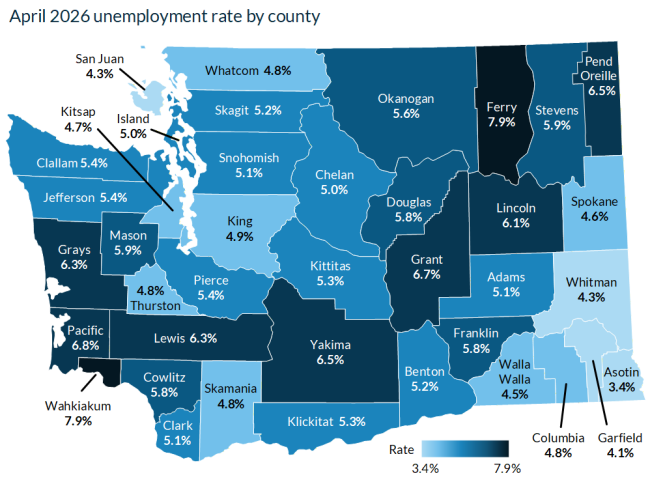
In Snohomish County, the not-seasonally-adjusted unemployment rate increased slightly to 5.1% in April from 5.0% in March. Employers added 3,100 jobs during the month, according to county-specific data released Tuesday by the ESD. Even so, the county’s total job count remained 2,500 below April 2025 levels.

“Employers in Snohomish County added 3,100 jobs during April, [but] the job count continues to lag last year’s count, under by 2,500 jobs,” said Toby Paterson, regional labor economist for Northwestern Washington. “The unemployment rate for Snohomish County increased little to 5.1%, up from 5.0% last month.”


Industry details in the April report showed mixed one-month changes. Gains occurred in financial activities (up 900 jobs), manufacturing, transportation/warehousing/utilities and other services (each up 400). Losses were led by construction (down 1,300), professional and business services (down 900), government and several other sectors.
Over the year, the largest private-sector gains came in professional and business services (up 4,900) and transportation/warehousing/utilities (up 4,100). The biggest declines in employment were in the retail trade (down 5,900) and information (down 4,700) sectors, with government also shedding 5,400 jobs.
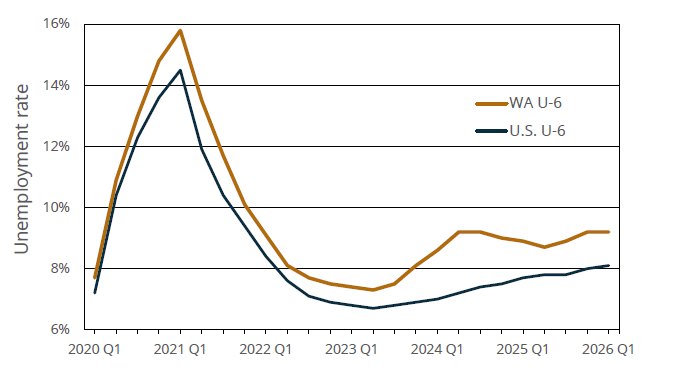
The broader U-6 measure of labor underutilization, which includes marginally attached workers and those working part time for economic reasons, averaged 9.2% for Washington over the four quarters through the first quarter of 2026, unchanged from the prior period and above the national U-6 rate of 8.1%.

Author: Mario Lotmore