

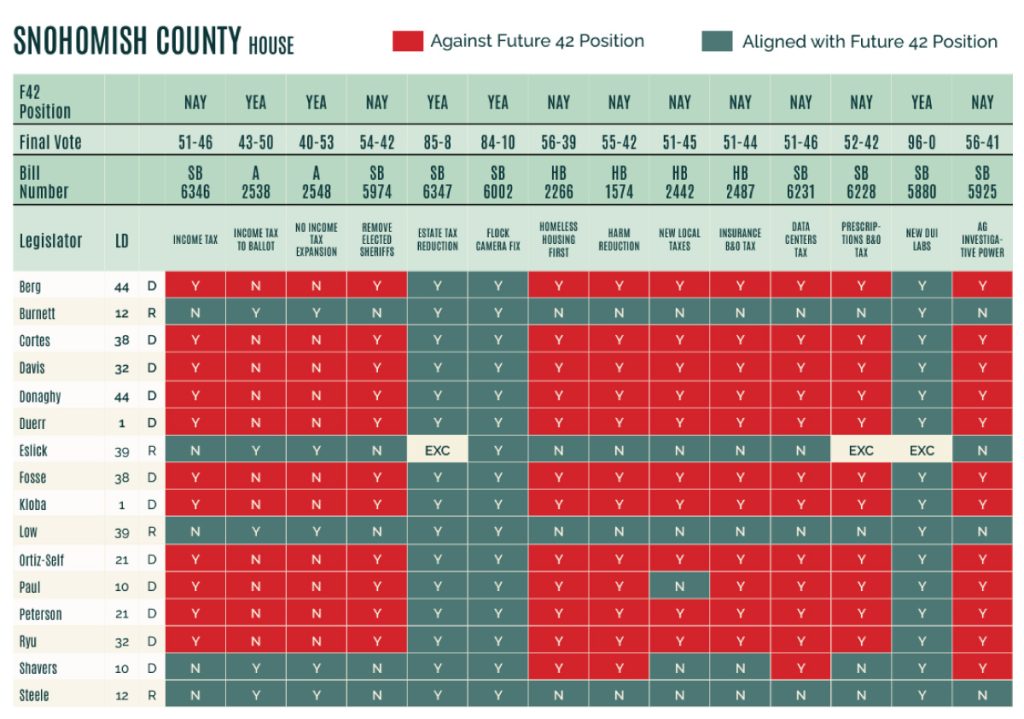
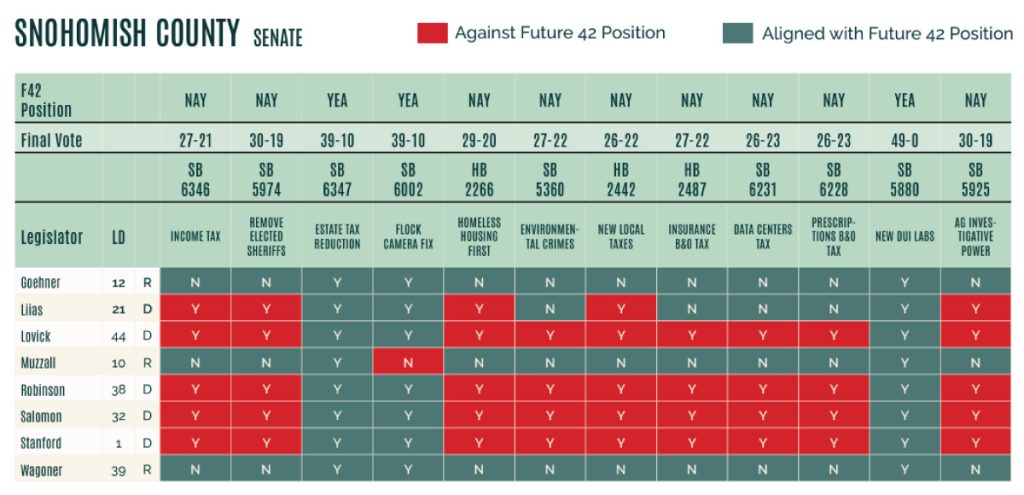
We at Future 42 are proud to release our 2026 Snohomish County Legislative Scorecard, an abbreviated version from the state scorecard focused on the votes cast by Snohomish County legislators this session in Olympia. Here, we shine a light on how our state senators and representatives stood on 12 key bills and amendments during the short 60-day session. These measures will shape the cost of living, public safety, housing choices and economic opportunity for families and businesses across Snohomish County for years to come.
In our view, the scorecard equips voters with the information they need to hold their elected officials accountable. We score bills that increase taxes or regulations negatively because these burden working families and drive jobs away. We support legislation that provides tax relief, strengthens law enforcement or restores local control because those steps help people prosper and keep our communities safe.
Below is a list of the current Legislators representing Snohomish County:
- 1st District – Senator Derek Stanford, Rep. Davina Duerr, Rep. Shelley Kloba
- 10th District – Senator Ron Muzzall, Rep. Dave Paul, Rep. Clyde Shavers
- 12th District – Senator Keith Goehner, Rep. Brian Burnett, Rep. Mike Steele
- 21st District – Senator Marko Liias, Rep. Lillian Ortiz-Self, Rep. Strom Peterson
- 32nd District – Senator Jesse Salomon, Rep. Lauren Davis, Rep. Cindy Ryu
- 38th District – Senator June Robinson, Rep. Julio Cortes, Rep. Mary Fosse
- 39th District – Senator Keith Wagoner, Rep. Carolyn Eslick, Rep. Sam Low
- 44th District – Senator John Lovick, Rep. April Berg, Rep. Brandy Donaghy
As our detailed matrices shows below (download here), a clear pattern emerges among Snohomish County’s delegation. The Republican legislators from the 12th and 39th districts — Sen. Keith Goehner, Sen. Keith Wagoner, Reps. Brian Burnett, Mike Steele, Carolyn Eslick and Sam Low — consistently aligned with our positions on limiting taxes, protecting public safety and preserving local decision-making. Their Democratic colleagues, representing the 1st, 10th, 21st, 32nd, 38th and 44th districts, voted with us far less frequently. A few Democrats, such as Rep. Dave Paul, broke ranks on select votes, offering glimmers of bipartisanship on fiscal issues.


Your Pocketbook: Taxes
Lawmakers passed SB 6346, which establishes a new state income tax on individuals earning above $1 million and certain small businesses — often called the “millionaires tax.” We opposed this bill from the outset. We believe it sends the wrong signal to entrepreneurs and high earners who create jobs throughout the region, including in aerospace, technology and manufacturing hubs like Everett and south Snohomish County. The measure passed the House 51-46 and the Senate 27-21 before Gov. Bob Ferguson signed it into law. It now faces legal challenges. In the House, Republican representatives from the 12th and 39th districts — Brian Burnett, Mike Steele, Carolyn Eslick and Sam Low — voted no. Most Democrats voted yes, though Rep. Dave Paul of the 10th District showed some independence on related measures.

HB 2442 opened the door for cities and counties to impose new local taxes without voter approval for various social services. We opposed it as another layer of taxation without direct accountability to taxpayers.
HB 2487 increased the business-and-occupation tax on insurance companies, a change likely to raise premiums for families and businesses. We opposed this cost increase.
SB 6231 added a sales tax burden on data centers, which could discourage investment in critical infrastructure and high-tech jobs.
SB 6228 applied higher B&O taxes to prescription drugs, potentially driving up health care costs.
On a brighter note, SB 6347 rolled back the estate and death tax rate from the recently hiked 35 percent — the highest in the nation — back to 20 percent. We supported this tax relief, which passed with broad bipartisan support in the House 85-8 and Senate 39-10. It offers some protection for family farms, small businesses and estates in our area, helping preserve wealth that stays local rather than flowing to state coffers.
Public Safety
SB 5974, sponsored by Sen. John Lovick, imposes new standards for running for sheriff and allows an unelected state commission to decertify and remove elected sheriffs. We opposed this power grab that strips authority from local voters. It passed the House 54-42 and Senate 30-19 and was signed into law, although a court injunction has blocked some provisions. Republican senators and representatives voted against it, while Democrats largely supported the bill.
We were pleased to back SB 6002, which protects local police from frivolous lawsuits related to Flock safety camera systems used to fight crime. This fix ensures law enforcement can continue using proven tools to fight crime without fear of costly litigation. The bill passed overwhelmingly and was signed. Similarly, SB 5880 allows private labs to help process DUI blood tests, addressing backlogs so impaired drivers can be held accountable more quickly. We supported it as a commonsense step for road safety.
We could not support SB 5925, which expands the attorney general’s power to issue civil investigative demands. This increase in government authority without adequate checks raises concerns about overreach.
We also opposed SB 5360, which creates harsh new environmental crime penalties that could ensnare businesses in lengthy legal battles over regulatory violations. The Senate passed it, but it died in the House — a partial victory.
Housing Policy
HB 2266 forces cities and counties to allow “housing first” permanent supportive housing, transitional housing and emergency shelters in any residential zone, overriding community planning. We opposed this one-size-fits-all approach that disregards the unique needs of neighborhoods in Lynnwood, Edmonds, Everett and beyond. It passed the Senate 29-20 and House 56-39 and was signed into law.
We opposed HB 1574, which sought to limit regulation of harm reduction programs distributing drug paraphernalia. While it passed the House 55-42, it died in the Senate.
In both cases we argued that prioritizing accountability and public safety over unchecked distribution better serves Snohomish County communities battling addiction and drug-related crime.
Why Our Scorecard Matters
These votes matter in our Snohomish County, home to thriving communities, family businesses and working families who already shoulder high costs for housing, energy and daily necessities. New taxes reduce take-home pay. Weakened local control and law enforcement erode the sense of safety and self-determination that draws people to our area. Overregulation threatens the job creators who employ thousands here — from Boeing workers in Everett to small manufacturers and tech firms scattered across the county. When state policy pushes up the cost of doing business or living here, it ripples through every household, every school budget and every Main Street storefront.
At the end of the day, our work stems from a simple belief: Washingtonians deserve policies that let them keep more of what they earn, live in safe neighborhoods and make choices for their own communities. When legislators vote to expand government power and reach deeper into pockets, they move us further from that vision. Snohomish County residents deserve representatives who listen to those concerns and act accordingly.
Future 42 is the public-facing initiative of Project 42, a 501(c)(4) nonprofit organization dedicated to promoting free markets, personal liberty, public safety and tax relief throughout Washington state. Through scorecards like this one, candidate recruitment, grassroots mobilization and policy advocacy, we work to build a Washington where families and businesses can thrive.
We invite Snohomish County residents to join us in this effort by staying informed, engaging with their legislators and supporting policies that put people first.
We urge you to share this Snohomish County scorecard with your neighbors, discuss it at the dinner table or community meeting, and use it as you engage with your elected officials. Informed voters are the foundation of good government. Together, we can ensure that Olympia hears the voice of Snohomish County loud and clear.
COMMENTARY DISCLAIMER: The views and comments expressed are those of the writer and not necessarily those of the Lynnwood Times nor any of its affiliates.

Author: Future 42