

SEATTLE — Sound Transit has released a comprehensive summary of public feedback gathered through its Enterprise Initiative, a document that directly influenced Board of Directors on its Sound Transit 3 (ST3) system plan vote on Thursday and will be used to forge an affordable path forward for the agency’s long-term finances.
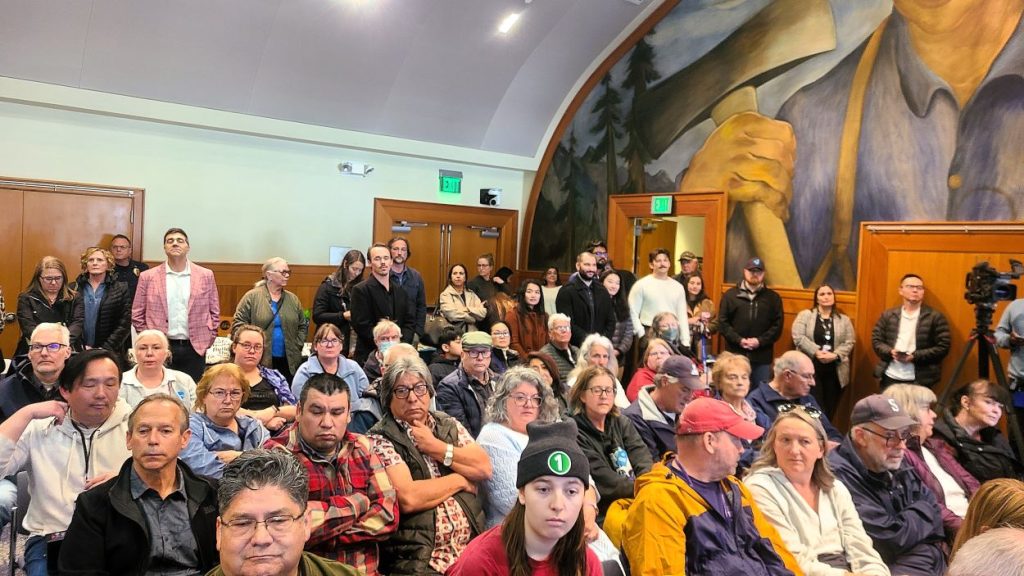
The Engagement Summary Report compiled input from one of the largest public outreach efforts in the agency’s history. More than 17,700 people responded to an online survey between March 30 and May 1, contributing more than 27,000 open-ended comments. Staff also participated in more than 20 community events across the three-county district, eight town halls that drew roughly 1,400 attendees, and dozens of briefings with elected officials, community organizations and employers.

Launched in 2025, the Enterprise Initiative examined every aspect of Sound Transit’s work — planning, capital delivery, operations and finance — to address escalating costs driven by inflation, labor shortages and supply chain disruptions, according to Sound Transit leadership. Without action, the ST3 deliverables post-2033 were at risk to not coming to fruition. Public engagement was designed from the outset to put community priorities at the center of those the Board’s and staff’s trade-off decisions based on “technical and financial analyses” that are “intended to support decision making for durable, equitable, and affordable Enterprise Initiative outcomes.”
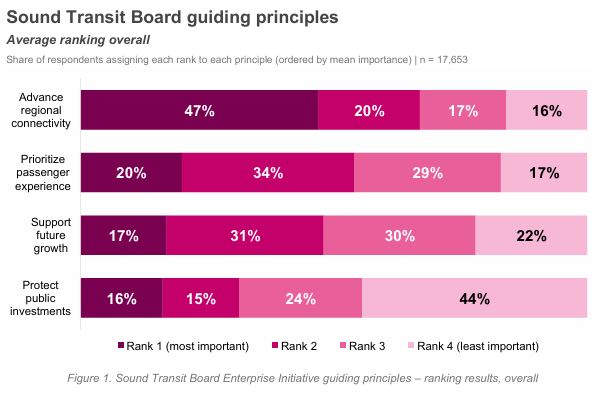
When asked to rank four guiding principles for Board decision-making, advancing regional connectivity topped the list, with 47 percent of regional participants rating it most important (Figure 1). Prioritizing the passenger experience followed closely, while protecting public investments ranked lowest.



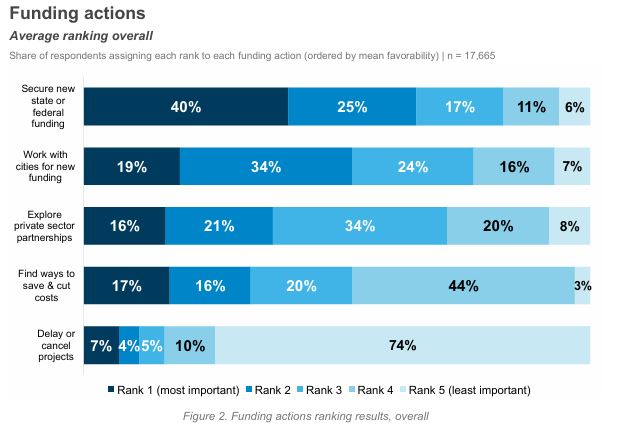
The same pattern held when people ranked actions to close the funding gap: securing new state or federal funding emerged as the clear favorite, chosen most favorably by 40 percent overall, while delaying or canceling projects ranked dead last (Figure 2).


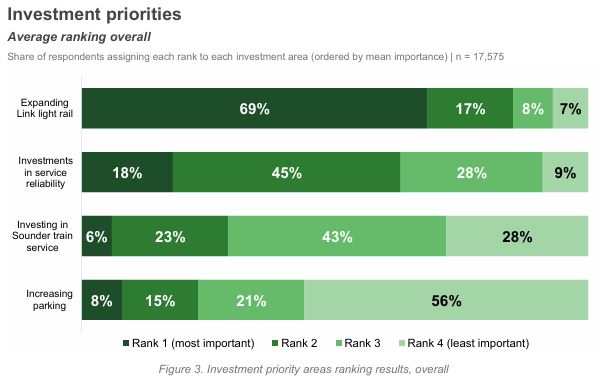
With regards to investment priorities, expanding Link light rail led the field, with 69 percent placing it first (Figure 3). Investments in service reliability came second. Sounder train service and parking expansions trailed far behind.

The report found that the closed-ended rankings (quantitative data) aligned closely with over 14,000 open-ended responses (respondent-typed qualitative data) in which respondents repeatedly called for completing light rail projects, avoid delays and focus on reliable, connected service across the entire Sound Transit region—not just the North King subarea that contains the Ballard Link.
Communities also made clear they wanted their local projects protected.
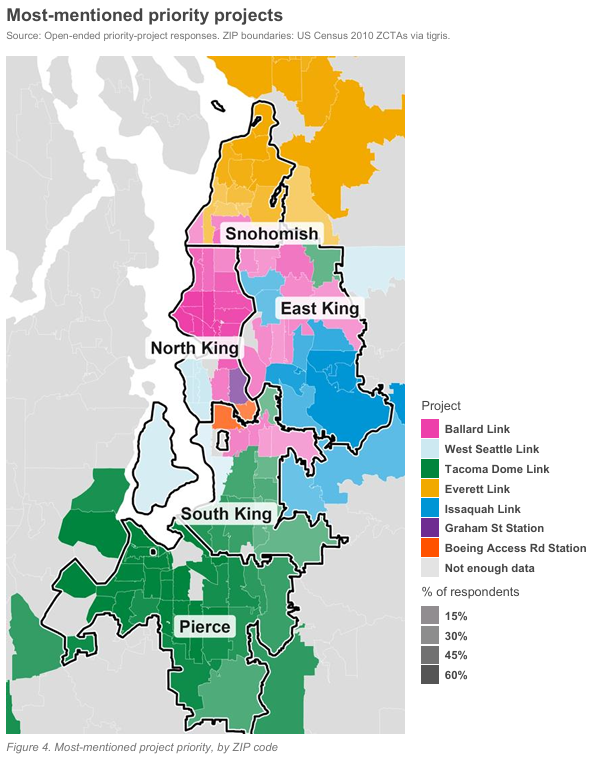
Open-ended comments and subarea-specific outreach revealed strong support for corridor-level priorities: the South Kirkland–Issaquah Link Extension in East King County, West Seattle and Ballard projects in North King County, Graham Street and Boeing Access Road stations in South and North King, and extensions to Everett Station in Snohomish County and Tacoma Dome in Pierce County. This data is represented below is a ZIP-code map of the most-mentioned projects by geographic intensity of support (Figure 4).
In Snohomish County, 1,547 survey responses and 54 separate community touchpoints — including a town hall at Everett Station and briefings with city and county leaders — centered on completing the light rail spine without further delay. Residents stressed timely communication about property impacts, taxpayer accountability for taxes already paid, and the importance of delivering on voter commitments. Some suggested prioritizing a direct I-5 connection to North Everett if choices become necessary.
East King County’s 2,379 responses and 75 briefings highlighted the Issaquah extension, while North King and South King participants emphasized infill stations and Ballard-West Seattle work. Pierce County voices focused on the Tacoma Dome link.
Across in-person events, emails and survey comments, participants consistently urged the Board to pursue new funding sources, pursue efficiencies and cost savings, and explore partnerships before considering cuts or delays. Many asked for plain-language explanations of project timelines, alignments and station designs, along with greater transparency about the factors driving the affordability challenge—all elements that comprised the 13 amendments voted on by the 18 Board of Directors on Thursday of which 12 were approved.
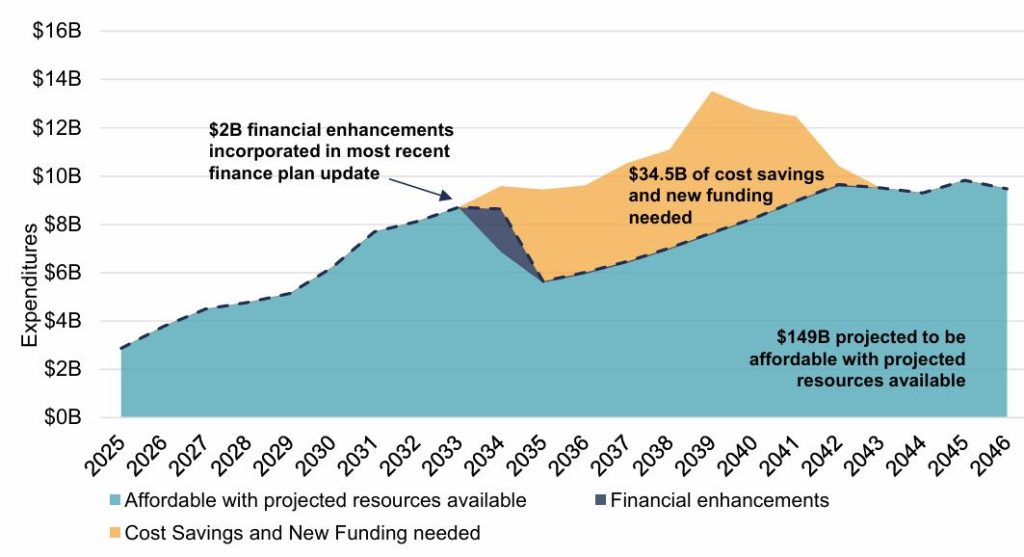
Respondents also praised the agency’s mission of “Connecting more people to more places to make life better and create equitable opportunities for all,” while at the same time voicing frustration with rising costs—almost tripled to approximately $149 billion since voters approved the measure back in 2016—and expressed willingness to support phasing or deferrals as preferable to canceling projects outright, which the Board agreed through its historic vote at its May 28th meeting.

Author: Mario Lotmore