

EVERETT—With a looming $34.5 billion budget deficit facing Sound Transit light rail over the next 20 years, the City of Everett is laying a compelling case for why the Sound Transit Board should keep a fully funded Everett Link in an upcoming ST3 System Plan vote expected no later than June 30.
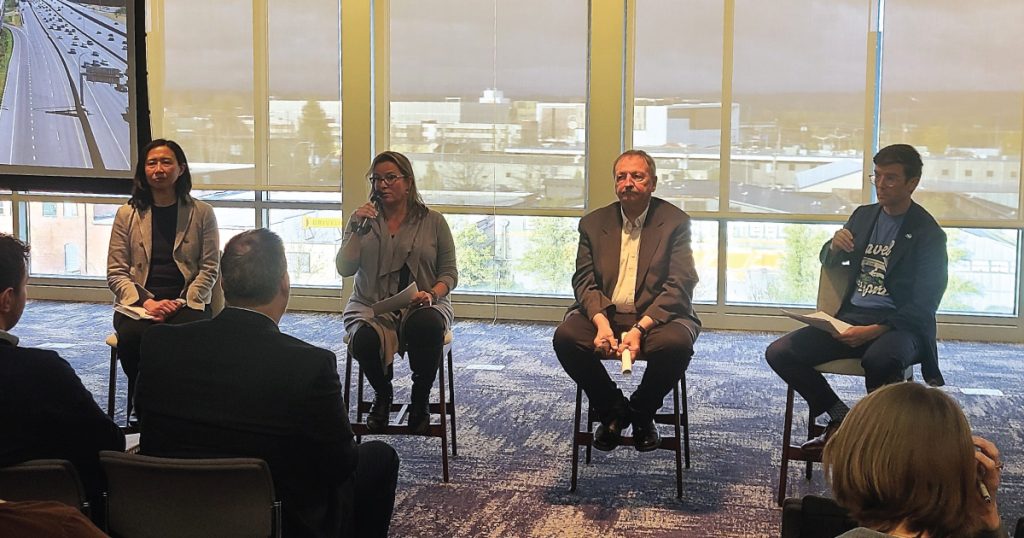
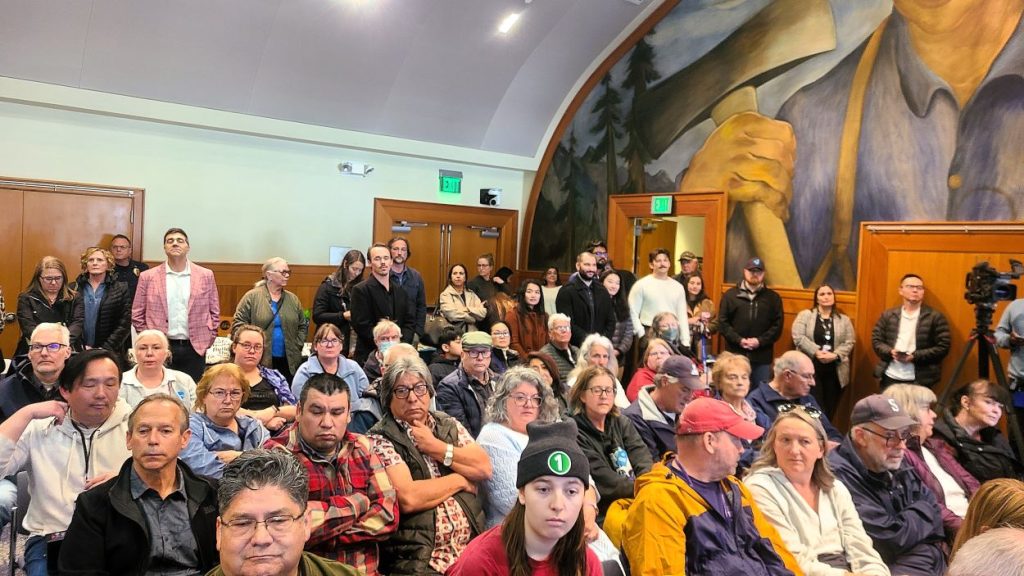
“So first of all, we saw the $34.5 billion shortfall that we have; it’s good to note that both the Ballard and West Seattle extensions have seen costs nearly double,” Mayor Cassie Franklin told a pack room of at least 200 people attending the Sound Transit Snohomish County Town Hall on Tuesday hosted by Transportation Choices Coalition and Snotrac. “And as I said before, we’ve been able to identify significant cost reductions [in the Everett Link] that don’t include canceling stations.”

Mayor Franklin stressed that Everett is home to Boeing with over 30,000 employees, awarding-winning Paine Field Airport that is expected to grow in passenger traffic volume with additional terminals according to the County’s Comprehensive Plan, and a vibrant and growing Southwest Industrial Center.
“When we talk about regional connectivity, it is the spine from Everett to Tacoma that is actually going to connect this region,” Mayor Franklin said, “So that is definitely on my mind as the priority.”



Snohomish County Executive and Sound Transit Board Chair Dave Somers shared that the momentum is to complete the Everett-to-Tacoma spine.

“Citizens of Snohomish County have been paying for a system for a long, long time,” Executive Somers said. “The spine I think it’s got more momentum and support on the Board now than it’s ever had, so I’m confident that we are going to find a solution.”
A leading driver comes down to cost and expected route revenues, Somers shared.
“So, you saw the three alternatives that had been kind of floated out there in the last few months that have different variations,” Somers said. “Two of those alternatives finish the spine getting up to Everett and getting down to Tacoma. The big changes are on the West Seattle / Ballard subarea and the Issaquah land, where the real questions are. Our segment going from Lynnwood to Everett…we can make it affordable, we can get it done – and no debate.”
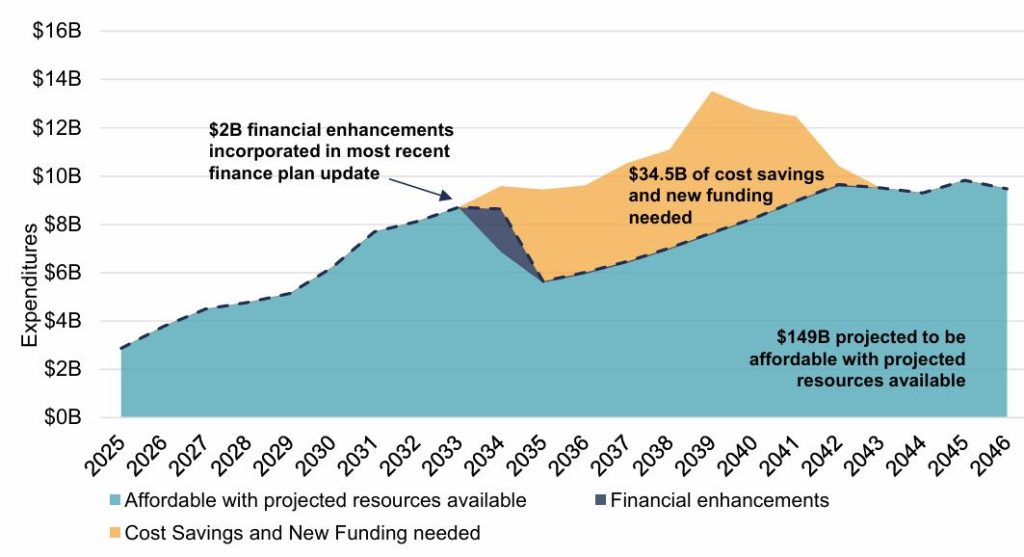
The total estimated remaining project cost to complete ST3 is projected at $149 billion by 2046 with a $34.5 billion cost avoidance need (up 25% since Fall 2024) no later than 2033 —approximately $30 billion of the cost overrun is attributed to capital cost growth. The West Seattle Link Extension ballooned from $4.2 billion in the finance plan to between $7 billion and $7.9 billion. The Ballard Link Extension climbed from roughly $11.9 billion to between $20.1 billion and $22.6 billion. Combined, the two lines exceeded $30 billion before adjustments.
In March 2026 the board held a retreat and reviewed three broad “approaches” for closing the gap. These include combinations of:

- Cost savings (e.g., design changes, value engineering, service adjustments).
- Project delays or deferrals (some options floated deferring stations like parts of Ballard or even pausing “shovel-ready” segments like West Seattle Link).
- New or enhanced revenue tools (higher rental-car taxes, longer-term bonds, fare increases, value capture from development near stations, etc.).
- Minor service or policy tweaks (parking fees, fares, etc.).
Sandra Fann, Director at Sound Transit in charge of the Central Corridor HCT Project, shared three “alternatives” that involve project delays or deferrals to reduce up to $30 billion in capital costs overruns:
- Approach 1: Keep active light rail extension projects moving. This funds Everett Link Extension, construct to Tacoma Dome, construct to South Center only, and construct West Seattle to Alaska Junction only; all other stations will be deferred: Graham Infill Station, Boeing Access Infill Station, T Line Extension, and South Kirkland–Issaquah Extension.
- Approach 2: Advance regional connectivity. This funds Everett Link Extension, construct to Smith Cove (located after South Center), construct to Tacoma Dome, and construct to South Kirkland–Issaquah Extension; all other stations will be deferred: West Seattle Extension, Graham Infill Station, Boeing Access Infill Station, and T Line Extension.
- Approach 3: Phase all light rail extension projects to advance other ST3 elements. This funds construction to Delridge (West Seattle), construct to South Center, construct to SW Everett Industrial Center (not downtown Everett), construct to Fife (not Tacoma Dome), construct to Graham Infill Station, construct Boeing Access Infill Station, construct T Line Extension (initial phase only), and construct South Kirkland–Issaquah Extension (initial phase only).
All three approaches deliver roughly 86–87% of the original ST3 rail ridership target and involve major cuts to the Ballard Extension. Everett Link is fully protected in Approaches 1 and 2 but truncated in Approach 3—this is what the Board will be voting on in its May or June meeting the future of the ST3 System Plan.
“There’s options for state, federal investment, or even private investment,” Somers said. “So, we will keep those projects alive in the planning, but they will not be authorized for moving forward because we can’t afford them right now. But it is important that we work together with the rest of the board members to say, we’re not writing you off, we’re not pushing you off the edge of the table, we’re going to find a way.”
Somers added that a subarea levy may be an option for to pay for the Ballard and/or West Seattle extensions.
“We can get to the Seattle Center, but we’re going to look in the future for ways to fund and have their own levy to finish the spine,” he said.


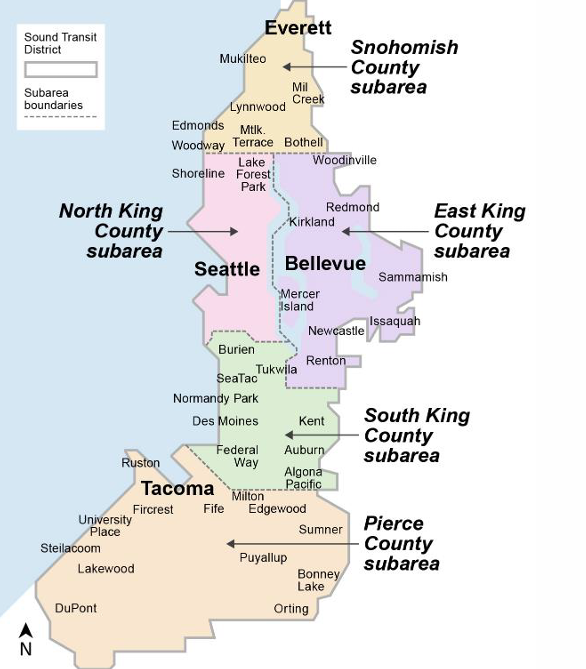
Somers explained that the Sound Transit District is made up of five subareas, each with dedicated funding mechanisms: Snohomish, North King, South King, Bellevue, and Pierce. Voters in the North King and South King subareas could put “forward a sort of ‘ST-4 light’ for their area to finish off their project,” Somer shared.
Depending on the subarea, 30 to 40% of the total costs for ST3 are currently dependent on federal grants, another risk to the project, Fann said given the Trump administration stance to sharply reduce federal funding for new light-rail and other major transit capital projects which would shift more funding responsibility to local governments.
The Trump administration released its official FY 2027 budget request on April 3, 2026, which includes cuts to the Capital Investment Grants (CIG) program—proposed cut of roughly $1.2–1.6 billion (nearly 50%)—and overall public-transit discretionary spending cuts of $208 million for $16.3 billion in available funding. Final passage of the proposed budget is expected no later than September 30, to avoid a government shutdown.
“They’re also adjusting their criteria for grants…. But the uncertainty over federal funding is significant,” Fann shared.
Despite the risks, both Somers and Franklin remain confident in completion of the Everett-Tacoma spine as approximately 90% of the cost overruns are in North King (mostly) and South King subareas with the Snohomish subarea almost fully funded.
“So, you add up Pierce County and Snohomish County, and our interests are very similar,” Somers said. “They want to get to Tacoma; we want to get to Everett. That’s eight votes out of 18. So, there’s ten votes that are outside our control.”
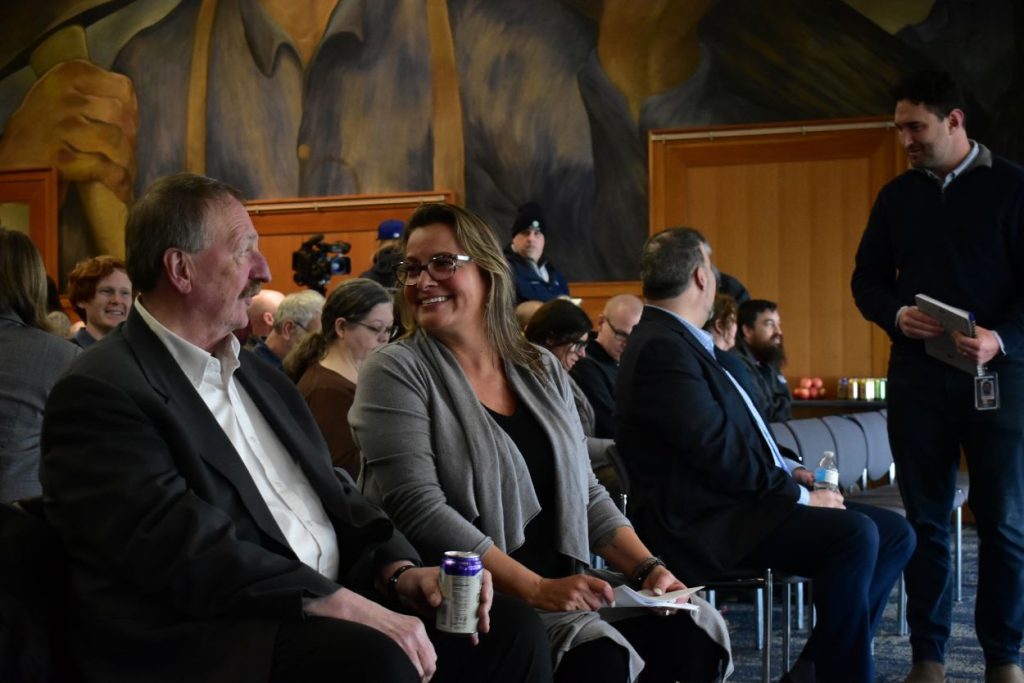
When asked how he plans to sway the other 10 Board members to “finish the spine,” Somers told the Lynnwood Times that he will put out a plan that is “realistic,” “fair,” and “based on finances,” adding that he will have conversations with each and every Board member.
When it comes to public-private partnerships, Somers shared with the Lynnwood Times that Sound Transit is currently working with both SeaTac and the Port of Seattle to explore revenue options. When asked if that would include possible transit fees on airline tickets, he responded that it is a decision for state officials.
Sound Transit is currently developing a comprehensive process called Enterprise Initiative to close its $34.5 billion budget gap over the next 20 years and wants public feedback to evaluate different approaches to updating the ST3 System Plan with a 5-minute survey. It is working to reduce the impact of what the agency characterizes as historic inflation, tariffs, labor shortages, supply chain disruptions, and other factors on its ability to plan, build, and deliver transit to the region.
Sound Transit staff will synthesize survey responses and share them with Board members in early May, combining this feedback with other input received through email and in-person events into a comprehensive engagement report prior to the May 28 Sound Transit Board meeting.
Everett Link Extension
The Everett Link Extension is scheduled starting 2037 through 2041, to provide connections to residential and employment centers with approximately 16 miles of light rail and six new stations connecting Snohomish County residents to the regional Link light rail network. In addition, Sound Transit is studying a provisional (unfunded) stationthrough the planning process as well as parking facilitiesat two station locations.
The project includes the essential OMF North, which would support overall system operation and have the capacity to receive, store, and service a larger train fleet to support Link extensions. To build this new facility, Sound Transit will need approximately 80-100+ acres near the light rail line.
The Sound Transit Board will make their official decision about which route and stations and which OMF North location to build after environmental review is complete, which we expect to happen in or around 2027.
The project is currently in the environmental review phase, which includes preparing an Environmental Impact Statement (EIS). The EIS evaluates the potential adverse or beneficial effects of each alternative to the physical, human, and natural environment and also proposes measures to avoid, minimize, or mitigate significant adverse effects where appropriate.
The EIS will be published in two documents: a Draft EIS and a Final EIS. The Draft EIS will be available for public review and comment for at least 45 days. The Final EIS will address public, Tribe, and agency comments; will include any necessary revisions to correct technical errors; and will add any new information that became available since the Draft EIS was published.
This EIS will be prepared in compliance with both the National Environmental Policy Act (NEPA) and the Washington State Environmental Policy Act (SEPA). The Federal Transit Administration is the lead agency under NEPA, and Sound Transit is the lead agency under SEPA. Sound Transit conducted public scoping under SEPA in 2023 to begin work on the Draft EIS, and conducted a second public scoping process under NEPA in 2025.
Miranda Redinger, Development Manager for Everett Link shared the remaining key milestones for the EIS:
- Publication of the combined NEPA/SEPA Draft Environmental Impact Statement (EIS) and a 45-day public comment that will begin in Fall 2026.
- Sound Transit Board confirms/modifies preferred alternative for Final EIS.
- Publication of the Final EIS.
- Sound Transit Board selects project to be built.
- Federal Transit Administration issues the Federal Record of Decision to fund the project.
“Before we publish the draft EIS, if your property may be impacted by any of the alternatives we’re studying, you’re gonna get a letter,” Redinger said. “So, we again encourage you to come to the open houses for the draft EIS this fall. Sign up for email alerts.”
Both Mayor Franklin and Executive Somers are encouraging Snohomish County residents, even those in cities currently with light rail, to advocate to the Sound Transit Board for Everett Link.
“I love seeing this packed room…. David, Executive Somers, and I can only do so much; it would be really way more important for you to reach out to the entire Sound Transit Board. If you can’t show up in the board meeting, email. Or you can go online and speak, just like you would at a city council meeting,” Mayor Franklin said adding that a group of 20 residents from Issaquah attend meeting s wearing shirts advocating for their light rail extension. “It’s really important; and hearing from our business community as well.”
Somers added that for every board meeting, all emailed comments are read.
“The more we all raise our hands and voices together, the better,” Somers told attendees.
Board meetings are held on the fourth Thursday of each month from 1:30 p.m. to 4 p.m. unless a Special Meeting is called. The public can attend meetings in person in the Ruth Fisher Board Room located at 401 South Jackson Street or virtually via Zoom. To attend the meeting virtually, visit the Board of Directors event calendar and click on the Board or Committee meeting name for details to join.
Next Sound Transit Town Hall event will be in Tacoma
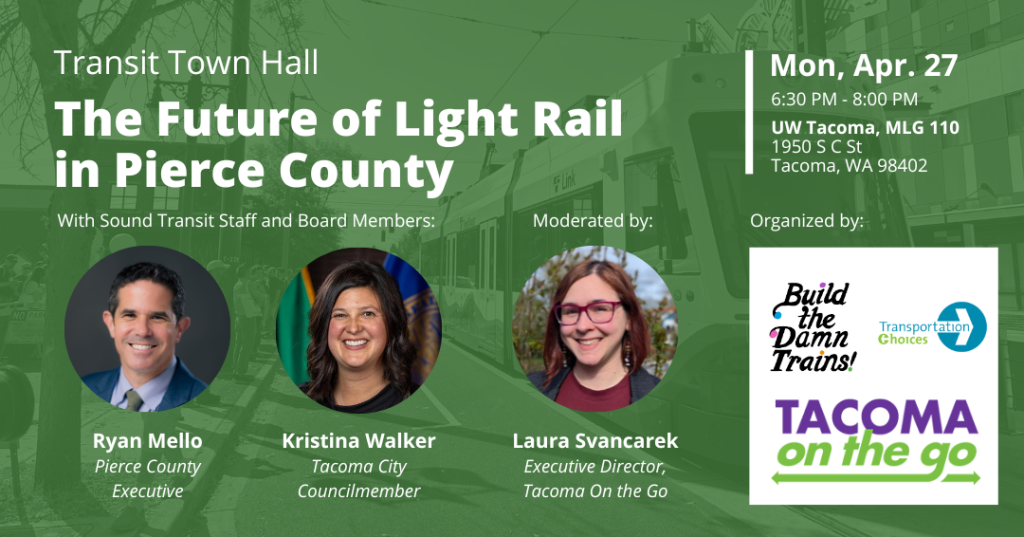
Transportation Choices Coalition and Snotrac will be hosting another Sound Transit Town Hall event in Tacoma on April 27.
Date: Monday, April 27
Time: 6:30 PM – 8:00 PM
Location: MLG 110, UW Tacoma
Address: 1950 S C St, Tacoma, WA 98402
Panelist will be Pierce County Executive Ryan Mello, Tacoma City Councilmember Kristina Walker and Sound Transit Staff. The event will be a hybrid town hall with a brief presentation from Sound Transit on the Enterprise Initiative, a structured Q&A and then an open Q&A. The event is organized in partnership with Tacoma on the Go and the conversation will be moderated by Tacoma on the Go Executive Director, Laura Svancarek.
To register, visit https://transportationchoices.org/transit-town-hall-the-future-of-light-rail-in-pierce-county-april-27/

Author: Mario Lotmore