


OLYMPIA — The Office of Financial Management has warned state agencies that Washington faces “significant budget shortfalls” in the 2027-29 biennium, calling it likely the most “most challenging budget any of us has yet faced” and directing a sharp break from routine spending practices.
“A ‘business as usual’ approach will not meet the need of this moment – and OFM will be working with each of you to reimagine what it looks like to continue providing essential services to the public while also addressing the budget shortfall,” wrote K.D. Chapman-See, Director of Office of Financial Management. “We recognize reductions necessary to address this shortfall will come on top of billions in reductions adopted in the last 16 months, making these further savings additionally challenging without significant impacts to services the state provides.”


In a letter sent to agency directors on June 5, OFM Director Chapman-See described a fiscal outlook in which costs for core services are rising far faster than available revenue. Inflation, population growth, federal funding cuts, economic uncertainty and court-mandated spending are all squeezing the state’s operating and transportation budgets, the letter states.
“To be direct, there will be significant budget shortfalls next biennium in both operating and transportation budgets,” Chapman-See wrote. “I want to be clear that we do not yet know precisely how significant the shortfalls will be.”




Chapman-See’s warning arrives just over two months after the Legislature closed a roughly $2.3 billion gap in the current 2025-27 biennium budget with a supplemental budget that raised the two-year operating total to $80.2 billion in near general fund-outlook dollars—the highest total operating budget so far in state history. That adjustment followed an original enacted budget of $77.9 billion passed in March 2025.

According to Chapman-See, inflation has climbed 39 percent over the past decade, meaning a service that cost $100 in 2016 now costs $139; and the state’s population has grown 14.2 percent, or more than 1 million people, between 2015 and 2025. Both trends, she wrote, have driven up demand for K-12 education, Medicaid, corrections and other services while simultaneously increasing the state’s own costs for utilities, construction, fuel and materials.

“This year’s revenue forecasts will likely not provide sufficient support for the maintenance of current programs, let alone any expansions, despite recent tax code changes,” the letter states.
OFM specifically cautioned agencies against counting on revenue from the new Millionaires Tax enacted in spring 2026. Collections will not begin until fiscal year 2029, with 42 percent of the projected revenue earmarked for rebates to small businesses, families and consumers, and the real risk that the tax could be reduced or eliminate the anticipated dollars if the court challenge or potential ballot measure is successful.
Chapman-See directed agencies to submit budget requests focused solely on mandatory increases in legally required caseloads or workloads; and recommended no new programs or expansions of existing services.
She further stressed that agencies must identify immediate savings, efficiencies and program reforms, particularly in non-essential areas.

In response to OFM’s warning letter, Governor Bob Ferguson asked agencies to scrutinize programs created or expanded after Jan. 1, 2019, and areas where Washington offers especially high levels of service compared with other states.
“My team and I are working closely with our agencies regarding our budget outlook,” Ferguson wrote in a statement on X. “This letter from the Office of Financial Management Director lays out the challenge well. … I’m meeting with our agencies and communicating my goals: Preserve core services, protect our state’s most vulnerable, don’t raise taxes, and address the structural challenges in our budget to achieve long-term financial stability and protect our AAA bond rating.”
Republican lawmakers and fiscal watchdog group Washington Policy Center responded sharply, arguing that OFM’s warning confirms a long-predicted spending problem rather than a temporary revenue shortfall.
Rep. Travis Couture, R- Allyn, ranking member of the House Appropriations Committee, pointed to his “Affordability First” framework introduced Dec. 18, 2025. That plan, he said, would have closed the current biennium’s gap without new taxes by identifying nearly $4 billion in savings and waste while restoring spending limits tied to inflation and population growth.
“Just a reminder…we could’ve had a balanced, no new taxes budget that I proposed in December 2025 that preserved the essentials, fixed problems, and cut $4B in waste,” Couture said in a statement on X.

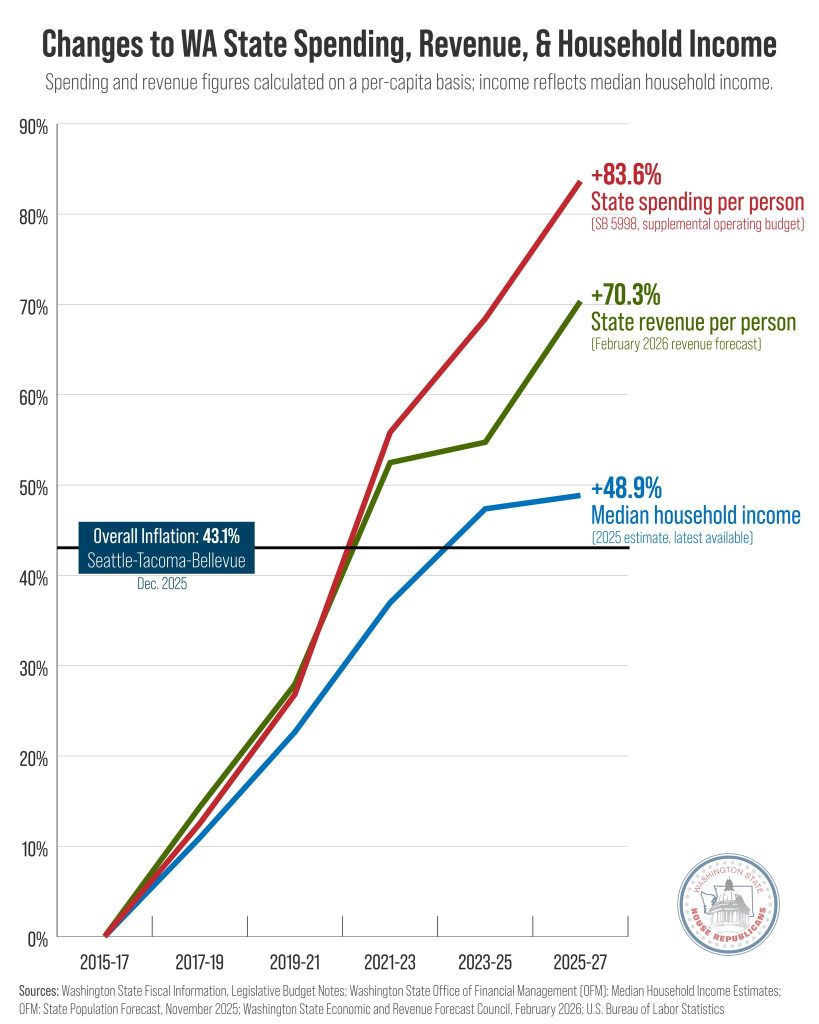
Ryan Frost, director of budget and tax policy at the Washington Policy Center, said the data contradict OFM’s emphasis on external factors alone. Over the past decade, Frost said that although inflation rose 39 percent and population grew 14.2 percent, state spending outpaced both by a wide margin—83.6% according to House Republicans.
“Outpacing inflation and population growth by this margin for years shows this is a spending problem,” Frost wrote on X. “Don’t let them rewrite the truth.”
Ten years in the making
The OFM letter arrives after a decade in which the state’s near general fund-outlook operating budget roughly doubled, from approximately $38 billion to $39 billion for the 2015-17 biennium to $80.2 billion after the 2026 supplemental for 2025-27. That growth far exceeded population gains of 14 percent since 2015, inflation of 39 percent over the decade, and median household income growth of roughly 54 percent.
OFM attributes the emerging 2027-29 biennium budget shortfall primarily to mandatory cost pressures — inflation, population-driven caseloads, federal funding reductions and court decisions. Yet critics, including former Democratic Gov. Christine Gregoire, contend the roots lie deeper in legislative choices that repeatedly allowed spending to outrun realistic revenue.
In four consecutive biennia budgets, lawmakers in Olympia appropriated (allocate funds to spend) more than projected revenues: $1.9 billion over in 2019-21, $2.6 billion over in 2021-23, $4.1 billion over in 2023-25 and $3.4 billion over in 2025-27. Budget writers routinely assumed a 4.5 percent annual revenue growth under the four-year balanced-budget law, even though actual collections in the 2023-25 cycle averaged only 1.85 percent—vastly overestimating realized revenue gains.
Major policy decisions compounded added to the current budget crisis:
- Full implementation of the McCleary Supreme Court ruling locked in permanently higher K-12 funding.
- The 2021 capital gains excise tax and later expansions of early learning under the Fair Start for Kids Act added ongoing costs that were partly funded with temporary federal pandemic aid. When that aid expired, the state absorbed roughly $1 billion or more in maintenance-level expenses.
- Legislators also used one-time sources — sweeping more than $2.3 billion from the Budget Stabilization Account between 2021 and 2023 and raiding more than 40 dedicated accounts, including transportation funds, for $1.2 billion in the 2025-27 budget — to support recurring programs.
- Also, the legislature chose to defer major costs such as pension liabilities and self-insurance shortfalls into future biennia budgets.
Former Governor Gregoire, who left office in 2013 with a budget of roughly $33 billion, delivered unusually blunt criticism of the current fiscal trajectory on May 6, 2026, at the Association of Washington Business summit.
“I left office with a budget of $33 billion, and the budget today is $80 billion. I think that’s a little bit too much of a growth,” Gregoire said. “I would suggest to you we don’t really have an income problem; we have a spending problem.”
She warned that repeated shortfalls, volatile new taxes and unpredictability for businesses had reached a tipping point for the state’s competitiveness.
The House Republican “Affordability First” framework released for the 2026 session and rejected by the majority party, offered a contrasting path that its authors say would have prevented much of the current pressure.
The plan proposed $3.7 billion in targeted reductions, efficiencies and program eliminations over the outlook period — none of which would reduce benefits or K-12 classroom spending. Savings would come from middle-management cuts, realigning higher-education administrative staff that grew 52 percent while enrollment fell 11 percent, adjusting public-employee health benefit cost shares, shifting the Working Families Tax Credit to Climate Commitment Act funds, eliminating the Apple Health Expansion for undocumented immigrants and recapturing misused community reinvestment account dollars.
The framework also called for restoring inflation-plus-population expenditure limits modeled on the 1993 voter-approved Initiative 601, with excess revenue directed to a new Tax Relief Account. It would require zero-based budgeting reviews of 20 percent of the state budget every biennium, forcing agencies to justify every program.
If implemented earlier, according to the proposal, the spending caps alone would have generated at least $15 billion in cumulative tax relief since the 2013-15 biennium—a cost avoidance of approximately $1,875 for every man, woman, and child in Washington state as of 2026.
Targeted restorations in the Republican plan — reversing $782 million in Medicaid cuts, adding $65 million for distressed hospital grants, $34 million for expanded Basic Food assistance for veterans, foster children, seniors and the homeless, and funding for the Pediatric Interim Care Center and wildfire prevention — would have been offset within the $3.7 billion in identified savings, leaving room to close the $4.3 billion deficit lawmakers faced entering the 2026 session.
Rep. Couture has argued that adopting such discipline would have stabilized the 2025-27 biennium without the $9.2 billion in new taxes enacted in 2025 and would have positioned Washington state to avoid the new 2027-29 budget crisis.
OFM’s current recommendations for the coming 2027-2029 budget cycle effectively adopts some of the same themes Republicans have long advocated — no new programs, aggressive pursuit of efficiencies, and a hard look at post-2019 expansions — while stopping short of the structural reforms such as binding expenditure limits or mandatory zero-based reviews.
Gov. Ferguson has on Saturday committed to “preserving core services” and protecting the “most vulnerable” without raising taxes, but the scale of the still-uncertain 2027-29 gap will test whether those goals are attainable through efficiencies alone.
Agency budget requests are due to OFM on September 14, and Ferguson’s is expected to deliver a budget proposal no later than December 2026. The Legislature will take up the 2027-29 operating, transportation and capital budgets in what is setting up to be fiscally- conscious 2027 legislative session.

Author: Mario Lotmore





2 Responses
How much of the 14.2% population growth generated new revenue???
Did Governor Ferguson’s campaign propose no new taxes? How did we get 9.2 Billion new taxes?