

WASHINGTON, D.C. — NASA has selected proposals from five Washington state companies to help mature technologies supporting the agency’s goals of establishing a sustained human presence on the Moon and enabling crewed missions to Mars.
“Five Washington State companies were selected for the NASA collaboration opportunity awards — projects that will advance launch and propulsion systems, next-generation space infrastructure, and more,” Senator Maria Cantwell, Ranking Member of the Senate Committee on Commerce, Science and Transportation, released in a statement to the Lynnwood Times. “This recognition by NASA reflects the strength of Washington’s leadership in aerospace manufacturing and innovation across the full space supply chain.”



The selections come from NASA’s 2025 Announcement of Collaboration Opportunity, or ACO, administered by the agency’s Space Technology Mission Directorate.
NASA selected 41 proposals from 37 companies overall under the 2025 ACO. The five Washington companies and their projects are:




- Aerojet Rocketdyne of DE, Inc., based in Redmond and an L3Harris Technologies company, will work on Advanced Electric Propulsion system Hall Current Thruster Affordability Improvements. The effort targets more affordable electric propulsion systems for space transportation.
- Blue Origin, LLC, based in the Kent area, will conduct a Space to Surface Deceleration Capabilities Assessment. The project evaluates technologies for slowing spacecraft during descent from orbit to planetary surfaces.
- Starcloud Inc., based in Redmond, will pursue a Flight Demonstration of High-Performance Computing for In-Orbit Autonomy and Exploration. The work focuses on onboard computing to support greater spacecraft autonomy.
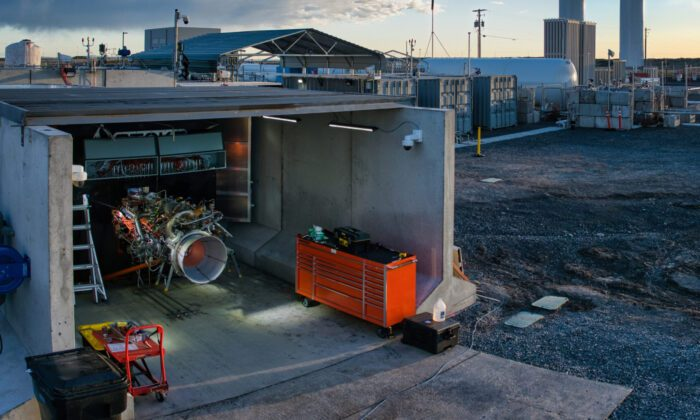
- STOKE Space Technologies, based in Kent, will advance its Nova Stage 2 Entry, Descent, and Landing capabilities. The company will use NASA Ames Research Center’s hypervelocity free-flight test facilities along with NASA expertise in aerodynamics and guidance, navigation, and control.
- Zeno Power Systems, based in Seattle, will perform Irradiation Testing of Sunpower Robust Stirling Convertor Organics. Zeno develops compact nuclear batteries that generate reliable power from radioisotope heat for use in harsh environments such as the lunar surface.
“We are excited…for a new partnership to advance upper stage re-entry capabilities of Nova, our fully reusable launch vehicle,” STOKE Space wrote on its website. “We’re excited and proud to partner with NASA again. We received a Small Business Innovation Research (SBIR) award in 2020 to develop a novel rocket engine configuration that resulted in the Stage 2 Andromeda integrated engine and regeneratively cooled re-entry heat shield.”


NASA’s Space Technology Mission Directorate develops, demonstrates, and transfers new space technologies to enable future NASA missions while supporting commercial and other government applications. It focuses on cross-cutting capabilities that advance exploration to the Moon, Mars, and beyond.

The ACO creates unfunded partnerships between NASA and U.S. industry. Selected companies gain access to NASA’s specialized facilities, software, hardware, and subject-matter experts to accelerate technology maturation. No NASA funding changes hands. The resulting Space Act Agreements typically last 12 to 24 months and benefit both commercial markets and future government missions.
Since the program began in 2015, NASA has supported more than 110 ACO projects with the agency contributing an estimated $30 million in resources while industry partners investing some $32 million.
Greg Stover, director of the Advanced Research and Technology Division in NASA’s Research and Technology Mission Directorate, said the selections empower American industry as active partners.
“By tapping into commercial industry, NASA can rapidly develop key capabilities to support its most ambitious missions while fostering the nation’s robust space economy,” he said in the June 26 announcement.

Current and future proposal opportunities, including any open appendices, are posted on NASA’s NSPIRES solicitation system and SAM.gov. Companies interested in partnering should monitor those sites for the latest announcements and submission deadlines.

Author: Mario Lotmore