

OLYMPIA — Washington Attorney General Nick Brown on Thursday joined a coalition of more than two dozen states and governors in filing a new federal lawsuit challenging three set of conditions that the Department of Homeland Security (DHS) and the Federal Emergency Management Agency (FEMA) have placed on billions of dollars in emergency preparedness grant funding.
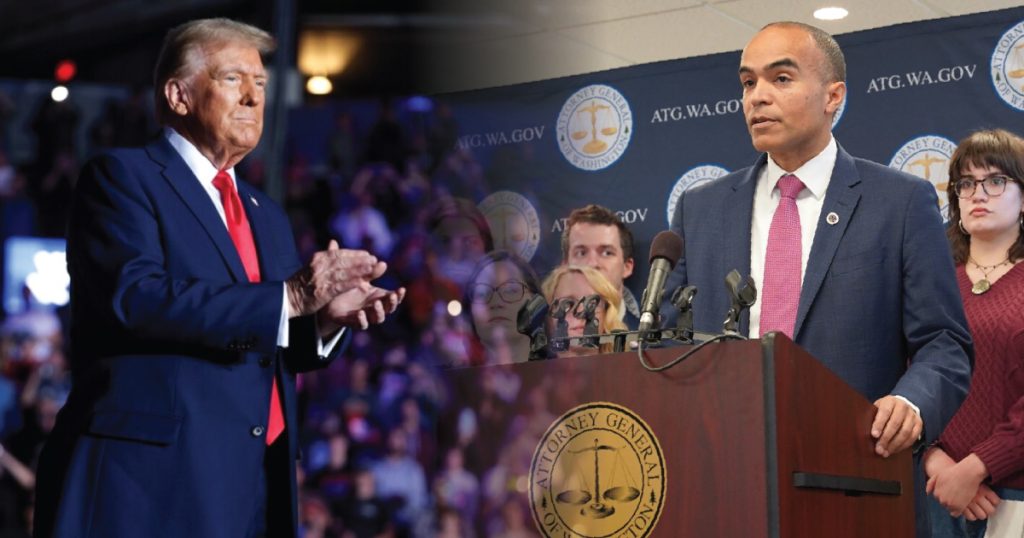
“Using this funding as a bargaining chip is shameful politics by the Trump administration,” AG Brown wrote. “I’m gratified the judge saw through this blatantly illegal effort to withhold critically important funds that keep Washingtonians safe.”


The complaint, filed in U.S. District Court for the District of Rhode Island as Case No. 1:26-cv-00485, seeks declaratory and injunctive relief against what the plaintiffs describe as continued efforts by the Trump administration to leverage critical funding streams. Brown, whose office co-signed the filing called what the Trump administration doing an illegal attempt “to coerce states into complying with the federal administration’s political agenda” on sweeping immigration enforcement and election integrity.
The lawsuit asserts that DHS and FEMA continue to press ahead despite losing two similar lawsuits in 2025 to Brown—DHS’s efforts to condition billions in federal emergency funding on states’ agreement to enforce federal immigration law and DHS’s subsequent attempt to unlawfully reallocate federal homeland security funding. It challenges three sets of requirements—election, immigration, and termination—attached to fiscal year 2026 funding notices and standard terms that again attempt to “coerce the states into complying with the administration’s policy priorities.”




For Washington, the AG Office says, the grants at issue support local governments improve cybersecurity, train maritime police officers in the Puget Sound region, assist the town of Malden in rebuilding following a devastating fire, and retrofit water storage facilities in the Cascadia Subduction Zone to avert damage in the event of an earthquake.


The state has been allocated more than $5 million in State Homeland Security Program funds, about $11.2 million under the Urban Area Security Initiative for the Seattle-Tacoma-Bellevue area, and roughly $7.2 million in Emergency Management Performance Grant dollars for fiscal year 2026, according to tables in the complaint. Those amounts form part of more than $740 million in Homeland Security Grant Program allocations to the plaintiff states overall.

FEMA has indicated it will withhold 20 percent of each recipient’s total Homeland Security Grant Program award until compliance is verified. Separate DHS guidance warns that sustained noncompliance could lead to suspension or full termination of the award under federal regulations
The first set of challenged requirements, known as the Election Conditions, appears in a revised Homeland Security Grant Program notice of funding opportunity issued July 9. Under a new national priority area for enhancing election security, states must do the following:
- Devote at least 3 percent of their State Homeland Security Program and Urban Area Security Initiative awards to related investments.
- Must submit a plan to transition from electronic voting systems that rely on bar codes or QR codes to equipment that reads only hand-marked paper ballots.
- Must prove compliance with a post-election 5 percent manual audit conducted under guidelines to be set by the DHS secretary.
- Must reconcile the number of voters who cast ballots in each federal election with the number of ballots counted, using methodology established by the secretary.
- Must verify the citizenship of every person listed in the state voter registration database within 120 days of accepting the award by using the Systematic Alien Verification for Entitlements system operated by U.S. Citizenship and Immigration Services, and then remove verified noncitizens.
- Must also verify the citizenship of every individual working at polling places or operating election systems and bar noncitizens from those roles.
The second set of challenged requirements, known as the Immigration Conditions, states must share information under 8 U.S.C. §§ 1373 and 1644, honor requests for joint operations or short-term detention under detainers, provide federal agents access to detainees, avoid publicizing enforcement operations, and certify that they operate no programs benefiting illegal immigrants or incentivizing illegal immigration.
The third set of challenged requirements, known as the Termination Conditions, expands FEMA’s power to end awards. For discretionary grants, the agency may terminate “for convenience, including if the award no longer advances the national interest.” More broadly, it may terminate if an award no longer effectuates program goals or agency priorities—including if an objective proves ineffective, the program design is flawed, the award is not aligned with DHS or FEMA strategic plans, or the agency later changes its priorities.
“This constant threat of termination undermines the processes these critical programs rely on to be effective,” the AG’s Office stated in its release. “A federal court recently rejected the Trump administration’s attempts to interpret existing regulation in the same way.”
Across all three sets of conditions, the plaintiffs allege violations of the Administrative Procedure Act on grounds that the agencies acted contrary to law, in excess of statutory authority, and in an arbitrary and capricious manner by failing to consider reliance interests, statutory constraints or relevant data. They also assert Spending Clause violations, arguing the conditions are impermissibly ambiguous, unrelated to the federal interest in counterterrorism and emergency preparedness, and unconstitutionally coercive because they place critical multiyear funding at risk.
Joining Brown in filing the lawsuit are the attorneys general of Arizona, California, Colorado, Connecticut, Delaware, District of Columbia, Hawaiʻi, Illinois, Maine, Maryland, Massachusetts, Michigan, Minnesota, Nevada, New Mexico, New Jersey, New York, North Carolina, Oregon, Rhode Island, Vermont, Virginia, and Wisconsin, as well as the governors of Kentucky and Pennsylvania.

Author: Mario Lotmore