

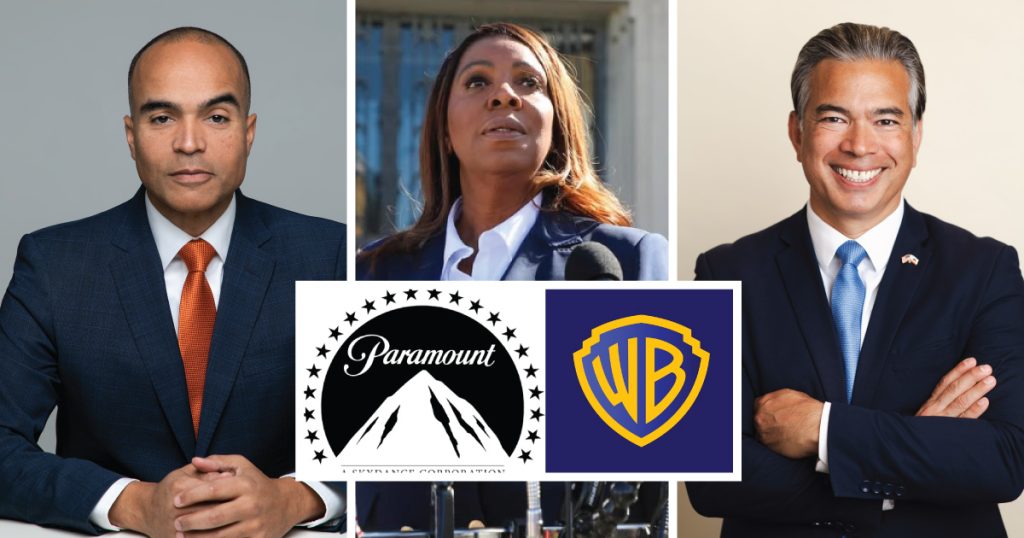
SEATTLE—Washington Attorney General Nick Brown, California Attorney General Rob Bonta, New York Attorney General Letitia James, and a coalition of 9 other attorneys general today secured a months-long halt to Paramount Skydance Corp.’s (Paramount) $110 billion takeover of Warner Bros. Discovery, Inc. (Warner Bros.).
On July 13, Attorney General Brown and the coalition sued Paramount and Warner Bros., alleging that their merger would illegally reduce competition throughout the film and television industries, harming workers, consumers, and businesses. On Monday, July 20, granted a temporary restraining order that blocks Paramount Skydance Corp. from closing its proposed $110 billion acquisition of Warner Bros. Discovery Inc. for at least 14 days and prevents the two companies from integrating their operations in the meantime. Today, the coalition secured a stipulation from Paramount and Warner Bros. that will delay the merger until after a court ruling on the merits of the lawsuit or June 1, 2027, whichever is earlier.

“Our argument against this illegal merger is straightforward: When too few corporations have too much power in markets central to American life, it makes things more expensive, and it makes things worse,” said Attorney General Bonta. “Today’s agreement is great news for audiences, movie theaters, and the many people who write, build, and create the art, news, and entertainment so many of us enjoy. We are eager to continue to make our case in court and celebrate another tremendous win in our effort to ensure this unlawful merger never sees the light of day.”
In a statement, a Paramount spokesperson shared that this is what they wanted, a full trial on the merits.




“Today’s agreement is a significant win because the result is exactly what we have sought from the outset: a direct path to a trial based on the evidence,” wrote the spokesperson. “This is the fastest and clearest way to prove that this transaction is good for competition, good for consumers, and good for creators, a conclusion dozens of competition authorities around the world have already reached. Plaintiffs’ market definitions bear no relationship to the realities of today’s marketplace and cannot withstand scrutiny. We look forward to proving our case at trial.”

As part of today’s deal, Warner Bros./Paramount agree not to merge until 5 days after a decision on the merits of the states’ challenge or until June 1, 2027, whichever comes earlier. If the court finds in favor of the states, the merger would be blocked pending appeal. If there are no merits determination by June 1, 2027, the states can file a motion for a preliminary injunction.

For more than a century, Warner Bros. and Paramount have stood astride the film and television industry as independent sources of creativity and competition. The lawsuit alleges that the merger violates Section 7 of the Clayton Act, which holds that mergers that may substantially lessen competition or tend to create a monopoly are illegal. The attorneys general allege that, if Warner Bros. and Paramount are allowed to merge, it would lessen competition in three markets: film distribution, anticipated blockbuster film distribution, and licensing cable TV channels.
Democracy Defenders Fund is a nonprofit founded in 2023 by former U.S. Ambassador to the Czech Republic Norm Eisen, a Barack Obama appointee. It advocates for defending the rule of law, fighting corruption, protecting elections, and resisting what it views as threats to American democracy
In a statement on the pausing the merger the organization wrote:
“The Ellisons believed their relationship with President Trump would help them push through a disastrous deal that threatened democracy, creative freedom, and independent journalism. We in the #BlocktheMerger campaign helped prove them wrong.
“Paramount’s decision keeps two major studios competing instead of handing one company even more power over what Americans watch, what they pay, and where entertainment workers can earn a living. The merger would have eliminated one of Hollywood’s largest buyers of scripts and productions while placing Paramount+, HBO Max, CBS News, CNN, and dozens of local stations under the management of one company.

“This victory in putting the merger on hold belongs to the people who refused to treat the merger as inevitable. Artists, journalists, filmmakers, and consumer advocates spoke out despite the risk of retaliation, more than 5,500 people signed our open letter, and Attorneys General Rob Bonta and Letitia James, along with 10 other attorneys general, acted. This collective resistance is turning the tide.”
Background
Today’s agreement came following a lawsuit filed July 13 by the attorneys general of 12 states, including Washington, that sought to stop the transaction under Section 7 of the Clayton Act. Brown is co-leading the state-led antitrust lawsuit with the attorney general of California. They are joined by the attorneys general of Arizona, Colorado, Connecticut, Massachusetts, Minnesota, Nevada, New Jersey, New Mexico, New York, and Oregon.
Large mergers like this one are normally reviewed by the Department of Justice or Federal Trade Commission at the federal level for antitrust clearance. However, states have independent authority to challenge mergers they believe harm competition within their borders.
David Ellison, chairman and CEO of Skydance Media and staunch ally of President Doanld J Trump, is the driving force behind Paramount Skydance’s efforts to acquire Warner Bros. Discovery. His father, Larry Ellison, who is the co-founder of Oracle, reportedly gave roughly $45 million to a political nonprofit supporting Trump’s 2024 re-election campaign.
The proposed merger, announced February 27, would combine two of the five major Hollywood film studios and two of the five largest owners of basic cable channels. According to the complaint, the combined company would control Paramount Pictures and Warner Bros. Pictures, the CBS broadcast network and 15 owned-and-operated stations, more than 50 basic cable channels spanning news, sports, children’s, and lifestyle programming, premium channels Showtime and HBO, and three streaming services. It would also hold rights to major franchises including Top Gun, Mission: Impossible, Star Trek, Batman, Harry Potter, and Lord of the Rings, along with rights to events such as March Madness and MLB games.


The Plaintiff States allege the deal would eliminate direct competition between Paramount and Warner Bros. in the distribution of wide-release theatrical films and in the licensing of basic cable channels to distributors. They contend the transaction would create a media company that pockets more than a quarter of every dollar generated by wide-release theatrical films and basic cable channels in the United States. Post-merger concentration would leave only four distributors controlling more than 85 percent of wide-release theatrical films and only two companies controlling 59 percent of basic cable.
The complaint describes how Paramount and Warner Bros. currently negotiate separately with thousands of theaters nationwide over revenue splits, minimum ticket prices, caps on discounts and complimentary tickets, and exclusivity windows. Competition between the two studios, the states allege, gives theaters leverage to secure better terms and encourages distributors to invest in creative, high-quality releases. Without that rivalry, theaters would likely face demands for larger revenue shares, stricter caps, and fewer new films. Those costs would then pass to theatergoers through higher ticket prices, reduced investments in amenities such as luxury seating and premium screens, and a narrower selection of movies, the lawsuit claims.
The states further allege heightened harm in the segment of anticipated top-grossing theatrical films. Over the past four years, five distributors including the defendants accounted for approximately 95 percent of such films by box office revenue. After the merger, only four distributors would remain, with the combined company and Disney controlling roughly 60 percent. The complaint argues that reduced competition around these event films would amplify pressure on theaters and audiences.
In the basic cable market, the complaint states that distributors currently bargain separately with each company and can use the existence of an independent alternative to resist blackout threats. A combined portfolio of more than 50 channels would give the merged firm substantially greater leverage, the states allege, leading to higher carriage fees and reduced investment in content by distributors and, ultimately, higher costs or fewer options for subscribers.
The complaint asserts that new entry or expansion by rivals would not replace the lost competition. Theatrical distribution at scale requires established nationwide theater relationships and valuable intellectual property developed over generations. Basic cable programming requires launching multi-network portfolios to secure carriage. The states also contend that claimed efficiencies do not justify the competitive harms.
Judge Martínez-Olguín applied the four-factor test from Winter v. Natural Resources Defense Council, Inc. She noted that the standard for a TRO is the same as for a preliminary injunction and that, when the government is a party, the balance of equities and public interest merge. Because the Plaintiff States would be entitled to relief if they made a sufficient showing in any one relevant market, the court focused on the distribution of wide-release theatrical films.
Judge Martínez-Olguín found that the states raised serious questions going to the merits under the burden-shifting framework for Section 7 claims—a merger resulting in significant increased concentration creates a presumption that it is likely to lessen competition substantially.
The Plaintiff States presented evidence, including from their expert declaration, that the combined firm would hold approximately 27 percent market share in wide-release theatrical distribution. Precedent establishes that a 30 percent share creates a presumption of illegality. The states also showed the transaction would increase the Herfindahl-Hirschman Index by approximately 359 points to a post-merger level of 2,074. Increases of more than 200 points in already concentrated markets are presumed to enhance market power.
Defendants offered a competing economic expert who challenged the states’ assumptions about theatrical economics and argued the absence of significant entry barriers. The court determined that this evidence created factual disputes but did not rebut the presumption of anticompetitive effects at the TRO stage, where a full record is not yet available. The judge expressly declined to accept defendants’ argument that efficiencies in the streaming market could justify the merger in the relevant theatrical market, citing precedent that efficiencies ancillary to competition in the relevant market do not provide a defense.
On irreparable harm, the court held that a lessening of competition constitutes irreparable injury. It further found that allowing the transaction to proceed would make unwinding extraordinarily difficult because of anticipated consolidation of operations, sharing of business-sensitive information, and potential termination or reassignment of employees.
The order on July 20 temporarily enjoins Paramount Skydance Corp., Warner Bros. Discovery Inc., and all persons in active concert with them from closing or consummating the transaction or taking any steps to integrate or consolidate their operations. It waives the bond requirement under Federal Rule of Civil Procedure 65(c) because the Plaintiff States are enforcing important public interests. The TRO remains in effect for 14 days unless extended for good cause.

Author: Mario Lotmore