

BOSTON — A three-judge panel of the U.S. Court of Appeals for the First Circuit on July 25 denied emergency motions by the Trump administration and 12 intervening states seeking to stay a lower-court injunction that blocks key provisions of a presidential executive order on mail-in ballots and citizenship verification lists. The decision leaves in place restrictions preventing the U.S. Postal Service from finalizing certain mail-ballot rules and the Department of Homeland Security (DHS) from distributing federal citizenship lists in 23 states and the District of Columbia for federal elections occurring on or before Nov. 3, 2026.
“The federal defendants and 12 states that intervened in the case in support of the executive order have now filed separate motions seeking a stay of the district court’s injunction pending appeal, arguing only that the Plaintiff States lack standing to bring their claims and that those claims are not ripe” wrote the appeals court, “We deny their motions.”

The order, entered by Circuit Judges Gustavo A. Gelpí Jr., Julie Rikelman and Joshua D. Dunlap, rejected arguments that the plaintiff states lacked Article III standing or that their claims were unripe. Gelpí and Rikelman, both Biden appointees, formed the majority in denying the stay in full. Dunlap, a Trump appointee, concurred in part and dissented in part, writing that he would have partially stayed the injunction as to one section of the executive order.
The underlying dispute stems from Executive Order 14399, titled “Ensuring Citizenship Verification and Integrity in Federal Elections,” which President Donald J. Trump signed on March 31, 2026, which specifically targets voting by mail—a voting process made mandatory in Washington state since 2011 with the passage of Senate Bill 5124 and signed into law by Gov. Christine Gregoire.


According to the EO, the Department of Homeland Security, in coordination with other agencies, to compile and transmit to state election officials lists of individuals confirmed as U.S. citizens who will be 18 or older at the time of an upcoming federal election and who maintain a residence in the relevant state. Those lists, known as DHS Citizenship Lists, are to be provided no fewer than 60 days before each regularly scheduled federal election—by September 4, 2026, for the November 3 general election in Washington state. It also orders the attorney general to prioritize investigation and prosecution of state and local officials who issue federal ballots to individuals deemed ineligible, as well as entities involved in printing or distributing such ballots.

DHS Sec. Markwayne Mullin has stated publicly that he will pursue criminal charges against state election officials who won’t submit voters’ records to run through this system Democracy Docket reports.

Federal officials are also given authority, based on the EO, to take lawful steps to deter noncompliance, including possible withholding of federal funds and referral of evidence of violations for investigation or charges. It also requires states and localities to preserve election-related records for five years.
Section 3 of the EO directs the postmaster general to initiate proposed rulemaking within 60 days to protect the integrity of the mail in federal elections by requiring a specific design for the envelopes used by state and local officials for voting by mail, including specific markings and unique barcodes—something Washington state already does. The proposed rule is to also provide that all outbound ballot mail must be mailed in such envelopes and that the Postal Service shall not transmit mail-in or absentee ballots from any individual unless the individual’s name appears on a state-specific list.
Any final rule must be issued no later than 120 days from the order’s date, or by July 29, 2026. The Postal Service published a proposed rule on June 2, 2026, titled “Ballot Mail for Federal Elections.” However, for Trump’s mail-in ballot rule to fully take effect nationwide, USPS would likely need to obtain an advisory opinion from the Postal Regulatory Commission. USPS has not yet filed a formal request for a PRC advisory opinion on this specific rule. The commission generally has up to 90 days to issue such an opinion after a formal request.
Because of the tight timeline before the November 2026 election, going through the full PRC process now would make it extremely difficult for USPS to finalize and implement the rule in time for this election cycle in a fully compliant way.
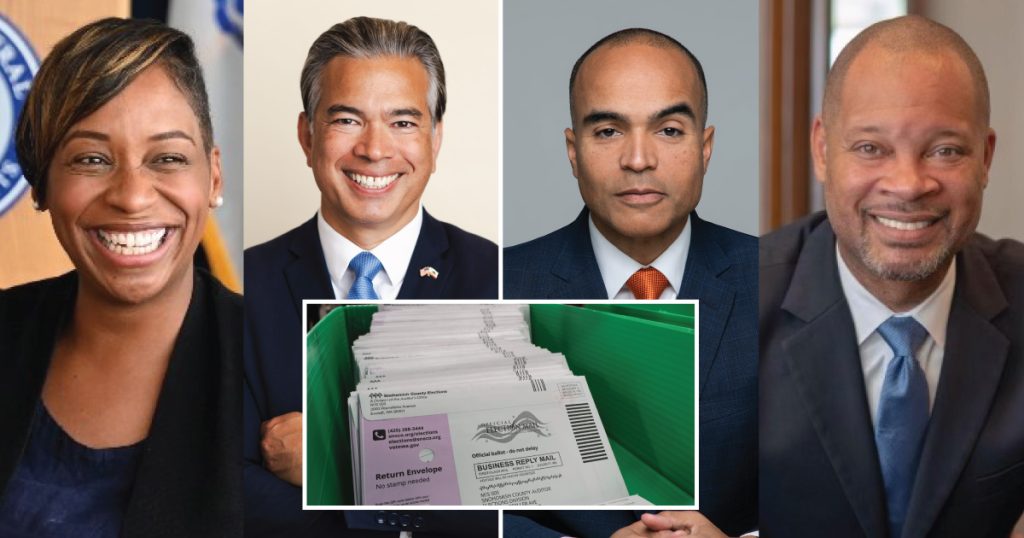
Attorney General Nick Brown along with the attorneys generals of California, Massachusetts, Nevada co-led a suit on April 3, 2026, with 19 other states, the District of Columbia and Pennsylvania Gov. Josh Shapiro, challenged Sections 2, 3 and 5 as ultra vires and unconstitutional under the separation of powers, the Elections and Electors Clauses, and the Tenth Amendment’s anti-commandeering doctrine.
“The President wants to control your vote,” wrote Brown in a press release announcing the filing. “He wants to tell the Postal Service what ballots they can accept and when. But this is patently unconstitutional. Mail-in voting is safe and legal in Washington. We will do everything we can to defend it. And come November, despite the president’s lawless threats, we’ll once again use that power to protect our democracy.”
U.S. District Judge Indira Talwani, an Obama appointee, who presided over the case, issued a 37-page order on June 25, granting the plaintiffs’ motion for summary judgment, declared key provisions of the executive order unconstitutional. She found that President Trump and USPS lacked authority to regulate state election procedures in this manner and enjoined implementation of the relevant sections against 23 states.
Talwani determined the plaintiff states had standing based on current and certainly impending injuries. These included planning and compliance costs already being incurred as states prepared for September primaries and the November general election, monetary costs from redesigning already-purchased mail-ballot envelopes to meet the order’s requirements, and a credible threat of criminal prosecution.
She also found that multiple sections of Trump’s EO implicitly threatened enforcement of federal criminal statutes against officials who furnished ballots to voters absent from DHS Citizenship Lists.
On July 7, Judge Talwani entered final judgment and declared Sections 2 and 3 of the EO ultra vires (beyond the power of) and violative of the separation of powers. She enjoined the federal defendants—excluding the president—from implementing the EO, giving effect to, or enforcing those sections as to the plaintiff states with respect to the November 3, 2026, election or any earlier federal election.
The federal defendants and intervenor states—Alabama, Missouri, Florida, Indiana, Kansas, Louisiana, Montana, Nebraska, Oklahoma, South Carolina, South Dakota and Texas—appealed Judge Talwani’s judgement and sought a stay pending appeal, arguing solely that the plaintiffs lacked standing and that the claims were not ripe.
In its July 25 order denying the stay, the First Circuit applied the four-factor test from Nken v. Holder for a stay pending appeal: the government bore the burden of making a strong showing of likelihood of success on the merits, irreparable injury absent a stay, lack of substantial injury to other parties, and that the public interest favored a stay.
The First Circuit Court’s decision on July 25 does not resolve the merits of the constitutional challenge to the EO; so the appeal technically remains pending. It also does not enjoin the president personally, nor does it prevent the federal defendants including 15 other non-plaintiff states from implementing the executive order ahead of the 2026 general election.
This ruling is separate from the D.C. Circuit decision on July 17, 2026, in NAACP v. USPS, which cleared the way for the U.S. Postal Service to move forward with a proposed rule requiring states to submit voter lists and use serialized barcodes on mail ballots for federal elections, at least temporarily lifting a lower court block tied to a 2021 NAACP settlement.
The D.C. Circuit’s temporary clearance of the path for USPS rulemaking under the settlement-based challenge does not override the First Circuit’s decision to leave the broader injunction in place against implementing the EO in Washington state, 22 other plaintiff states and D.C.
For the Trump administration, next steps include continuing the appeal in the First Circuit on the merits and, potentially, seeking emergency relief from the U.S. Supreme Court.
The decision now creates a patchwork for the 2026 midterm elections which could lead to a legal fight based on Equal Protection or Elections Clause claims arguing that federal rules cannot treat voters differently solely based on which states sue. Also, civil rights groups and/or candidates in non-plaintiff states may sue contesting election results if ballots are delayed or rejected under the new USPS rules.
In Washington state, the First Circuit ruling preserves the state’s established vote-by-mail system for the 2026 cycle, for now, unless congress passes the SAVE America Act or the U.S. Supreme Court offers a relief.

Author: Mario Lotmore