
SPOKANE — Governor Bob Ferguson requested a federal emergency declaration Sunday to mobilize additional federal resources as rapidly spreading wildfires force thousands of evacuations and destroy hundreds of structures across the state.
“Governor Ferguson has made the request for federal assistance,” Congressman Michael Baumgartner (R-WA05) posted to on X at 2:07 p.m., Sunday, August 2. “I was in the room with the Governor, Sen. Cantwell, Mayor Brown, Sheriff and state legislators as the call was made. I’m pleased that we are working in a good bipartisan fashion on this terrible fire.”

The request followed Ferguson’s statewide state of emergency declaration Saturday, which included a burn ban on most outdoor and agricultural burning through September 30. Governor Ferguson spoke with Homeland Security Secretary Markwayne Mullin about FEMA assistance. Rep. Baumgartner said Mullin committed to taking the request directly to President Donald J. Trump, who is aware of the situation.
Sen. Patty Murray, shared that she also spoke with Mullin, who “made clear the federal government will do everything it can to support response and recovery” and that assisting Washington residents is a “top priority.”



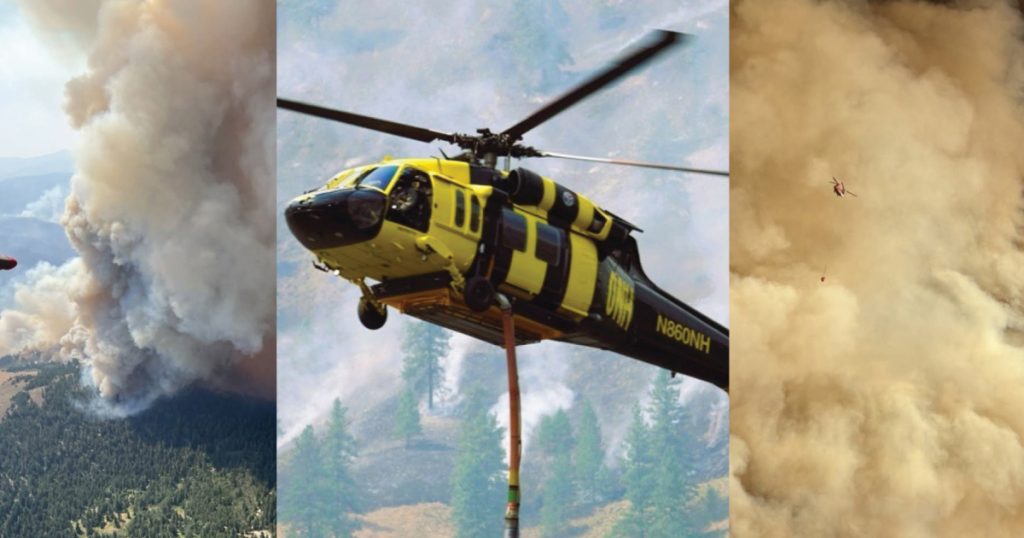
On Saturday, the situation escalated sharply around Spokane where fast-moving fires including the Old Trails Fire grew rapidly forcing thousands of evacuations and destroying hundreds of structures. The National Guard have been deployed and are providing aid to victims.

A federal emergency declaration, if approved, would unlock additional resources, funding and support beyond what a state-only declaration can provide.

In 2017, the Washington Department of Natural Resources adopted a 20-Year Forest Health Strategic Plan for Eastern Washington. The plan aimed to restore 1.25 million acres through thinning, prescribed fire and related treatments under an “all-lands, all-hands” approach involving state, federal, tribal, private and nonprofit partners.

DNR tracks progress in two ways. Footprint acres count each acre once even if it receives multiple treatments. As of Oct. 31, 2025, DNR and partners had treated 589,520 footprint acres across central and eastern Washington. Total treatment acres count every treatment, including sequential ones on the same land; the total stood at 1.14 million acres as of the same date.
Most acres require at least two treatments for resilience. Dense forests typically need both density reduction—thinning or fuel rearrangement—and surface fuel consumption which includes pile or broadcast burning. Across 45 priority planning areas with landscape evaluations, density reduction treatments are on pace to meet overall plan goals, with 29% to 40% of the need completed. Surface fuel consumption treatments lag, with 14% to 20% completed. Treatments have focused on high-priority locations, with 83% of forest management activities in areas identified as moderate, high or very high priority and those with high wildfire hazard potential.
In 2021, the Legislature unanimously passed House Bill 1168, sponsored by Rep. Larry Springer, D-Bellevue, creating the Wildfire Response, Forest Restoration, and Community Resilience Account. It committed $500 million over eight years—$125 million per biennium—for additional firefighters and foresters, helicopter upgrades, tens of thousands of acres of treatments and community grants.
Funding was reduced in the 2025 budget amendment amid a state budget shortfall to $60 million, below the biennium commitments. The account received about $130 million in the 2021-23 budget and roughly $115 million to $120 million in the 2023-25 budget.
In a December 2025 press release, Commissioner of Public Lands Dave Upthegrove said restoring the $60 million was his “No. 1 priority” for the 2026 legislative session. Lawmakers restored the funding through the 2026 supplemental budget (SB 5893), which Ferguson signed. The funds became available shortly after the budget’s enactment in early April 2026.
Rep. Shaun Scott (D-Seattle) with his bill HB 2089 in the 2026 session, did pass the legislature that dedicate a funding mechanism to the Wildfire Response, Forest Restoration, and Community Resilience Account by redirecting revenue from a tax preference related to community banks. The bill took effect on July 1, 2026.

Author: Mario Lotmore