

LYNNWOOD—As the City of Lynnwood continues its consideration of a wage theft ordinance, council received a wage theft research presentation conducted by Mayor George Hurst’s intern Issiah Sinclaire at council’s Work Session on Monday, August 3.
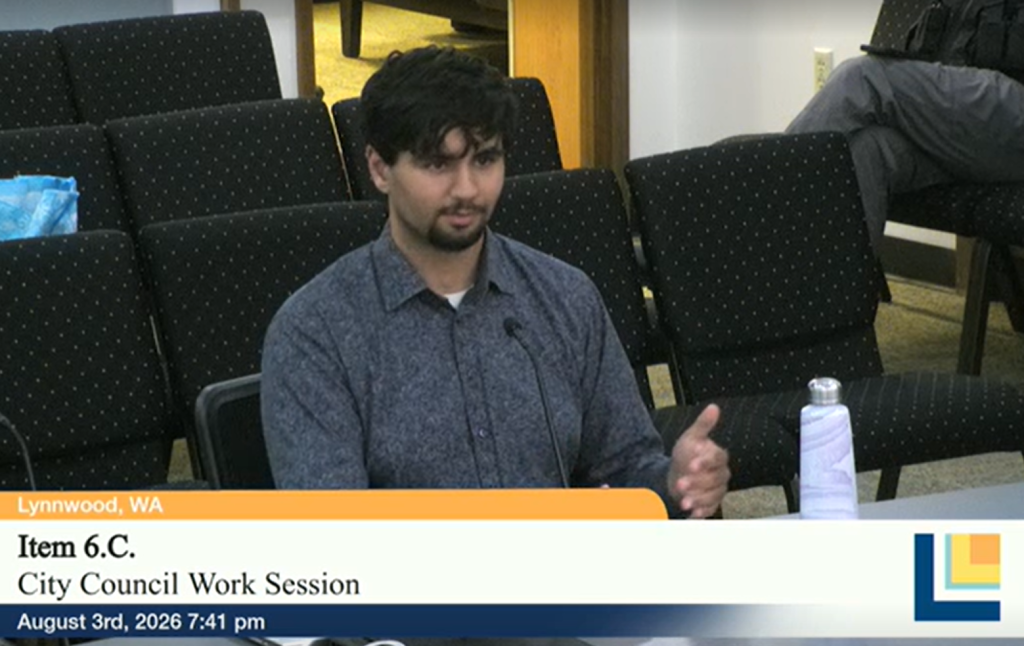
During that presentation, Sinclaire equated wage theft to larceny, resulting in a ripple effect that pushes workers below the poverty line, affecting marginalized groups disproportionately, increases workplace prevalence of disease and untreated injuries, makes honest employers less profitable, and reduces payroll taxes and income taxes.



“If we are going to make it illegal to steal items from a store, we should make it illegal to steal hours from our workers. It impacts workers more than stealing from a store, and that’s not to say we don’t care about business here, but a business can afford to lose merchandise way more than someone living paycheck to paycheck can afford to miss that paycheck,” said Sinclaire.
Several bodies work together to hold those committing wage theft accountable, from the federal level requiring recordkeeping, establishing overtime regulation, illegalizing retaliation, and having an investigative arm, to the state’s Labor and Industries and Attorney General Nick Brown’s Workers Rights Unit, to municipal agencies such as the Seattle Office of Labor Standards, and even private such as lawyers, compliance assistance companies, and advocacy groups.




As far as any type of wage theft ordinance, there have only been three in Washington State; Seattle, Burien, and Spokane. Though, according to Sinclaire, Seattle’s has been the most effective.


Sinclaire broke down what city of Lynnwood could do, as far as wage theft prevention, into three main categories – worker protections, investigations, and enforcement.
Protections include anything that could be turned into law in which workers have rights that they can reference in court. Examples of this include clarifying distinction between employees and independent contractors, being transparent about pay, guaranteeing adequate lunch and rest time, bridge financials gaps for affected workers, and ensure timely pay at a regular interval.
Investigation methods include a statute of limitations (extends to 6 years and pauses when a complaint is filed), flexible prioritization (which is a triage of high-impact cases rather than first-in, first-out), case referrals, which allow investigators to hand cases to state and federal agencies, random/preemptive audits, which target high-risk industries without requiring complaints, subpoenas, which add investigators and allow courts to issue subpoenas, communication, assigning contacts or trackers for complainants, community intel, listening for third party tips on wage theft, and suitable staffing.
Means of enforcement include enforcing larger penalties (treble or quadruple damages; inflation-adjusted penalty matrix), bringing charges (allow criminal charges and potential business license revocation), liens/shareholder payments (ensuring payment even if businesses dissolve and restructure), police involvement (treat wage theft as enforceable theft), and forced arbitration (limit or discourage forced arbitration via transparency or contracts).
According to Sinclaire’s presentation on Monday, around 18-25% of workers experience wage theft yearly, reaching as high as 68% of low-wage workers experiencing at least one weekly pay-related violation.
69% of workers experienced meal break violations, 43% of workers that report wage theft face retaliation and a further 20% don’t try because they fear it.
98% of wage-theft victims cannot file claims because employers impose forced arbitration agreements.
In Washington, an estimated 245,699 low-paid workers are subject to forced arbitration each year, and 62,604 abandon their claims annually. Stolen wages in Washington total $128 million annually.
Lynnwood’s vision for a potential wage theft ordinance program
The first step in creating wage theft protections in Lynnwood, according to Sinclaire, would be to work closely with Washington Labor and Industries to team up for resources while being conscious while alleviating their burdens.
Nxt would be to establish a resource hub for education and outreach followed by an official council ordinance while establishing a potential victims’ fund.
Later the mission would hopefully be expanded before the city adopted enforcement. The last step would be to innovate the program based upon its functionality and the changing landscape.
A program like this would require additional funding, Sinclaire added, but many of the options require no continuous funding (example: independent contractor definitions). Some options, on the other hand, pay for themselves (such as bonds). Additionally, Sinclaire noted that if there is no pay the city does not collect taxes on that pay, which, in turn, would add to the city’s revenue.
“Fighting crime is a necessary expenditure for a city, and a commercial hub like Lynnwood must pay special attention to business-related crimes,” said Sinclaire.
Another foreseeable challenge Sinclaire anticipated is unclear laws which, he said, could easily be solved with attention and intentionality. He suggested a summary of laws be made available online (following Seattle’s model), and including relevant resources provided by the government according to the 2022 Limited English Proficiency Plan (LEP) for the City of Lynnwood.
Additionally, employers should make resources available in the languages their employees speak, and a Lynnwood ordinance should match the language and structure present in Washington.
Sinclaire would also want to be cautious of not overburdening businesses or adding unnecessary “red tape.” He suggested that laws should consider the size of a business, as large enterprises can handle strict regulations more easily than small LLCs. Overburdening businesses could also make enforcement more difficult, he noted.
While government resources to fight crime are limited, Sinclaire acknowledged, one wage theft investigator working for the City of Lynnwood would be far more effective than current state and federal reach. For example, one wage theft federal covers approximately 278,000 people, at the state level one investigator covers 129,000 people, but for a potential Lynnwood investigator it would be about 40,000 people.
Recent wage theft incidents in Lynnwood
There are at least five known wage theft incidents that have taken place in Lynnwood over the last 5 years.
The first involves Royal India Cuisine which was charged with first degree theft and multiple counts of second-degree theft related to unpaid waged from 2021 through 2023. Washington Labor and Industries investigated 41 wage theft complaints that allegedly took place at the Lynnwood-based Indian restaurant, as well as 16 Notices of Assessment issued from 2021 through 2025. Royal India Cuisine owners plead not guilty.
The second involves Paradise Espresso of which the Washington Attorney General’s Office filed a lawsuit against in September 2025, in King County Superior Court, alleging unlawful sexual harassment/retaliation and wage-related violations (including failure to pay minimum wage for all hours, withholding tips, and sick-leave violations).
The third involves the ENSO Apartments construction, which the Lynnwood Times first broke the story on back in October 2025. These involve overtime-pay and sick-leave violations involving a drywall subcontractor. The investigation is still ongoing as of 2026.
The fourth involves Menchie’s Frozen Yogurt where the U.S. Department of Labor recovered back wages and damages for 330 workers after finding unlawful tip-taking and overtime violations across 11 stores in Washington and Oregon, including Lynnwood’s 2902 164th Street location.
Lastly, Zeek’s Pizza Lynnwood location was found to not disclose service charges for delivery drivers via the Seattle Office of Labor Standards. 257 current and former delivery drivers were awarded a total of $285,000. However, Zeeks remained in violation until 2022, pushing the total amount up to $410,000 when they settled with OLS (though strangely, the employees paid dropped to 224).
As of June 2026, Zeeks Pizza blamed the software vendor for the failed disclosures. Zeeks’ Lynwood location has since rebranded into Bocca Kitchen and Bar.

Author: Kienan Briscoe