


OLYMPIA [Aspen Ford] — Washington Gov. Bob Ferguson has been traveling the state to build support for his forthcoming legislation to ban cellphones in public schools.
On Wednesday, Ferguson promoted his “away for the day” plan at Pasco High School, where a phone ban is already in place.



“We find it hard to believe that we ever allowed smoking on airplanes, right?” Ferguson said. “That’s how we’ll view cellphones being available in classrooms.”
Under the proposal, cellphones would be banned at public schools from the first bell of the day to the last. The governor expects to release more details on the proposal Sept. 15 and pre-file a governor-requested bill on Dec. 7, the day that prefiling opens for the next legislative session.




If passed during the session, which begins in January, school districts would be required to implement the policy in September 2027.


“This is not a punishment, but a way to help us connect with the real world,” said Tais Borge, student board representative at Pasco High School.

When Borge was a new student, she said it was easy “to pretend I was doing something important on my phone instead of facing the discomfort of talking to people I didn’t know.”
“When I finally had enough courage to put my phone away and approach people, I discovered that it actually wasn’t as scary as it seemed,” Borge added.
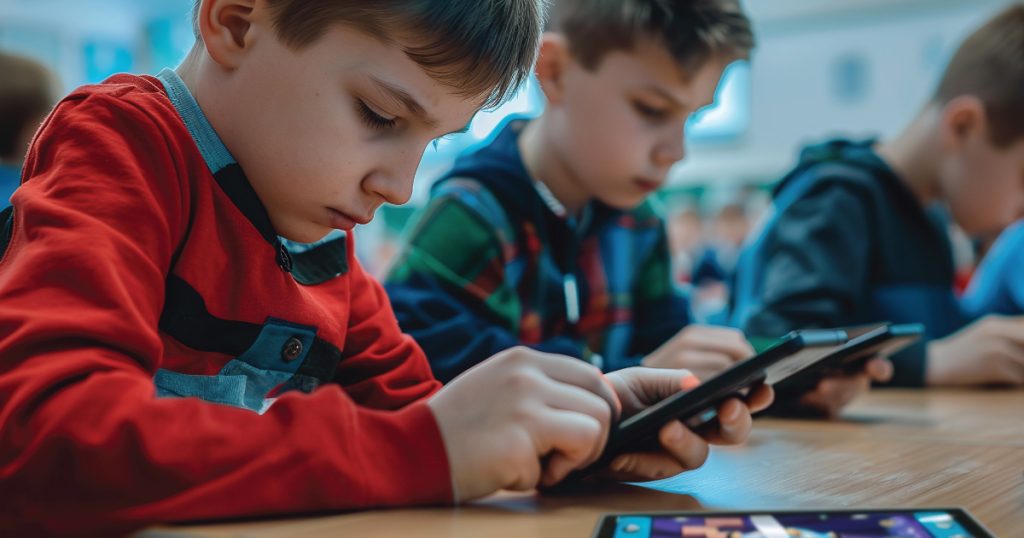
Washington is behind the curve on restricting cellphones in the classroom. At least 29 other states have implemented some kind of ban, according to Education Week. One national report gave Washington an F grade for its efforts in this area, or lack thereof.
“This is a thing we can do that essentially costs no money that can really improve student learning and achievement all across our state,” Ferguson said.
When asked why it’s taken Washington so long to pass a statewide cellphone ban, Ferguson said “change is hard” and “getting any bill through the Legislature is hard.”
“I’m not really too focused on the past,” Ferguson said. He expressed optimism his bill will get across the finish line next year.
The idea isn’t new in Olympia. In fact, lawmakers have proposed it in the Legislature for the past three years.
Earlier this year, Sen. Marko Liias, D-Edmonds, passed a bill that would have banned cellphones, but it was slimmed down into a study from the superintendent’s office, with a deadline to submit policy recommendations by December 2027.
Rep. Stephanie McClintock, R-Battleground, has sponsored, but failed to pass, a cellphone ban for the last three sessions. During the past two, her bill did not receive a hearing in the House Education Committee, the first step in passing this kind of legislation.
And in 2024, state Superintendent Chris Reykdal challenged school districts to enact cellphone bans, and about 75% complied.
Reykdal has called for a statewide policy, voicing concern that a patchwork of cellphone policies has emerged. He endorsed the governor’s proposal when it was announced in June.
“Educators, students, and families whose schools have cellphone restrictions report the positive effects on student engagement and learning,” said Katy Payne, chief strategy officer for the superintendent’s office. “A statewide policy … is an important and necessary step.”
SOURCE: This article was authored by Aspen Ford of the Washington State Standard part of States Newsroom, a nonprofit news network supported by grants and a coalition of donors as a 501c(3) public charity.

Author: Washington State Standard





One Response
This ban can’t come fast enough. As a former teacher, one of the biggest issues I faced, and one of the reasons I left the profession, was poor student engagement, distraction, and lack of attention from phones. Tell a child to stop texting in class and they say “But my mom/dad was texting me about XXX.” We’ve conditioned parents (the first generation to grow up in an world where smart phones were available) and their kids to expect immediate responses no matter the setting. You cannot put an addictive and highly engaging device into the hands of adolescents with an underdeveloped pre-frontal cortex and poor impulse control and then expect them to “learn to manage their behavior.” Teachers cannot compete with TikTok and the other content on their students’ screens. They shouldn’t be expected to manage wireless earbuds connected to devices, hoodies pulled up to hide earbuds, pockets hiding phones, and all the other strategies students use to stay connected to their device at all times. The magnification of social behavior can get out of control so much faster as it spreads among students in real time. Students texting each other, coordinating times to sneak to the bathroom, and/or engage in other activities that distract from the learning environment. A lack of clear and enforceable rules leaves school districts, schools, and administrators to set policy on their own which then pits “Cool/Chill teachers” against “Strict/Mean” teachers to enforce, or not, from classroom to classroom because there are no “teeth” for administrators to set or enforce complete bans. And at $800 or more per phone, don’t even THINK about touching or attempting to get a student to relinquish their device when caught using it in class. That’s a sure recipe for a parent to accuse you of interfering with their student’s rights and private property. I don’t care what side of the ideological spectrum you fall on; adolescents with cell phones, headphones, earbuds, and other means of “checking out” while sitting in class is NOT good for their development or their education. Parents, get your kid a flip phone if it’s so important to be able to text them in the middle of the day. Administrators, quit claiming that if teachers’ lessons were more engaging, students wouldn’t want to be on their phones. The can’t help themselves. It’s an addiction. Legislators, PASS THE BAN.