

SEATTLE — Washington Secretary of State Steve Hobbs and U.S. Sen. Maria Cantwell (D-WA) on Wednesday released county-by-county figures they said show a sharp rise in mail ballots rejected as “too lates” after the August 4 primary, and they warned that rural voters who depend on the United States Postal Service face the greatest risk ahead of the November Midterm Election.
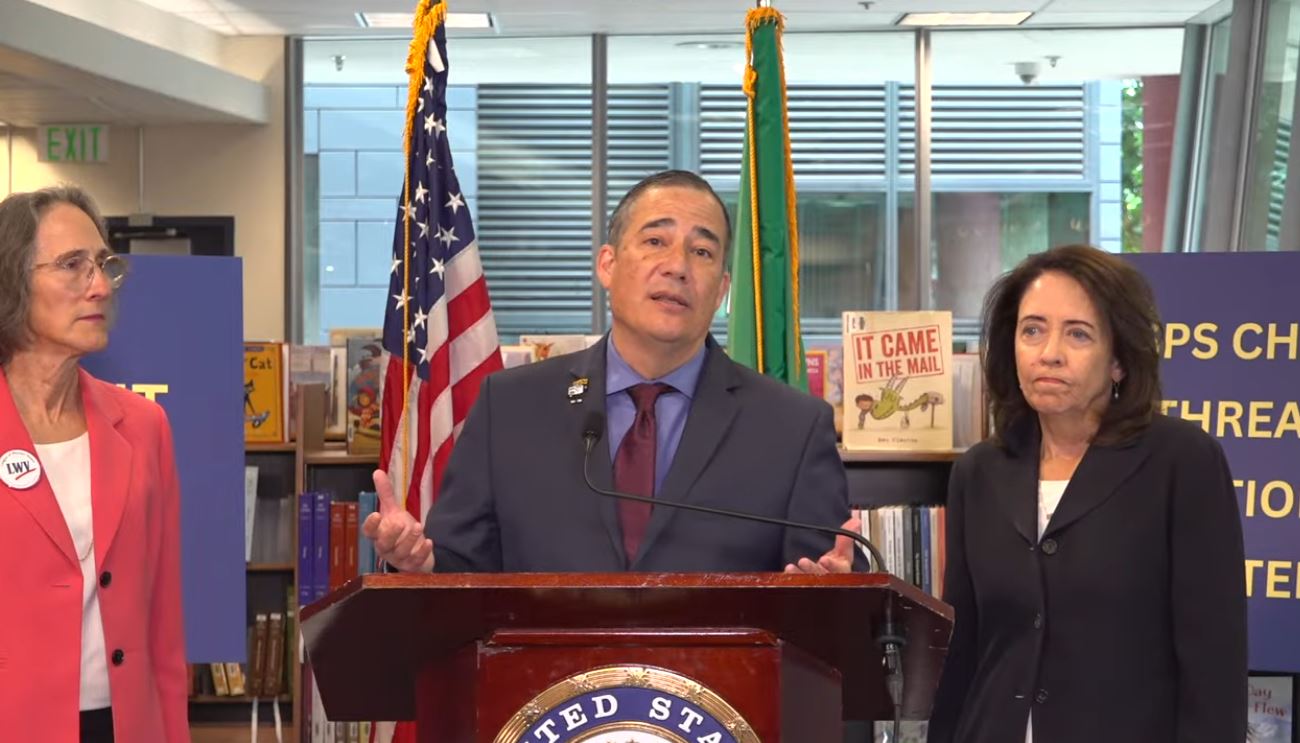
“We’re here today to talk about a report that we are issuing that basically talks about what happened in our primary,” Cantwell said, standing with Hobbs, League of Women Voters of Snohomish County President Brenda Mann Harrison and Seattle-King County NAACP President Hayward M. Evans. “Ballots that voters believed they had mailed in time were rejected because they lacked a timely, verifiable postmark or arrived too late to be counted.”


Washington automatically mails a ballot to every active registered voter. State law counts a mailed ballot if it is postmarked on or before Election Day, even if it arrives later, within a certification window. Cantwell’s snapshot report, based on data from the Secretary of State’s Office, show that the rate of ballots rejected as “too-lates” rose 32% from the 2024 primary, even though fewer ballots were returned this year.
Harrison, President of the League of Women Voters, added that late-arriving mail ballots in Washington increased from about 16,000 two years ago to about 20,000 this year.



The report states the too-lates rate more than doubled in 19 of Washington’s 39 counties and jumped more than 300% in Mason and Stevens counties. Mason’s rate rose 329.7% and Stevens’ 303.7%, followed by Yakima at 268.5%, Okanogan at 263.5%, Franklin at 206.0%, Pend Oreille at 205.9% and Lewis at 203.4%. Clallam, Walla Walla, Asotin, Benton, Douglas, Whitman, Skagit, Chelan, San Juan, Klickitat, Adams and Wahkiakum also more than doubled.

“The story was even worse in rural communities,” Sen. Cantwell said. “Stevens County had 172 ballots rejected for late postmark in 2024. In the August election, that number quadrupled to 602, even though fewer people voted in this election.”


Stevens County Auditor Lori Larsen told the secretary of state’s office that the county’s challenge rate was driven almost entirely by late arrivals and that she did not believe voter behavior or wildfires explained the spike.
“I am concerned that this is NOT a function of voter behavior, nor a result of wildfires, but may be a locally occurring USPS breakdown,” Larsen wrote, according to the snapshot report.
However, King, Pierce, Clark and Spokane counties recorded declines of 20.2%, 17.8%, 24.7% and 12.4% in “too-lates” from 2024 to 2026.
Cantwell and Hobbs attributed the rural spike to Postal Service network changes they said delay the stamp that Washington law treats as proof a ballot was mailed on time.


“I find a little bit of irony here that the President may be disenfranchising his most stable voters in rural communities by taking the vote away,” Sen. Cantwell said.
In December 2025, the Postal Service finalized a rule that postmarks are applied at regional processing and distribution centers, not necessarily at the local post office on the day mail is dropped off. Offices more than 50 miles from a regional center generally get one dispatch a day instead of two.
Analyses of the agency’s Regional Transportation Optimization plan at regional plants in Seattle, Spokane and Portland have found that about 330 of the state’s roughly 520 post offices lost evening collection.
Snohomish County tracked the delivery of all ballot packages it mailed to other Washington counties and reported significant delays. County officials told the Washington Secretary of State’s office that several packages arrived after August 18 despite being mailed well in advance. The average travel time was 5.6 days, with the longest at 20 days – nearly three weeks later.
Island County also shared with the Washington Secretary of State’s office that they received a USPS Priority Mailer sent by Skagit County bearing the required “Ballots Only” tag. The package was postmarked on August 7 but was not delivered until after certification.
Sometimes, voters drop their ballot in a drop box that’s in a different county than the one where they are registered to vote, according to the snapshot report. In these cases, counties mail these ballots to the appropriate county elections office. As long as the ballots are received by the county Primary Election certification date – August 18, in the case of the most recent primary election – the ballots can be counted.
Statewide, 68.7% of 2026 primary ballots were returned in drop boxes, secretary of state figures show. Pierce County said 69% of its accepted primary ballots came that way.
“I can walk to mine just in my own neighborhood, at the library, and cast my ballot, but in a rural community you don’t have that ability,” Cantwell said. “If you are now casting your ballot, driving to that post office who’s not stamping your ballot as received and stamped that day — that’s what Washingtonians need to know. The post office is taking your ballot as a piece of mail but not stamping it that day. They are waiting and going to a distribution center and then later postmarking that and may thereby be delaying your actual vote.”
She said almost a third of voters wait until the last 48 hours to cast their ballot. Under the current system, Cantwell added, “a ballot received the day before the election might not be postmarked until the next day and a ballot received on Election Day might not be postmarked until the next day. That means your ballot won’t count.”
Snohomish County Auditor Garth Fell has separately urged voters to use official drop boxes in the final days before an election and, if they must use the mail, to request a free manual postmark at a post office counter.
Secretary Hobbs during the presser said the separate Postal Service rule, issued to carry out a March 31 executive order from President Donald Trump, would force counties to scrap envelopes already printed for November. The rule would require states to enroll mail voters in a federal portal and meet Postal Service envelope standards before ballots move through the mail.
“We don’t have the capability to do that because we are out of time,” Hobbs said in an August 26 statement. “That’s 5 million ballots. We don’t have the ability to reprint those. So they’re really putting us in a bind.”
Washington is scheduled to mail ballots to overseas and military voters on September 18, Hobbs said, and October 16 for everyone else.
Washington Attorney General Nick Brown is currently co-leading a 25-state lawsuit filed August 26 challenging the new USPS rule. The national League of Women Voters and other groups brought a parallel case in federal court in Massachusetts. A temporary restraining order now blocks key parts of the rule for November, but expires on September 10.
“This state placed a lawsuit on the current rule. It is a restraining order for now,” Hobbs said. “The courts will hear it tomorrow. We should get a decision between tomorrow and hopefully the 10th because the restraining order is only good till the 10th. And then hopefully an injunction will be made. I’m guessing they’ll take this all the way to the Supreme Court and we will fight it there.”
He said the Supreme Court, when it earlier lifted a related injunction, “did not talk or rule on the constitutionality” of the underlying order. In June, in Watson v. Republican National Committee, the court left intact state laws — including Washington’s — that count ballots postmarked by Election Day but received later.
Harrison said the League of Women Voters is nonpartisan and does not endorse candidates, but “our bylaws enable us to advocate for and against issues, and we are bold and loud when democratic norms and voting access are threatened.”
“The League opposes the current administration’s attacks on mail-in voting,” she said. “And we’re concerned that the manner in which the U.S. Postal Service now postmarks mail is leading to more ballots being rejected for late arrival.”
The Snohomish County League is telling voters to use a drop box if they can, to mail at least a week before Election Day if they cannot, and to track ballots at VoteWA.gov. Harrison said the national League is also challenging Postal Service requirements on ballot design, voter information and approval processes.
“The Constitution of the United States clearly gives states control over the administration of elections,” she said. “The League encourages everyone to hold our federal administration accountable and make it clear that voters want to cast their mail-in ballot free from interference this November.”
Evans said the NAACP has spent more than a century defending the ballot, from poll taxes and literacy tests after the 15th Amendment through the Voting Rights Act of 1965. He said the Supreme Court’s 2013 decision in Shelby County v. Holder weakened federal preclearance and that “progress is not permanent unless we protect it.”
“Right here in the state of Washington, voting by mail is not an alternative system. It’s our voting system,” Evans said. “Every active registered voter is automatically mailed a ballot.”
He added that USPS’ advice that mailed ballots should go out at least a week early because of transportation and delayed postmarks “should concern all of us.”
“We can protect election integrity. We can protect access to the ballot. We can do both,” Evans said.
He is encouraging young Black voters not to “allow frustration in politics to cause you to surrender the power that generations before us fought to obtain.”
The NAACP, he said, does not tell people how to vote. “Register, educate yourself, vote, and hold your elected officials accountable.… Your vote is your voice, and your voice matters.”
Sen. Cantwell said she was “calling on my colleagues in the United States Senate to do their oversight job and hold hearings as why the President of the United States and the United States Postal Service is disenfranchising voters across the United States with policies that are leaving them with a ballot that was cast but never counted.”
She will advocate in Congress to restore Voting Rights Act protections through the John Lewis Voting Rights Advancement Act rather than advance the SAVE Act, a Republican-backed proof-of-citizenship registration bill.
According to the snapshot report, Washington state has already spent $357,648 reimbursing counties for reprinted envelopes and new drop boxes and $400,000 on voter education emphasizing drop boxes, plus more than $13,000 a year for cybersecurity software after federal election-security support was cut.

Author: Mario Lotmore