

OLYMPIA — Washington’s secretary of state and attorney general on Thursday issued written guidance to all 39 county election offices on how to handle contacts from federal agencies, three days after Homeland Security investigators began a multi-state voter-fraud surge that includes Washington state.
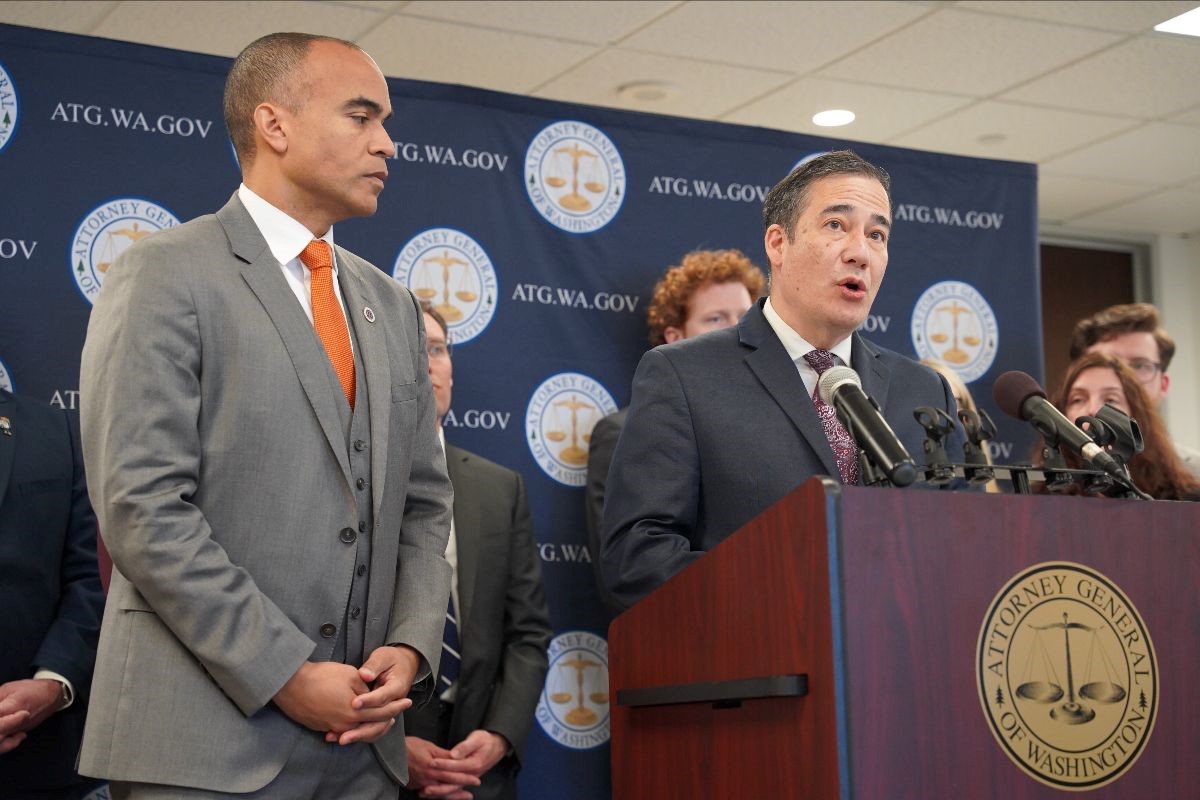
“Washington state elections are successful thanks to the tireless efforts of local elections workers in all 39 counties. Their work is as important and demanding as ever in our current political climate, and the state is ready to support them,” Attorney General Nick Brown said. “We hope this guidance is a useful resource as we all work together to continue Washington’s tradition of having one of the most secure elections systems in the country.”

The guide, titled “Election administration: a guide to federal and state authority,” was developed jointly by Secretary of State Steve Hobbs and Attorney General Nick Brown and is framed as a preparedness resource—not legal advice. It walks county auditors through state versus federal power, the kinds of federal personnel who might appear at voting centers or counting facilities, and step-by-step responses to verbal requests, letter demands, administrative and grand-jury subpoenas, and judicial search warrants.
Later sections of the guide cover federal presence at voting sites, a hypothetical use of the International Emergency Economic Powers Act (IEEPA) to seize voting equipment, executive orders, Postal Service changes, and the President invoking the Insurrection Act to deploy the military or federalized National Guard.


“This year, it is clear that Washington election officials must be prepared to handle inquiries and interactions with the federal administration, on top of the significant work it takes to administer a secure and accurate election,” Secretary of State Steve Hobbs said. “Supporting county election partners’ preparedness is one of my top priorities. That includes making sure they have clear, practical guidance when questions arise.”


That roles and responsibilities between the Secretary of State’s Office and the Attorney General’s Office is the guide’s starting point.

In Washington state, the 39 counties prepare, mail and count ballots. The secretary of state supervises and certifies the statewide results—for the midterms, that will be no later than December 2, 2026. The attorney general advises the elections office and defends the state in court. Article I, Section 4 of the U.S. Constitution gives state legislatures the power to prescribe the times, places and manner of congressional elections, subject to laws Congress may make. The Supreme Court has called the states the “default” administrators of those elections. Nothing in the guide’s opening chapter conflicts with that framework.
The release of the election guide for county officials aligns with a “coordinated criminal voter fraud surge initiative” on September 1 and will continue through at least mid-October in nine states: Washington, Wisconsin, Missouri, Georgia, California, Pennsylvania, Nevada, New York and Connecticut. Homeland Security Investigators were told to pursue leads, conduct field interviews and support prosecutorial review, with a focus on alleged noncitizen registration or voting. A DHS spokesperson shared with CNN that the agency “is actively rooting out and investigating election fraud wherever it can be found.”
Hobbs in a press release on August 31 wrote that he learned Washington was on the list from news reports. He has called documented voter fraud in Washington state rare — five cases from 2008 to 2025 among about 90 million ballots — and described the surge as an effort that risks confusion before the November 3 general election. Brown has said he has “no reason to believe this is a legitimate inquiry by DHS.”
The guide names the type of encounters federal agents are likely to put in front of county staff. A section on “Federal personnel you may encounter” lists Justice Department election monitors, congressional observers, FBI or other DOJ agents, and “Department of Homeland Security (DHS) investigators,” including Immigration and Customs Enforcement (ICE). It specifically called out that DHS personnel typically do not arrive with judicial warrants but may carry administrative subpoenas—examples of just warrants were also included.
The guide tells staff to verify the identity of federal personnel, determine whether the request is voluntary or backed by a subpoena or warrant, assess whether it reaches non-public records or non-public space, consult county counsel before agreeing to an interview or producing documents, and notify the secretary of state and attorney general when an encounter occurs. It states that workers should not release documents on a verbal request and that they need not stop ballot processing to accommodate a verbal request.
Much of that guide fits inside existing federal law such as interview requested without a subpoena is voluntary; officials may decline or insist that a lawyer be present; and a search of a non-public area of an election office without consent requires a warrant from a federal magistrate supported by probable cause.
The guide tells staff not to block agents, hide files, shut down computers or move documents if a warrant is served — instructions that track federal obstruction statutes. However, the guides does say a county may designate someone to observe, document and photograph a search, ask for an inventory, and later seek return of material taken beyond the warrant’s terms.
The booklet also fits within federal law in that congressional election observers have a statutory right, under the Confirmation of Congressional Observer Access Act, to broader access than the public, including areas where ballots are processed, tabulated, canvassed or certified, provided they do not handle ballots or interfere with the election process. Two Reconstruction-era laws still make it a felony for officers of the armed forces, or of the National Guard when in federal service, to bring troops or armed men to a place where an election is held except to repel armed enemies of the United States, or to interfere with election officials and voters. The Posse Comitatus Act separately limits use of the active-duty military for domestic law enforcement.
The first legal tension in the guide comes to the authority of the National Guard and second is the grouping of “military or other federal law enforcement.”
Governor Bob Ferguson is the commander-in-chief of the Washington National Guard when it is not in federal service and the guide cites HB-1321 that restricts deployment of out-of-state armed forces without the governor’s permission, “except where otherwise required under federal law” —this caveat matters. See, once the president federalizes the Guard under Title 10, state command ends. The Insurrection Act, which the guide includes, still authorizes the president, in defined circumstances, to use federal troops or a federalized Guard: at a governor’s request to suppress insurrection; to suppress rebellion against the United States; or, in a narrower clause, to enforce federal law when ordinary civilian processes are obstructed.
The guide’s states that if President Donald J Trump were to use the Insurrection Act “to intimidate voters, or to influence certain election outcomes” it would be “unprecedented” and warns that such as action will be fought in federal court.
The section in the guide that pairs the military with other federal law enforcement also blurs a line. The poll-ban statutes and Posse Comitatus apply to the armed forces and to the National Guard after federalization. They do not, by themselves, forbid FBI agents, HSI investigators or Justice Department civil-rights monitors from standing near a voting center (or ballot box) or walking into an election office. Those civilians are limited by voter-intimidation laws, the Fourth Amendment, state facility rules and whatever warrant or subpoena they carry. Treating an ICE interviewer as if he were a federalized Guardsman overstates the military-at-the-polls (or drop box) bans.
Another question is how far a DHS administrative subpoena reaches into election files — the issue most likely to arise in Washington state. ICE may issue administrative subpoenas for immigration investigations, whether that power can compel a county to produce voter-registration data, voting histories or election-system records will most likely be disputed as Washington is already in court over the DOJ’s demands for unredacted voter rolls.
The National Voter Registration Act and Help America Vote Act assign list maintenance to the states and Washington state’s confidentiality rules cover some election materials. The Privacy Act limits how federal agencies collect and share personal records. Telling staff not to produce records on a verbal ask, and to send paper demands to counsel, is a cautious first step. Suggesting that counties may ignore a valid administrative subpoena would go further than federal law clearly allows, so a judge would need to decide whether a particular subpoena is authorized for a specific ask.
A fourth point of friction is the description of the DOJ’s election monitors. The guide says Civil Rights Division monitors have “no special federal authority to enter election facilities” and rights “akin to the general public.” That is largely true of staff monitors who arrive without a court order; however, it is not true of court-appointed federal observers authorized under the Voting Rights Act, who can be placed inside polling places, election offices, or at ballot boxes by a judge. If a court order exists, counties cannot treat those observers as just ordinary visitors.
Another area of contention is around grand-jury subpoenas. The guide tells officials to call their lawyer, and usually the state offices too, if federal agents ask for records. A grand-jury subpoena is different from a casual request. Even when state law treats those records as confidential, officials generally cannot ignore the subpoena. They have to turn over the records or ask a court to narrow or block it.
The guide also discusses a possible attempt to use the International Emergency Economic Powers Act to seize voting machines, a theory that would draw immediate lawsuits if tried.
It describes executive orders that, in the state’s view, shift election power to the federal government — a claim Washington has already taken to court this year, including over a March executive order on citizenship lists and mail ballots. It also warns that U.S. Postal Service rule changes can disrupt Washington’s vote-by-mail system, a point already in multi-state litigation.
In either of the two aforementioned scenarios, the instruction is the same: call Olympia, do not improvise a physical confrontation, and let the attorney general decide whether to sue.
Call it the unofficial “Evergreen Doctrine” (a bit of editorializing here) with Olympia’s new election power trio — Ferguson, Hobbs and Brown — where this trifecta is now building a paper perimeter of briefs, temporary restraining orders, and county scripts: a county handbook on Thursday, a lawsuit docket that will never cool, and a standing order to call Olympia before anyone with a federal lanyard lays their hand on an election-related file.
Congress may regulate the manner of federal elections, the president may send a stern letter, and Homeland Security may surge investigators from September to mid-October; and what is Washington’s new election power trio’s response, bury the Trump administration in lawfare against what Hobbs and Brown call “falsehoods about the security of elections systems” to preserve the state’s election authority.
The November ballot will include U.S. House races, state legislative seats, judicial positions and local measures. County offices are scheduled to begin mailing ballots to military and overseas voters by September 19 and to all other registered voters by October 16. Drop boxes and voting centers open 18 days before Election Day.
The offices of the secretary of state and attorney general said they remain available to county officials who receive federal requests and that they are committed to supporting “safe, secure and accurate elections” across the state.
To circumvent USPS from not mailing election ballots to Washington voters if the state is unable to implement design specifications called out in Executive Order 14399, the Secretary of State’s Office told the Lynnwood Times in an email that as “a contingency the office is actively considering,” a guide to voters on how to print their own ballots from home or the library and to encourage voters to drop off their ballot at one of the state’s secure drop boxes.
State law (RCW 29A.40.091) requires return envelopes sent by election offices to include prepaid postage, so if the ballots mailed are delayed or not even delivered, this would cost the state well over a million dollars in lost postage and print fees alone.

Author: Mario Lotmore