

SEATTLE — The Citizen Action Defense Fund announced Thursday an out-of-court settlement that removes the Washington State Capitol Correspondents Association (CCA) from the Washington’s House credentialing process, ending one front of a federal lawsuit over who may cover lawmakers from inside the Capitol while leaving the fight against the House itself unresolved.
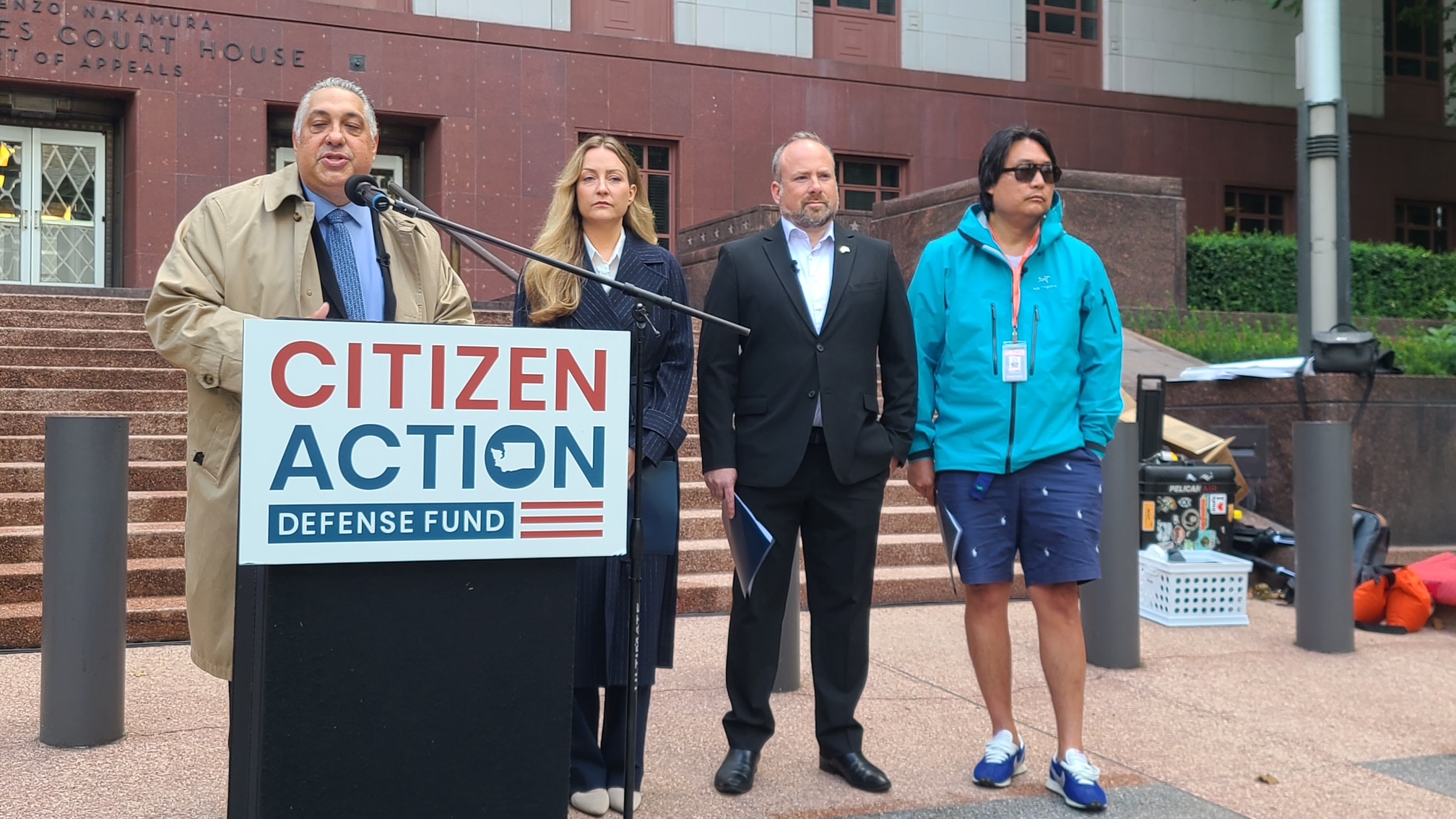
“This settlement affirms what our association has said from the beginning: the House determines access to its chamber. This has been true for years. It is still true. It will continue to be true,” CCA President Jerry Cornfield wrote in a statement to the Lynnwood Times on the settlement agreement.
The agreement, signed September 2 by Cornfield, settles only the claims brought by radio host Ari Hoffman, political commentator Brandi Kruse and investigative reporter Jonathan Choe against the CCA, a private press association. Under the deal, the association will stop recommending who should receive House press passes, will not oppose future chamber-access applications by the three plaintiffs, and will send House Chief Clerk Bernard Dean a letter stating it has not taken the public position that Choe, Kruse, and Hoffman, are not practicing journalists. The journalists will dismiss their suit against the CCA with prejudice—dropping their case permanently.
“This case asks a fundamental question: who gets to decide who is a journalist or reporter? What role should the government, or other reporters have, in making that determination?” asked Jackson Maynard, Executive Director of the Citizen Action Defense Fund. “This case is not about ideology. CADF’s concern here is not about government power and constitutional rights. If the system can be used against these three reporters, it can be used against other reporters and journalists for entirely different viewpoints. Freedom of press does not depend on who’s byline is attached to a story.”



However, their case against the House of Representatives, Dean and the state legislature continues.

Choe, Kruse, and Hoffman call the settlement a first-step win for press access and warned about what happens when working reporters help decide which competitors may approach the very elected officials they cover.

“They told us we didn’t qualify and defended a system that allowed an insiders’ club of journalists to decide which other journalists were allowed through the door,” said Ari Hoffman. “Then we sued, got into discovery, and started demanding their emails and records. Now the CCA has agreed to get out of the press-pass recommendation business altogether – funny how that works. The journalists who already have a seat at the table shouldn’t get to decide who else is allowed into the room to cover their government and hold it accountable.”
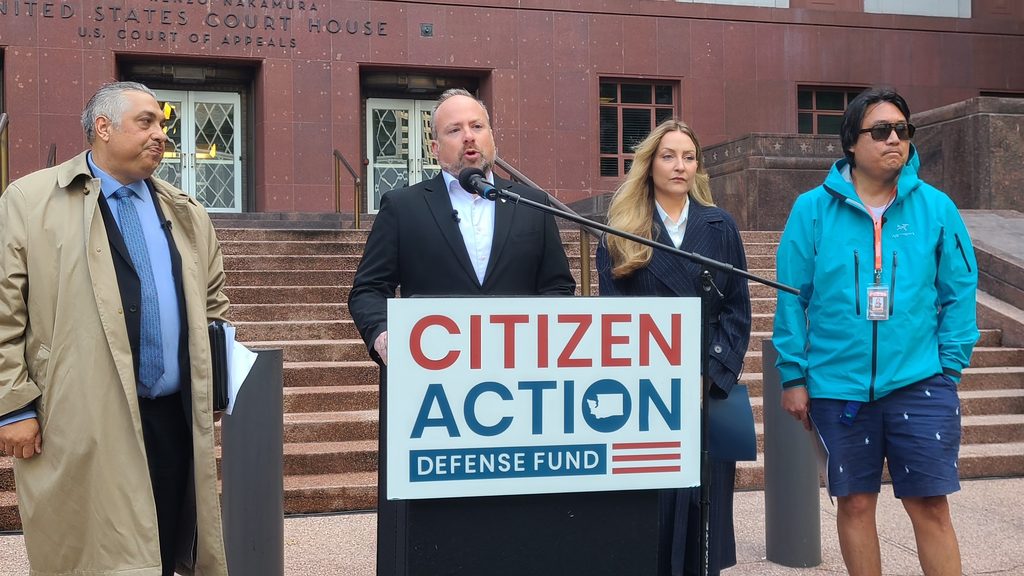
“Today’s victory against legacy media gatekeepers does not itself improve press freedom – but it is an important first step in uniting around the principle that expanded access to those in power leads to more government accountability,” said Brandi Kruse. “Independent media challenges outdated orthodoxies about who gets a seat at the table to question elected leaders. Media outlets across the state should unite in calling on the House of Representatives to expand its credentialing and ensure all Washingtonians have trusted sources reporting on their behalf in Olympia.”
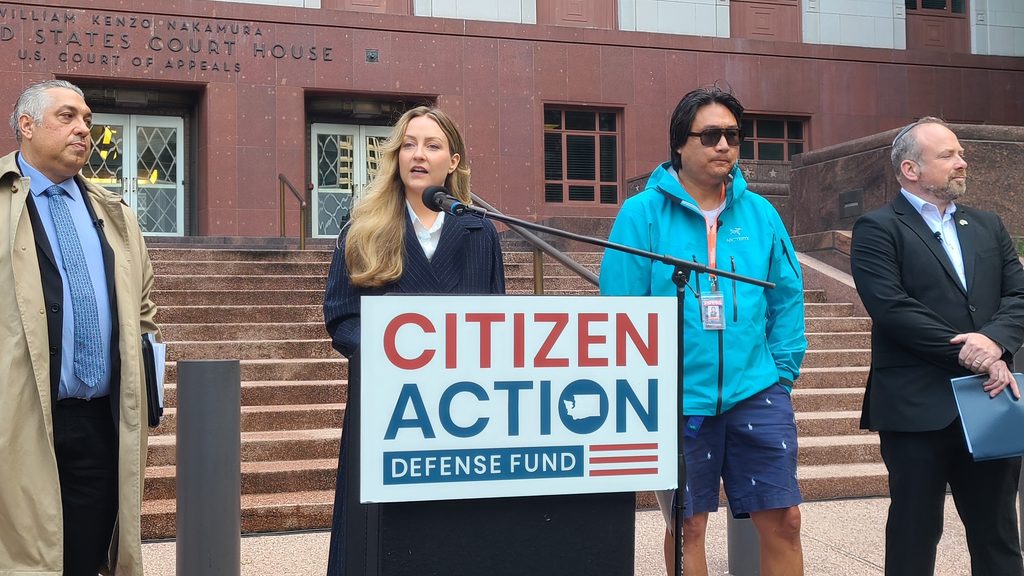
Kruse is now calling upon the House to adopt the same standards as the Senate did with its rule 10, when determining press credentials.
“Access matters. You cannot hold powerful institutions accountable from the other side of a locked door,” said Jonathan Choe. “Independent journalists are doing some of the most important reporting in Washington right now, and they deserve the same opportunity to show up, ask questions, and report what they see. This fight was about making sure the next journalist who challenges the status quo doesn’t have to wonder whether that will be used to keep them out.”

The settlement agreement does take the CAA out of the recommendation business for every applicant, not only the three media professionals, and it makes the executed agreement public. It does not, however, award credentials, money nor a court finding that the three are journalists under House rules, only that it has not taken a public position on whether Choe, Kruse, and Hoffman, are practicing journalists.
In accordance with Section 2 of the settlement Cornfield, CCA President, sent House Chief Clerk Bernard Dean the attached letter on association letterhead:
“I am writing to formally inform you that the Capitol Correspondents Association will no longer make recommendations to the House regarding press pass applications, effective immediately.
“This means that should Brandi Kruse, Ari Hoffman and/or Jonathan Choe apply for press credentials granting access to the House chamber in a future session, the association will not oppose their requests.
“Looking ahead to the 2027 session, please let me know if the House decides to revise the credentialing process. If there are changes, I will help spread the word to members of the press with an interest.
“Regarding Kruse, Hoffman and Choe, who challenged the current system, the association has not taken the public position or pronounced that that they are not practicing journalists.”
The House, Dean and the Legislature are not parties to the deal and are not bound by it. House Rule 8 and whatever written or unwritten credential standards the clerk uses remain in the state’s hands.
An 18-month Legal Battle: How It All Started with a Rule Change
For about 50 years, the Capitol Correspondents Association — a small, unincorporated group of reporters based in Olympia during session — screened who received the plastic credentials that open the wings and press areas of the chambers. That arrangement cracked in early of 2025.
On February 19, 2025, an attorney at Davis Wright Tremaine sent a demand letter to Cornfield over denials involving Kruse and Choe. The association, which Cornfield later described as having no lawyers and little budget, relinquished credentialing to the Legislature rather than litigate. Cornfield declined comment at the time because of the threat of suit.
On March 27, 2025, near the end of session, the Senate adopted Senate Resolution 8638 on a voice vote. Sen. Manka Dhingra, D-Redmond, sponsored the measure that amended Senate Rule 10 so that members of the press could not remain in “the wings” and adjacent areas unless a senator or Senate staff member accompanied them. Reporters were directed to a capacity-limited press table and could still use the gallery.
Senate Majority Leader Jamie Pedersen, D-Seattle, told the Lynnwood Times the CCA’s action to relinquish credentialing forced the Legislature to act.
“The Capitol Correspondents Association (CCA) has for many years determined who does and does not receive credentials to cover the Legislature,” Pedersen wrote in a statement to the Lynnwood Times back in March 2025. “The CCA, under threat of legal action from bloggers and others not employed by traditional broadcast and print media, decided to cease self-governance. That left the responsibility with the legislature.”
Pedersen described a tradeoff as a broad definition of press, which the Senate said it now chose to do, versus risking an open process that could be used to organize demonstrations or interfere with Senate business. As a result, the lieutenant governor’s office set up an online form agreement on which people could self-identify as press, provide contact information and agree to Senate decorum rules.
Sen. Dhingra said the press is “fundamental to our work here” and that senators looked forward to working with journalists and open-government advocates on a more durable credentialing system during the interim.
Sen. John Braun, R-Centralia, supported the resolution as a way to expand who qualifies as press, including nontraditional outlets, and to let each caucus control access on its own side of the wings. Immediately after the vote adopting the new Senate rule, Braun sent a letter to Sarah Bannister, Secretary of the Senate, requesting for established members of the press corps to be granted blanket access and not be reliant on weekly requests for temporary press passes to the Chamber.
Sen. Keith Wagoner, R-Sedro-Woolley, said he and many other Republicans voted against the new rule. Sen. Jeff Wilson, R-Longview, invoked a “Free Press” argument and warned against treating reporters as people to “usher through and to shuttle through quickly.”
Ellen Haitt, then executive director of the Washington Newspaper Publishers Association, called the restriction a mistake at a time when the state had already lost roughly two-thirds of its journalists over two decades.
“It’s not ok to limit access to the press,” Haitt said. “Those who are there need to be able to connect in meaningful and timely ways to our elected officials.”
Kruse at the time of the rule’s passage told the Lynnwood Times that the CCA, in trying to keep her and Choe out, had handed power to the politicians reporters are supposed to watch.
“The Capitol Correspondents Association was so opposed to giving me a press pass, they abdicated more than 50 years of control and handed it off to the very politicians we’re supposed to be holding accountable,” she said in 2025. “It took a matter of days for politicians to use that power to limit press access to the wings, where reporters have been allowed for as long as I can remember.”
Choe asked why lawmakers feared questions: “From a journalist’s standpoint, we should all have access and close access to hold our legislators accountable. That is what journalists are supposed to do, that is why we are the Fourth Estate.”
The Senate later did issue credentials to the plaintiffs; the House, on the other hand, did not follow the same path.
CADF then filed suit February 10, 2026, almost a year later, in Thurston County Superior Court on behalf of Kruse, Hoffman and Choe, alleging violations of the First Amendment and Article I, Section 5 of the Washington Constitution, federal and state due process, and Washington’s non-delegation doctrine. The plaintiffs sought the restoration of access and the adoption of clear, viewpoint-neutral rules for press credentials.
Why the House said no
House Rule 8 states it is the general policy of the House to admit representatives of the press to the chamber. For the 2026 session the House created an online day-pass process and, in denial letters, said it looked “in part” to association guidelines on whether an applicant is a “bona fide” journalist.
Those guidelines drew a line between professional journalism and political or policy work and discouraged credentials for people engaged in campaigns, lobbying or public-policy development, or for people working for publications inside larger non-news organizations.
Hoffman, host of “The Ari Hoffman Show” on Seattle’s KVI and an editor for The Post Millennial, was denied after House officials cited his role with Let’s Go Washington (LGW), a political action committee that campaigns for citizen initiatives, and his appearance as a speaker at a Capitol-steps rally for LGW’s measures.
Kruse, an Emmy-winning former FOX 13 reporter who hosts the unDivided podcast, was denied on similar advocacy grounds. House lawyers later told a federal judge that Kruse had been featured at the same rally as Hoffman and was scheduled to speak at another Let’s Go Washington event around the time she sought floor access. Kruse also has ties to Future 42, a group that criticizes Democratic policymakers and takes positions on bills.
Choe, a former KOMO reporter and senior journalism fellow at the Discovery Institute, applied in connection with “Discovery Institute/Frontlines TPUSA.” The House treated that as a think-tank affiliation barred by the association’s non-news-organization guideline. Turning Point USA describes its mission as identifying, educating and organizing students around limited government and free markets.
The defendants removed the case to federal court in Tacoma on March 2, 2026, four days before a scheduled state-court hearing. CADF, attorney for Choe, Kruse, and Hoffman, immediately sought a temporary restraining order (TRO) so they could cover the final days of the 2026 session.
Jessica Goldman, an attorney for the House, told the court the three were not merely covering events but were “leaders.”
“They were the leaders of these events, they were the keynote speakers,” Goldman said. “They have attached their names and fame and notoriety to try to get these laws passed by the Legislature.”
The plaintiffs’ legal counsel argued that Goldman’s characterizations collapsed ordinary political speech and opinion journalism into disqualifying “advocacy,” applied unpublished standards, and let a private club of competitors shape a government access list. They further held that the Senate granted them credentials and that they had attended some governor’s office media events.
CADF further contend that the House’s process was discrimination dressed up as professionalism.
U.S. District Judge David G. Estudillo denied the plaintiffs TRO restraining order March 10, 2026. He found the House floor press area is a nonpublic forum in which reasonable, viewpoint-neutral limits are allowed.
The plaintiffs, he wrote, had not shown they were excluded because of political affiliation or that the process was arbitrary. The House, he said, has “a substantial interest in ensuring the reporters it permits to access the House floor meet the credential standards promulgated so the House may ‘debate and pass laws without interruption or lobbying in that space.’”
Although he disagreed with Judge Estudillo’s injunction ruling, Jackson Maynard, Executive Director of CADF, said he would not appeal it given how little session time remained, and would keep litigating “until we either prevail or exercise every viable legal option.”
The 2026 session ended without Choe, Kruse, and Hoffman receiving House floor passes; discovery against the CAA then followed which eventually led to Tuesday’s settlement agreement signed by Cornfield.
The gatekeeping dilemma
When a press corps aids the legislature in deciding which other reporters may stand in the wings, two risks present themselves.
First, incumbents in the credentialed pool have an incentive to define “real journalism” in ways that match their own business models — full-time newsroom jobs, traditional employers, a claimed separation from advocacy that many opinion columnists and cable hosts do not actually practice. Second, elected officials can point to that private recommendation and say they were only following the professionals, even when the effect is to keep persistent critics farther from the floor.
Washington has also spent public money to shore up news coverage as newsrooms shrink. In 2023, Sens. Karen Keiser, D-Des Moines, and Marko Liias, D-Edmonds, helped create a $2.4 million journalism fellowship program with Washington State University’s Edward R. Murrow College of Communication. Fellows were meant to fill coverage gaps, including at the Capitol. Supporters described the program as an answer to news deserts. Critics asked what it means when the same government that writes those checks also decides which independent critics may stand in the House wings.
Rep. Travis Couture, R-Allyn, put that concern to the Lynnwood Times in February, before the lawsuit was filed.
“The moment the House issues press passes, it creates what’s called a limited public forum,” Couture said. “In that forum, the government may set neutral rules (space, safety, credentials), but it may not favor or punish viewpoints which include political advocacy. Credentials cannot include viewpoints or advocacy. The House punished the viewpoints of Ari Hoffman, Jonathan Choe, and Brandi Kruse (in writing) by denying press passes exclusively on those grounds.”
He argued political advocacy is protected speech, including when legacy outlets advocate policy outcomes or testify for their own financial benefit.
“So, we have politicians trying to hook dying legacy media with the lure of state money (and control) under the guise of ‘save the news,’ while simultaneously denying access to legitimate media that criticizes them,” Couture said. “The hypocrisy is not new, but certainly this should shock you awake.”
Couture said his position would be the same if left-leaning independents were locked out and conservative outlets were asking for state funds. If legacy news cannot survive without public money, he said, consumers and advertisers — not the government — should decide what is worth paying for.
“It’s a slippery slope and dangerous precedent,” he said, “and it’s the slow creep of incrementalism that inevitably becomes the soft tyranny of tomorrow’s state-run media.”
That is the policy argument CADF and the plaintiffs are now trying to press against the House alone. With the association gone, Dean and House leadership can no longer say a private press group told them the three do not qualify. They must defend their own criteria, in writing, under constitutional scrutiny.
What happens next in court
The next practical test is the 2027 session. Cornfield’s letter invites the House to revise its process and offers to notify interested reporters. If Hoffman, Kruse or Choe apply, the association is contractually barred from opposing them; however, the House may still deny them. If it does, the remaining constitutional claims — viewpoint discrimination, due process and the argument that floor access cannot turn on a lawmaker’s view of a reporter’s politics — will be litigated without the buffer of a private press corps recommendation.
Plaintiffs can now use Cornfield’s letter and the CCA’s retreat as exhibits in its complaint against the legislature and the CCA can now say it never publicly declared the three Choe, Kruse, or Hoffman as non-journalists and that it is out of the recommendation business.
The separate PDC fight
The settlement collides with a different proceeding at the Public Disclosure Commission.
On August 12, 2026, the PDC opened a formal investigation of Let’s Go Washington after a complaint by Washingtonians for Ethical Government (WFEG). The complaint alleges the committee failed to report between $345,000 and $1.25 million in in-kind political advertising tied to Kruse’s unDivided platforms between September 2025 and February 2026.
Let’s Go Washington, through counsel, has said it never paid Kruse, that her work was news reporting or editorializing exempt from contribution rules, and that the complaint is harassment. Kruse has said she has “never taken a dime” from the committee to support the effort and is exercising her First Amendment rights.
The CCA letter does not bind the PDC as campaign-finance law and press-pass policy use different tests. But the association’s written statement that it has not pronounced Kruse, Hoffman and Choe “not practicing journalists,” combined with its agreement not to oppose their House applications, is a document both sides in the PDC matter can now try to use.
Kruse and the committee can argue that even the group that once screened Capitol passes would not brand her a non-journalist, a term WFEG is using to justify its complaint to the PDC. Complainants, on the other hand, can argue the settlement is a litigation cease-fire, not a finding that Kruse’s initiative-related commentary was exempt reporting.
Editor’s Note: Added statement from CCA President Jerry Cornfield (12:16 p.m., Friday, September 4, 2026)

Author: Mario Lotmore