

LYNNWOOD—The Executive and Finance departments with the city of Lynnwood provided an update on the city’s financial situation at council’s Work Session Tuesday, September 8, as council prepares for the adoption of the 2027-2028 biennial budget later this year.
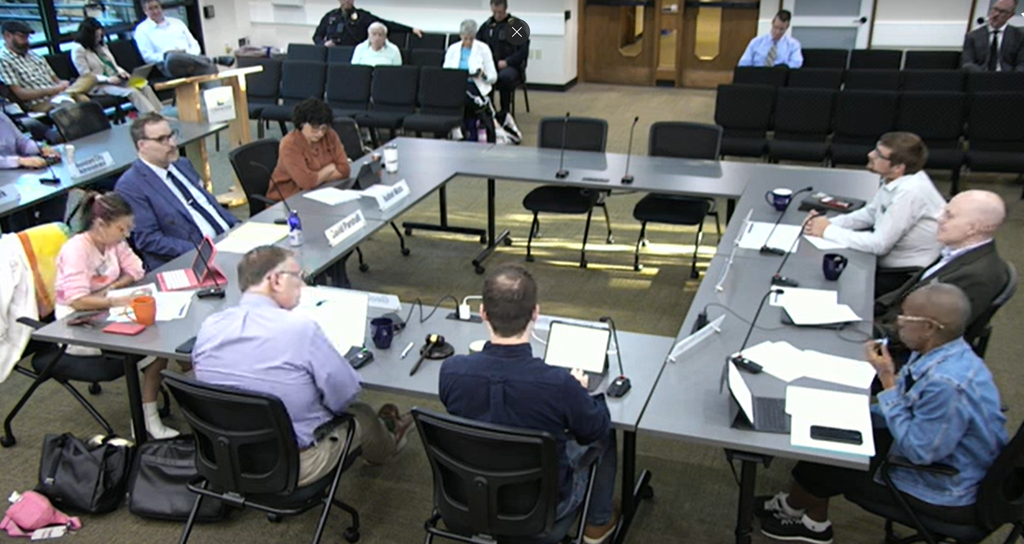
The Budget Summit was framed by Assistant City Administrator Monisha Harrell as a conversation, not a vote. Department leaders sat in the room so councilmembers could state the vision and logic that will drive the 2027-28 biennial budget.
“As we enter budget season this is an opportunity to talk to leadership directly in the departments around each of your visions as council members, to talk to each other as council members, about the vision and the lens that you’re using going into this upcoming budget. This is going to be the most significant thing that you will do together this year,” said Harrell. “Before we get to those up and down votes, this is the opportunity to better understand what’s behind those votes, the reasoning and the logic that you’re using, the vision that you’re bringing forth.”
Mayor Hurst’s memo and addressing the “elephant in the room”…the deficit


Included in Tuesday’s summit was a budget memo by Lynnwood Mayor George Hurst, who said that within his first year of mayor it has been a “challenge” for him to maintain a balanced budget in an uncertain economy.”

Separate to this, Hurst added that he has his own priorities which include addressing youth violence, homelessness, public safety, and increasing costs of housing.

“Our ability to provide solutions to these issues depends on having a city with a strong and sustainable financial foundation,” said Mayor Hurst.
Mayor Hurst was forthright in admitting the City of Lynnwood is in a budget deficit, as is the case with nearly every level of government, whether State, County, or neighboring cities.
Back in May of 2025, former Mayor Christine Frizzell announced Lynnwood had a $3 million shortfall in the City’s General Fund. However, in September 2025, the City Finance Director updated the forecasts revealing that the 2025-2026 General Fund was facing a deficit of actually more than $20 million.
Mayor Hurst chalked the deficit up to, what he calls, “voodoo economics.”
“Instead of controlling City spending, the 2025–26 budget was balanced on paper using overly optimistic revenue forecasts by the former Mayoral Administration. The Budget Book presented to the City Council contained misleading statements and lacked transparency regarding actual expenditures and fund balances,” said Hurst.
To deal with this deficit, the city put a hiring freeze on new city staff positions and filling vacancies, laid off nine city employees and continues to assess staffing levels for each City department, increased revenue with a new Public Safety Sales Tax (by an estimated $2.5-$3.1 million per year), shifting five Utility Billing FTE positions to the Public Works Department, began reviewing the City’s contract with South County Fire and its fleet size, created a Municipal Jail Caucus, increased jail fees, and is looking to hire a Budget Analyst position and is assessing continuing to have an in-house City Attorney.
Leading into this budget season Mayor Hurst noted it’s important for council to consider its property tax banked capacity, its reserve policy, prioritizing street safety, exploring possible annexation and growth, as well as utilizing the Public Safety Sales Tax to support existing commissioned officer positions.
“During my years on the City Council and now as Mayor, my focus has always been on serving this City and its residents. Although we face significant challenges, bringing Lynnwood’s government back to financial stability has been the focus of my first year in office,” said Mayor Hurst. “I remain optimistic about Lynnwood’s future. The diversity of our community is matched by the diversity of our economy.”
Harrell added the methodological change: future revenue projections will be built from three-year actuals averaged, not from prior optimistic forecasts stacked on earlier optimistic forecasts. Department presentations will show 2023-25 actuals, year-to-date 2026, impacts of reductions, and any innovations possible with the same or slightly smaller resources. She described 2027-28 as “the smallest Lynnwood will ever be again,” then a foundation for later growth.
Each council members’ vision for the city
Mayor Hurst’s vision for the City of Lynnwood is a financially stable city that remains a transportation, economic, and cultural hub. He wants to see festival streets on 198th and at Northland Village (Totem Lake Village-style mixed-use with retail below and housing above), an autonomous trolley linking light rail, festival streets, and the mall, preservation of leafy residential neighborhoods, and a city center that finally matches the 30-year-old vision.
Councilwoman Isabel Mata’s envisions starter homes being available at $200-400k (what she calls “cottage housing”), sidewalks and bike lanes on every street so people can reach library, transit, mall, and grocery without a car, a day center or shelter for people who remain unhoused, and robust placemaking-farmers market, yard sales, July 4th parade, art markets, and live music. She said parks and the Connect Lynnwood plan are “the bare minimum,” and also wants the Rec Center hours expanded, not cut, with higher non-resident fees and larger resident discounts.
Councilwoman Derica Escamilla wants to see enough officers for growth, a therapeutic court so the jail is filled with non-Lynnwood inmates and local people do not return. She’d like to see complete connectivity inside the existing 4.5-square-mile city before annexation, a rent-stabilization and impact-fee policy, protection of fixed-income and working-class residents from third-party utility add-on fees, and continued youth work so the old “Lynnhood” reputation does not return. Lastly, Escamilla wants the finished event center to make Lynnwood a place conference-goers talk about.
Council member Bryce Owings’ vision for the City of Lynnwood is to see residents working local jobs and local contractors winning local infrastructure bids so money recirculates. Owings wants to see smart, overdue annexation that unifies people who already thought they lived in Lynnwood, in addition to safer, more bikeable streets.
Councilman Robert Leutwyler’s vision for Lynnwood is for it to be the South Snohomish County destination that has leapfrogged other cities on housing tools (MFTE, etc.), so developers choose Lynnwood. He also wants connectivity that lets a family drop from three cars to two or two to one, parks, public works, and development services as the city’s differentiators once light-rail extensions arrive. He sees residents who would later vote yes on a levy lid lift because they feel they already receive great value.
Council member Nick Coelho wants Lynnwood to be a city of pride, and to have a predictable, rational cost of living. He’d like to see the city motto shortened to “a great deal.” Coelho also envisions spaces for dreamers to start pop-ups and businesses, safety and predictability, and residents treated as valued stakeholders on big projects.
Councilwoman Chelsea Wright would like to see a greener, cleaner, walkable “little big city.” She’d like to see safe walking and biking routes to light rail, and a mixed-use downtown that keeps money and entertainment inside Lynnwood. Lastly Wright would like to have housing options so people can live where they work, and a city her son can inherit, work in, and raise a family in.
Council member David Parshall envisions a slow, steady climb rather than zero-to-60 after the budget crisis. He’d also like to see a strong retail base recovered, public safety that keeps businesses from fleeing, and roads/sidewalks/bike lanes that feed that retail. Additionally, Parshall would like to see tax relief anticipated within 10-12 years because the current pace of increases is “unsustainable”. Parshall is also excited about the Public Facilities District event-center expansion as the next spark.
Areas of contention
The room largely agreed on the destination-safer, more walkable, still-affordable, prouder Lynnwood with two light-rail destinations and a real city center-while disagreeing on how fast to get there and how many tax and camera levers to pull while the foundation is still being rebuilt.
The current 2027-28 budget plan assumes council will take all remaining banked levy capacity (more than $2 million). Without it, staff says programs will get cut and some grants/levy-lift options could get harder.
Last year Mayor Hurst opposed taking the full amount because camera and other forecasts looked soft and he wanted to hold the line. However, he now says those forecasts came in worse, sales tax and construction permits have not recovered, banked levy is more predictable than sales tax, and some federal/block grants require showing the city already used its capacity noting “I don’t like to do it but that’s the way it is.”
Council was split on the suggestion of adding 24/7 speed cameras to school zones and intersections, which is not currently in the budget.
While the pro’s of adding the legislatively allowable one additional red-light camera and one additional speed cameras mean Lynnwood’s funds don’t have to go towards hiring a new FTE, Council member Isabel Mata was a hard no, adding that tickets are not the root-cause of safety.
“It makes me feel sad because we want people to speed,” said Mata.
Council member Derica Escamilla added that, when speaking to her constituents, the public seemed to prefer seeing a camera at every intersection rather than another across-the-board tax.
Council member Roberty Leutwyler added that the city is already hooked on volatile sales tax and existing camera money.
Combined with highest in-state sales tax and banked property tax, the civic story becomes “you get the worst of everything,” he said.
Coelho argued the dollar impact of “responsible taxation” on lower-income households has been overstated and that the council has over-indexed on tax resistance. Mata and Escamilla replied that every small increase stacks on county, state, school, fire, and utility increases; people are already moving. Both want more non-tax revenue (rec-center hours and fees, merch, grants, PFD partnerships) and policy that protects the most vulnerable if taxes keep rising. Parshall wants the city to rebuild reserves so it is not forced into the same bind again.
“I don’t want us to compromise on setting up for our community’s future just to address basically the deficiencies of the past,” said Coelho.
Coelho asked whether the budget merely locks in “Swiss cheese” departments. Harrell said some slowdowns will occur, jobs will be reshuffled, and 2027-28 is a rightsizing year; later biennia can add positions back.
Coelho noted the 2024 budget was sold in part on promised efficiency studies that never materialized.
Harrell and Hurst said low-hanging-fruit efficiencies are already identified (duplicate vendor contracts, tipping-point analysis on an in-house attorney, etc.) and that annual departmental efficiency studies plus a restored budget analyst and year-end look-backs will be built in.
Leutwyler wanted residents told the story that the council held the line as long as it could and is now doing the unglamorous work of starting from zero.
“You don’t cut your way to prosperity,” said Leutwyler.
Near the end Mata asked whether colleagues would support resolutions opposing two statewide initiatives she said threaten queer youth and Snohomish County Proposition 3 (removing party labels). Owings said the council should stay on sidewalks and the budget. Coelho will allow any member to bring an item but personally prefers not to use the dais to campaign on outside ballot measures.
Escamilla wanted process (policy work group, legal review) rather than a rushed “optic baby.” Mata said she will draft anyway.
Previous council actions leading into Tuesday’s summit
On January 26, 2026, the City Council adopted Resolution 2026-03 which adopted the planning calendar for the 2027-2028 budget.
At the July 13 Council Business Meeting, Assistant City Administrator Harrell and former Interim Finance Director Fujioka reviewed the adopted budget calendar and provide considerations for the upcoming 2027-2028 biennial budget.
At the July 21, 2026 Council Finance Committee meeting, Assistant City Administrator Monisha Harrell provided an update to the Council’s committee on the financial status the of the City’s General Fund. The committee also discussed the goals of the Budget Summit scheduled for the September 8, 2026 Work Session.
What comes next?
Lynnwood City Council will receive a Proposed 2027-2028 Budget, limited to a general overview of fund revenues and expenditures, during its Business Meeting on September 14.
On September 28, council will hold its first public hearing on budget priorities and assumptions.
Council will be presented with the Preliminary 2027-2028 Budget with the Mayor’s budget message presented to City Council on October 12 and will continue budget presentations through November 2.
On November 9, council will hold a second public hearing on the Preliminary 2027-2028 Budget and its 2027 property tax levy before reviewing the preliminary budget on November 16.
Council will adopt the 2027-2028 Budget, and 2027 property tax levy, on November 23 at its Business Meeting.

Author: Kienan Briscoe