

LYNNWOOD — Mayor George Hurst has sent the City Council for review at its Monday business meeting a preliminary 2027-28 General Fund forecast that shows a $21.4 million deficit, far larger than the $3 million shortfall written into the adopted 2025-26 budget, and warned that the plan does not yet include all the known risks which could balloon the deficit, by a Lynnwood Times estimate, to $29.6 million or 21.8% above revenue projections.

A one-page budget summary compiled by the Lynnwood Times coupled with Mayor Hurst’s Sept. 14 memo puts proposed operating, transfer and other revenues at $135.8 million against $157.1 million in expenditures and other uses. Operating revenue alone would fall $16.3 million from the prior 2025-2026 biennium. Hurst and Assistant City Administrator Monisha Harrell, who is also the interim finance director, wrote that the proposed 2027–2028 Biennial Budget is meant to “realign City expenditures with a more realistic, base-case revenue forecast.”

In March 2026, Mayor Hurst originally stated that the $25 million deficit from the 2025-2026 biennium was closed, to later in July 2026 during a financial review after Finance Director Michelle Meyer left, found the deficit larger than previously reported by $2.2 million—this is still looming for the current biennium.
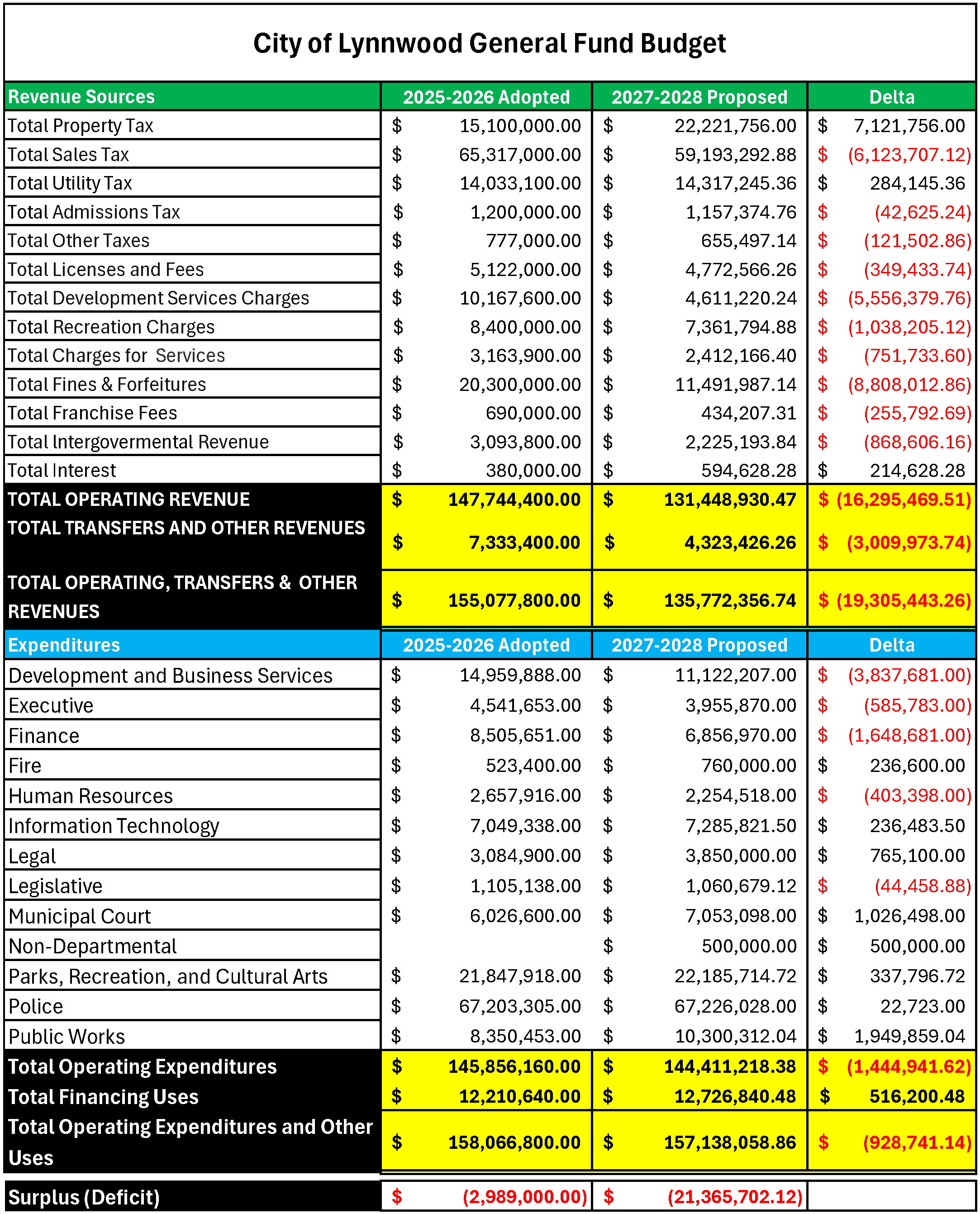
Harrell shared in her joint memo that most 2027-28 estimates use the average of actual receipts from 2023 through 2025 rather than stacking forecasts on forecasts. The projected 2027-2028 deficit is driven by a “realignment” in revenues that never matched the growth assumptions in the November 2024 adopted budget. The drivers of a $23.9 million revenue collapse in the projected 2027-2028 forecast are:



- Fines and forfeitures (photo enforcement) drop by $8.8 million (from $20.3 million to $11.5 million).
- Sales tax drops by $6.1 million (from $65.3 million to $59.2 million).
- Development services charges drop by $5.6 million (from $10.2 million to $4.6 million) indicating a slowed permitting and project backlog.
- Transfers and other revenues drop $3 million.
- Recreation charges, charges for services, intergovernmental, licenses/fees, franchise fees, and other taxes also decline.
Offsetting the revenue collapse is a proposal by Mayor Hurst’s staff to utilize the city’s full banked levy capacity rising property taxes by $7.1 million from $15.1 million to $22.2 million—a 47% cash basis increase. The offset including utility tax and interest income results in a net Operating Revenue without transfers of a reduction from $23.9 million to $16.3 million; including transfers, the net revenue collapse is $19.3 million or 12.45% in reduced revenue compared to the previous biennium.

Spending is nearly flat. The proposed operating expenditures of $144.4 million are $1.4 million below the prior adopted total. Factoring in a roughly $500,000 increase in financing uses, total operating expenses see a $929,000 (or 0.59%) decrease compared to the 2025-2026 adopted budget.

Development and Business Services, Finance, Executive and Human Resources show cuts of $6.475 million offset by Public Works, Municipal Court and Legal which rose by $3.74 million.
Police, at $67.2 million, is essentially unchanged showing an increase of only $22,723. The new public-safety sales tax collections that began April 1, 2026, raising the combined sales tax rate to 10.7% is expected to generate about $2.5 million to $3.1 million a year in revenue, however, these monies are restricted to only criminal justice use and are currently reflected in the 2027-2028 sales tax revenue projection.
The projected $21.4 million net general fund budget hole is not yet the bottom. Employee insurance was factored into Hurst’s preliminary proposal at a 6.2% premium increase; AWC rates due in October are now expected to rise 11% to 14%—a Lynnwood Times estimate based on an 8% health insurance increase of $611,000 in 2025 would but this in a $0.7 million to $1.2 million increase. The jail’s medical contractor has indicated it may leave Dec. 31, 2026. If the city cannot keep the provider, Hurst shared in his joint memo, transition costs could run $1 million to $2 million annually, on top of already-higher court, prosecution and jail operating costs tied to the Community Justice Center.
Nowhere in the proposal does it address reserve policy where the stabilization fund was lowered to two months as a temporary budget fix in the 2025 supplemental that expires after 2026. Staff have said that the stabilization fund must be rebuilt. Using the proposed $144.4 million in biennial operating expenditures — about $72.2 million a year — two months is roughly $12 million and two and a half months about $15 million, a difference of about $3 million that does not appear to be funded in the preliminary deficit figure.

So, that $21.4 million hole, after factoring in the risks, could balloon to $29.6 million or above 21.8% of current revenue projections. A deficit of this size cannot simply be absorbed by ordinary fund-balance drawdowns as it far exceeds the city’s own reserves.
Lynnwood Council to decide: Tax increase, layoffs, or both
Council options are the familiar mix of use the banked property-tax capacity already assumed in the forecast; keep directing the 0.1% public-safety sales tax to existing police costs; increase sales tax by 0.1%; raise other fees or seek a voter-approved levy lid lift; or further budget cuts. Without more revenue, staff have already said programs would face elimination.
Layoffs are not listed in Hurst’s memo, but this was a tool used when Lynnwood’s previous budget broke. In 2025, then-Mayor Christine Frizzell ordered 10% general-fund cuts (6% for police), froze about 20 vacancies, furloughed directors, and in September 2025 laid off nine employees as part of $11.7 million to $12.3 million in reductions, when the projected ending balance turned $10.7 million negative.
The 2025-26 budget the council adopted in November 2024 looked manageable on paper with about $155 million in revenues into the General Fund; however, this did not hold. Lynnwood started 2025 already $4.2 million short of the opening General Fund balance that budget had counted on.
By summer, then-Mayor Christine Frizzell was telling the council the main revenue lines — sales tax, building permits, red-light camera fines — were not growing at all. So, staff said that if nothing changed, the city was staring at a $25 million hole by the end of 2026 resulting in Frizzell ordering deep cuts.
The council later loosened the reserve rule from 2.5 months of operating costs to 2.0 months to offer structural relief and raised the property levy, the utility tax, permit fees, and business licenses. The council in its last meeting of the year in December added two more fee hikes: 14.7% on Development and Business Services permits by 14.7% and business licenses by 33%.
When Hurst took office January 1, 2026, the 0.1% public-safety sales tax took effect in April. He continued Frizzell’s hiring freeze, shifted utility-billing posts off the General Fund, raised jail fees charged to other cities, and extracted about $2 million more in 2026 departmental cuts.
The council now has to decide how to close the $21.4 million to a possible $29.6 million 2027-2028 budget defict — another tax increase, more layoffs, or some of each. That choice will be clearer after Oct. 12, when the full budget lands in their lap. Hopefully by then, AWC sends the real insurance rates and there is a resolution to the current medical contractor walking out on the jail at year’s end.
2027-2028 Biennium Budget Schedule
Public hearings are set for Sept. 28 and Nov. 9, with adoption targeted for Nov. 23. Department budget presentations are scheduled for the following dates:
- October 19
- Executive – Mayor’s Office
- Human Resources
- Information Technology
- Finance
- Development and Business Services: Business Licenses, Planning, and Economic Development
- October 26
- Municipal Court
- Police
- Legal
- November 2
- Legislative – City Council
- Development and Business Services: Permits, Inspections, and Code Enforcement
- Public Works
- Parks, Recreation and Cultural Arts

Author: Mario Lotmore