


EVERETT — The City of Everett and Community Transit on Wednesday released a proposed interlocal agreement (ILA) that would fold Everett Transit into the county agency on April 1, 2027, raise the city’s local transit sales tax from 0.6% to 1.2% that same day, and send the city a $54.5 million check while $16 million in transit capital reserves moves the other way — a $38.5 million net cash deal for Everett.
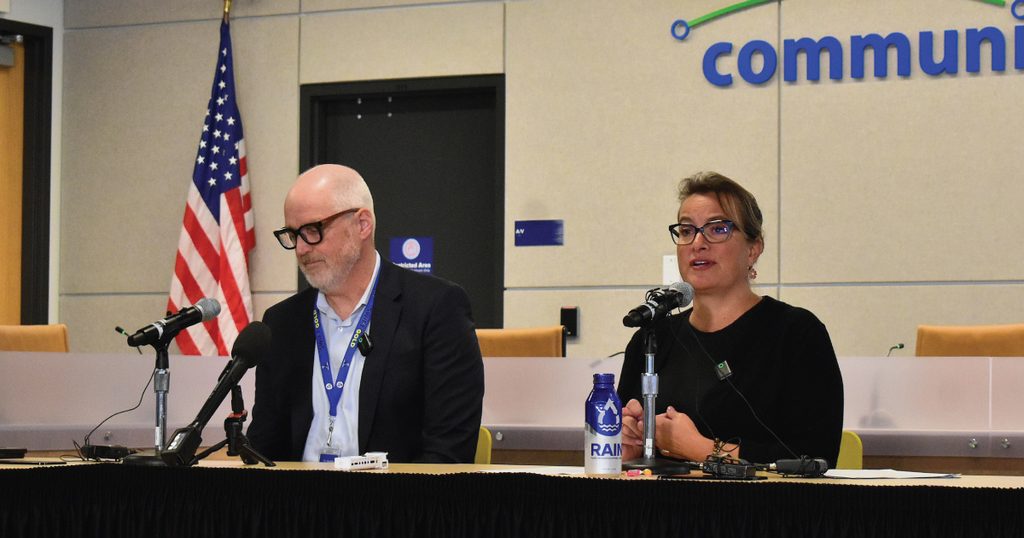
Mayor Cassie Franklin and Community Transit CEO Ric Ilgenfritz presented the deal as the end of a very long-awaited endeavor that has been on and off for years. If the Everett City Council and the Community Transit Board both approve annexation this fall, Community Transit becomes the transit operator inside Everett limits and Everett Transit, as a separate city department, will no longer exist.
“This is a super, super exciting day for Everett, for the region,” Mayor Franklin said at Wednesday’s press briefing.
Ilgenfritz put the same point in a recurring theme during the presser, “People are at the center of this agreement.”




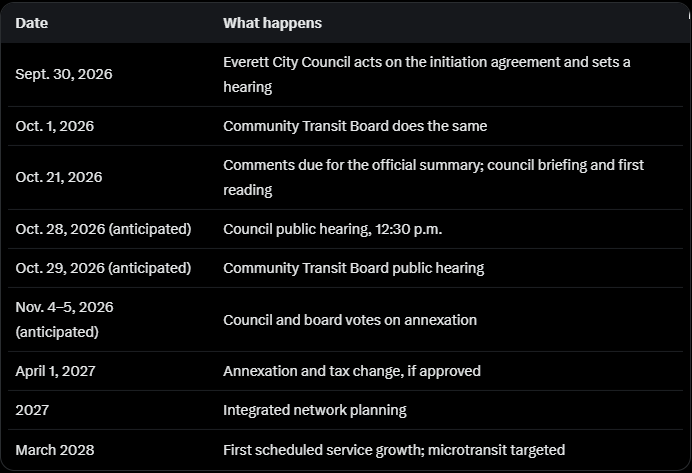
Under the agreement, extra service is planned to start with the March 2028 service change, following a year of network planning. Ilgenfritz said existing paratransit customers by the day before annexation would be grandfathered in, including about 23 seniors who use the service because they are 65 years old or older. New applicants after annexation would be under Community Transit’s existing rules, not Everett’s current automatic age-65 standard.


“Everett has made a practice of allowing senior citizens,” Ilgenfritz said. “Once you turn 65, you’re eligible for that service. That’s not the norm industry-wide. So, we’re agreeing in this agreement to grandfather in all the existing Everett Paratransit customers…. There are other products and services that could benefit seniors in their mobility needs…. We’re experimenting with micro transit.”
On the effective date, April 1, 2027, Community Transit takes the routes, the fleet, Everett Station, the contracts, and most of the workforce. Everett stops collecting its 0.6% transit tax and Community Transit tax of 1.2% — the rate charged in its service area — applies inside Everett limits. This comes to 6 cents more per $10 taxable purchase or about $29 million a year, or $158.3 million from 2027 through 2031.
State law does not require the merger nor the tax increase to be sent to Everett voters. Senate Bill 5801 created the annexation path the two agencies are using, so the decision to approve the annexation sits solely with the Everett City Council and the Community Transit Board who are schedule to vote on the merger no earlier than November 2026.
Franklin’s justification for the merger on Wednesday centered on both growth and the upcoming $12 billion light rail investment. She shared that the city expects to annex nearly 40,000 residents next year and grow by another 60,000 over 20 years.
“There’s not a scenario where Everett Transit can deliver that level of service” at a future end-of-line Link station, Franklin said, pointing out that the transit demand in 20 years will be three-times that of today.
Ilgenfritz tied the same argument to jobs that are hard to reach by bus today. Boeing already has service, he said. The Navy base, Providence, and the port do not have the same web of routes from Arlington, Lake Stevens, or Snohomish.
Sound Transit has dropped parking garages from the Everett Link alignment, which leaves buses as the main way to feed the new stations.
Franklin said a public-private garage might still be possible at the downtown end-of-line station, but not at Mariner Station.
“I wish we had a few parking garages, but parking garages are really expensive,” she said then referred to the estimated $147 million cost for the Lynnwood Transit Center garage.
Ilgenfritz then used Lynnwood’s “ballet of busses” as the model for Mariner. More than 60% of riders at the Lynnwood Transit Center arrive by bus, he said, and the 1,500-stall garage is full by about 7:30 a.m. Community Transit is already running buses into that station every 30 to 45 seconds in the peak. That, he said, is the pattern Everett will need to meet its public transit demand.
The agreement also guarantees Everett at least one seat on the Community Transit Board. Because adding Everett triggers a state-law reconstitution of the Community Transit Board due to the service-area population jumping by more than 15%, a meeting of the cities has to happen within 90 days after annexation to welcome the new Board member.
Show me the money
Community Transit would pay Everett $54.5 million at closing. After combing through the full 220-page ILA proposal, here is the agreement breakdown netting $38.5 million to the city of Everett as follows:
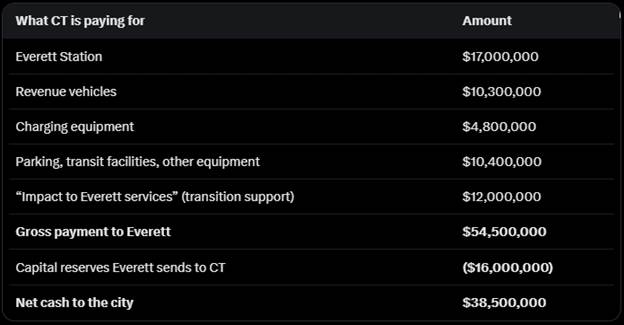
The $17 million for Everett Station is not a full market appraisal. The footnote in the document calls it the local share of assessed land value plus building cost, with the federal share stripped out.
The $12 million for “Impact to Everett services” is the price of keeping city staff on the work after annexation: payroll-adjacent help, IT, fare vaults, and “technical support to Community Transit in its labor negotiations.”
Communications Director Jason Kelly, in an email to the Lynnwood Times on what happens to the “Everett Transit Fund 425” ending fund balance of $34.4 million (according to the approved City of Everett 2026 operation budget), wrote that the remainder of these dollars after the $16 million is sent from this fund to Community Transit as capital reserve money meant to replace vehicles and equipment would remain in the City.
“The Transit Fund revenues were generated specifically to support the transit system; there are legal requirements that govern their use for that purpose going forward,” Kelly wrote. “Some of the Transit Fund revenues would remain with the city to be used for transit-related purposes, including transition costs and capital projects in Everett that improve access to transit.”
“Access to transit” can mean bus pads and sidewalks, or it can mean almost any street project near a bus stop. Neither the ILA nor Kelly’s email disclosed the city’s estimate of Fund 425 cash on annexation day after the $16 million transfer.
Everett’s revenue vehicles originally purchased at $55.7 million — $43.9 million on hand and $11.8 million in 2028 hybrids still on order — will be sold to CT for $10.3 million, which tracks the remaining local book value after federal and state grant interests. The vehicle roster lists paratransit vans from 2011 and mid-2000s diesels to 2022 and 2025 Gillig battery-electric buses.
Ilgenfritz said Community Transit has been working with the Federal Transit Administration (FTA) on the transfer and “will compensate the city for the investment it has made in those vehicles and in that infrastructure.”
Everett Station goes to Community Transit with existing tenants staying through their leases. City and community use of the station is reserved for three years. The tenant list consists of Bezos Academy’s first-floor lease runs through Aug. 31, 2032, at $10 a year plus capital improvements; Amtrak occupies space at $1 a year; Jasmine’s Coffee lease ends Dec. 31, 2026, before annexation; and Greyhound holds a month-to-month bus slip.
The operations and maintenance yard on Tower Street stays with the city. Everett keeps the land and leases it to Community Transit for $300,000 a year for five years, with two one-year options at the same rent. Community Transit pays for utilities. The city may sell the property during the term and terminate the lease on six months’ notice, but not before the end of year four.

Asked why Everett would pay the higher rate a year before the first extra service in March 2028, Ilgenfritz told the Lynnwood Times, “If we’re going to start growing service, then we need to buy buses. We need to hire people. We need to finish the planning work,” he said.
If the rate changes April 1, the new money “begins to show up in our treasury probably in June or July” which is roughly nine months before the March 2028 service change, he added.
Asked whether the 1.2% collections would be dedicated to the city or dropped into a Community Transit’s countywide pool, Ilgenfritz did not say and shared that consolidation “would increase transit service in Everett 50% by 2031,” along with capital work that includes the Swift Gold Line.
“Everett Transit has a long-range plan,” he said. “Best case scenario with that plan and the resources available to Everett Transit, they could grow service by 25% in the city over the next 20 years. At the heart of this agreement [on the other hand] is a commitment to grow service in the city by 50% in four years.”
Service: A 50% increase in four years, starting March 2028
According to Attachment D in the ILA, Community Transit would spend 2027 on an integrated network plan, with three rounds of public engagement and a board vote at the end of the year. Microtransit — the Zip-style product — is due by March 2028. Fixed-route and microtransit hours phase in from 2028 to 2030. The Swift Gold Line is listed for 2031 but is “subject to change based on available funding and other factors.”
“If we do our jobs right,” Ilgenfritz said, “the service you see out there on the road today will be there after this takes effect.”
Until that plan is adopted, the contract only requires Community Transit to keep Everett’s existing service such as the routes, frequency, hours and span in place on annexation day, or improve on it.
Fares will be frozen for 12 months according to the ILA on those Everett routes and on paratransit services that would stay the same. Any increase in rates after the annexation would need staff analysis, public outreach and a vote by the Community Transit Board.
145 jobs and three unions
Franklin shared that “most” employees go to Community Transit and “a handful” stay at the city for other departments.
According to attachment C-3 of the ILA lists 145 positions transferring to CT, including 69 bus operators, 24 paratransit operators, 5 paratransit schedule technicians, 8 maintenance workers, and inspectors, supervisors, security, station, and administrative titles.
Community Transit would assume the ATU Local 883 and AFSCME contracts now in effect of which the ATU agreement runs through 2027.
“We will honor the collective bargaining agreements that are in place today with ATU and with AFSCME,” Ilgenfritz said. “And we will also commit to bargaining in good faith future changes to follow-on contracts.”
That bargaining, he said, is how the agencies “honor and comply with the 13(c) requirements.” Section 13(c) of federal transit law is the worker-protection screen that applies when FTA money is in a transit system that changes hands—both agencies draw federal grants. The ILA packet included ATU labor agreements but did not include the 13(c) exhibit—something ATU International will need.
Franklin said she emailed city transit staff Wednesday that the ILA document was public. Ilgenfritz said he has met Everett Transit employees twice and union leadership once, with “regular dialogue” between them. Franklin added that city staff have been meeting union leadership every few days to ensure an open communication channel.
When it comes to seniority Ilgenfritz said, “That’s actually something that the two ATU unions, together with the international ATU union, will be working through.”
There is no single date when Everett Transit comes off the city’s books. Community Transit becomes the operator on April 1, 2027, but Franklin said the city would still issue paychecks “for a number of months” and that city HR would keep helping with the handoff. Ilgenfritz added that the assigned union contracts will run through 2027, and that employees “move away from the city fully” only after a successor COLA agreement is accepted.
“I wish I could say today what day that will happen,” he said, “but we have to bargain that.”
Most of the public comments against the ET-CT merger have come from Everett Transit workers. Franklin shared that she believes this is out of fear of change and not a hidden layoff plan.
“People who are facing change, they’re facing a bevy of negative emotions,” Ilgenfritz said.
Every employee, he said, still has a choice whether to come. He pointed to Community Transit’s recent in-house takeover of work that Transdev had run on Sound Transit Express and commuter routes after Lynnwood Link opened, a move he said kept “well over 100 people.”
Key dates and public comment on annexation
The Everett City Council and Community Transit Board of Directors will take action on an initiation interlocal agreement setting the dates for public hearings on the actual annexation of Everett into Community Transit’s service area. The anticipated schedule for the public hearings and further action by the Council and Board, as well as the future milestones should annexation be approved, are listed below.
Community members can share what they think about the proposed annexation of Everett Transit into the Community Transit service area:
- Online comment form: https://bit.ly/etctcomment
- Email: communications@everettwa.gov
- Voicemail: (425) 257-7121
- Mail: City of Everett Communications, 2930 Wetmore Ave, Suite 10-A, Everett, WA 98201
You can also give comment at Everett city council or CT board meetings:
- Everett City Council meets on Wednesdays typically at 6:30 p.m. (12:30 p.m. on the 4th and 5th Wednesdays of the month)
- WHERE:
- In person: City Council Chambers, 3002 Wetmore Ave Everett, WA 98201
- On YouTube: youtube.com/everettcity
- Visit everettwa.gov/council to learn more about how to join online and how to sign up to comment.
- Public hearing at Everett City Council Meeting will be scheduled
- WHEN: Wednesday, Oct. 28, 2026, 12:30 p.m. (anticipated)
- WHERE:
- Public hearing at Community Transit Board of Directors Meeting
- WHEN: Thursday, Oct. 29, 2026, 3 p.m. (anticipated)
- WHERE: Community Transit Board Room, 2312 W Casino Rd, Everett, WA 98204
- Visit communitytransit.org/board-of-directors and click on Upcoming meetings for information about how to attend online and sign up for comment.
All comments received by Oct. 21 will be summarized and provided to the Everett City Council and Community Transit Board of Directors.
To learn more, visit https://www.everettwa.gov/2786/Transit-Consolidation

Author: Mario Lotmore



One Response
You will be leaving ALOT of people who RELY on Everett Transit for YEARS with NO way to get to doctor appointments grocery shopping or other NEEDED things when you take out certain ET routes, such as the #29, that goes from Everett mall to the Everett station, passes by Optum walk , Winco Costco snd orher places the #18 that servies Mukilteo & other routes that are DESPERATELY NEEDED!
What they supposed to do?