

SEATTLE — Gov. Bob Ferguson signed Executive Order 26-04 on Monday, September 28, creating a Governor’s Space Council, stating that Washington already makes most of the world’s working satellites and cannot treat that lead as permanent.
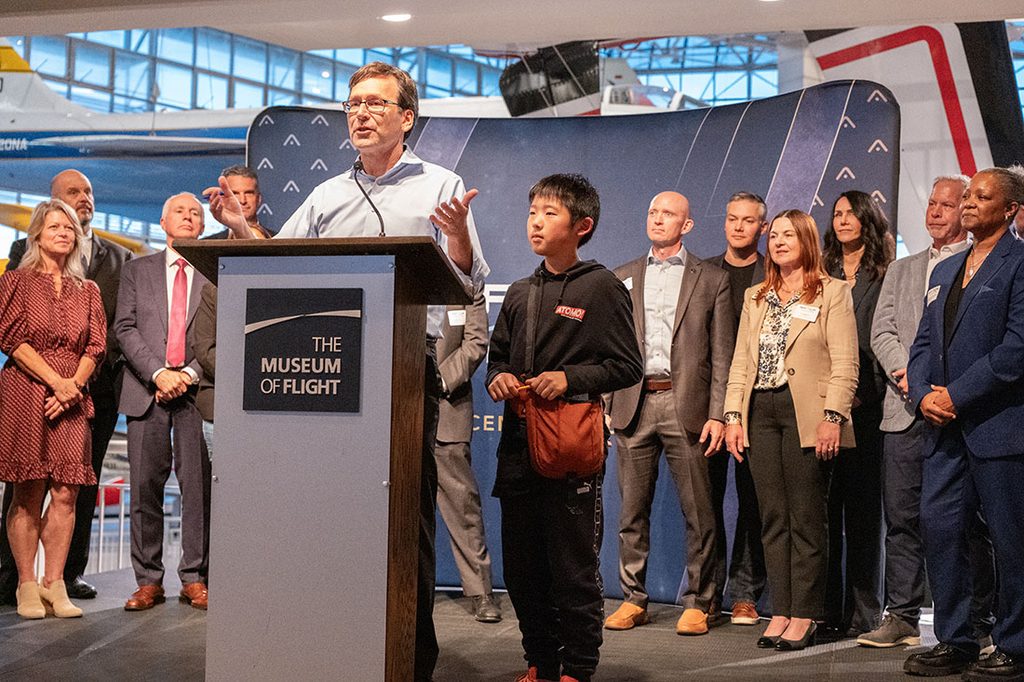
“This is going to bring together folks on how we can move forward as a leader nationwide or worldwide in space,” Ferguson said. “It’s Boeing employees in Kent who literally created the rovers that wandered over the lunar surface back when we had the Apollo mission. We have a tremendous history here in Washington as a leader. We need to continue that. That’s exactly the work the Governor’s Council on Space is going to do. Looking forward to see what we’re going to do next.”



Executive Order 26-04 was signed at the Museum of Flight as Seattle Space Week began. The 23-member advisory council mixes satellite and rocket companies with labor, universities, mayors and lawmakers. The Washington State Department of Commerce will provide staff support for the council.
The Governor’s Space Council members include Andy Lapsa of Stoke Space, Rob Meyerson of Interlune, Jeff Thornburg of Portal Space Systems, Austin Link of Starfish Space, Colin Doughan of Gravitics, Michael Edmonds of Blue Origin, Lisa Scalpone of Amazon LEO, Cornelia Rosu of SpaceX, Kelly Maloney of Space Northwest, Kent Mayor Dana Ralph, Redmond Mayor Angela Birney, Sen. Claudia Kauffman, D-47th District, Rep. Alex Ybarra, R-13th District, Brendan Wales of FUSE, Jason Chan of IAM 751, Ray Goforth of SPEEA, Bill Pike of PNNL, Dr. Mehran Mesbahi of the University of Washington, Washington State University President Betsy Cantwell, Lynn Strickland of the Aerospace Joint Apprenticeship Committee, Trevor Devaney of Hi-Rel Laboratories, Scott Keeney of nLIGHT, and Philip Johnston of Starcloud.




The group is to report its findings and recommendations to the governor and has no authority to appropriate monies, license a pad or change tax law. The council is to measure Washington against other states and countries, name barriers and openings, review workforce and research, inspect infrastructure and supply chains, and study “opportunities and requirements for Washington-based commercial launch capabilities.”

Washington’s Space Sector: Three industries, not just one
Washington’s space story sits inside the major economic sectors — space, aerospace and technology. Since Boeing won the lunar rover contract in 1969 and built the Apollo moon buggies in Kent, Washington has grown into one of the nation’s premier commercial space clusters.


The state’s commercial space industry as the governor’s office describes it, is more than 90 companies, more than 13,000 direct jobs, about $4.6 billion in annual activity and $1.6 billion in annual payroll; with approximately two-thirds of the world’s operational satellites built in Washington.
SpaceX has said its Redmond plant was turning out about 70 Starlink satellites a week earlier this year, and Amazon has been increasing output for its Leo satellites at its Kirkland facility.
Aerospace manufacturing employment is forecasted to hit near 83,000 by the end of 2026 in Washington state. Broader Puget Sound tallies run above 110,000 jobs when supply chain support is included. The Aerospace Industries Association’s wider aerospace-and-defense measure for Washington has put total supported jobs above 230,000 and GDP contribution above $50 billion — roughly 6% of the state’s output.
The Technology sector is the behemoth economic driver for Washington state. The information sector alone employs about 164,000 people on recent state payrolls and was the biggest single contributor to Washington GDP in 2025, on the order of $160 billion in a state economy near $720 billion. Broader tech-occupation counts put hundreds of thousands of workers in software, cloud and related jobs.

Governor Ferguson is betting that Washington’s space-based economy can become a larger sibling in an economy already led by aerospace and technology.
“Washington has deep roots in the space industry,” Governor Ferguson said. “But the industry moves at an incredible pace. To remain a national leader, we cannot be complacent. My council will help us innovate and adapt as this sector rapidly grows.”
A Lynnwood Times’ 10,000-foot SWOT
Ferguson’s executive order creating the Space Council, directs its members to inventory Washington’s existing strengths, identify gaps, and assess the competitive risks that could shift space work to other states.
Washington state already has the two highest-volume commercial satellite lines in the country, a deep aerospace supplier network, software talent, strategic ports and a strong post-graduate research bench at UW, WSU and PNNL.
However, Washington does not appear on the FAA list of licensed spaceports. Blue Origin’s headquarters may be in Kent, but its New Glenn reusable orbital launch vehicle flies from Florida and major engine work sits in Alabama. SpaceX, the largest commercial space company in the world by both valuation and launch volume, launches from Florida, California and Texas—of which Florida and Texas have no personal income taxes and right-to-work protections that reduce labor union influence compared to Washington.


Housing, energy and permitting costs in the Puget Sound are high, putting Washington at a disadvantage for constructing new buildings and attracting out-of-state talent.
Statewide, Zillow put the typical Washington home at about $592,000 in August 2026, well above the Census Bureau’s U.S. median sales price of about $411,000. For a mid-career satellite or propulsion engineer, this becomes a compensation problem for an employer.
Also, typical permit timelines in Washington state are roughly double what they were a decade ago and are some of the longest in the nation. Standard residential permits now feature heavy hourly review fees ($292–$551/hour), while government regulations account for nearly 30% of total new home building costs.
Historically, Puget Sound has enjoyed electricity rates well below the national average due to the region’s hydropower. However, in the last three years, rates have escalated rapidly. Puget Sound Energy (PSE) has requested a $1.5 billion rate increase, aiming for a 30% spike in residential electricity bills and 20% increase for natural gas by 2029 to meet Washington’s new clean energy mandates now that the voter-approved Initiative 2066 to protect consumer access to natural gas was struck down by the Washington State Supreme Court on September 17, 2026.
According to analysis from the Building Industry Association of Washington (BIAW), the court’s invalidation of I-2066 will also increase new home construction costs by $20,000 to $30,000 per unit; forcing builders to install pricier all-electric heat pump systems and upgrade electrical panels to 400-amp service to meet reinstated energy codes.
Software publishing is another pressure—although a latent one. State forecasts have had the sector falling for several years and projected another decline of 2,600 jobs in 2026. Space companies still need software people for flight code, ground systems, and constellation operations. A softer local software market can make some of those hires cheaper, but with increasing layoffs, the talent pool dwindles.
The 9.9% tax on household income above $1 million is the political elephant in the room. It is scheduled to take effect in 2028 unless Initiative 645 or the courts repeal it. However, nothing prevents the legislature in the future from amending the law to impact all income levels.
Although the new income tax does not tax a plant or factory, it will tax venture capitalists, founders, senior executives, and anyone whose wages, bonuses, and equity push adjusted gross income over the line. Texas and Florida still have no personal income tax. The practical risk is not that a Starlink leaves Redmond next year, or a Blue Origin leaves Kent, it is that the next startup incorporation, the next dual-state executive, and the next increment of capacity gets priced against Austin and the Space Coast while Olympia is still arguing about whether the tax will survive.
A Washington council that talks only about “the space economy” is competing with places that already have federal centers, licensed ranges, and tenants. The competitive threat is not that Redmond or Kirkland goes dark next year. It is that the next increment of work—another satellite line, a propulsion shop, a headquarters function, a supplier park—lands in a state that already sells launch space, has the cash, and a simpler tax story.
Florida has the Eastern Range, Kennedy Space Center, and Cape Canaveral and Blue Origin already flies New Glenn from there. SpaceX already splits production among Hawthorne, Texas, Florida, and Redmond. Amazon already stages constellation work toward Florida. Texas has Starbase, no personal income tax, and a state space commission with a $150 million grant pot—with an upcoming $300 million second round.
When a company is choosing where to put building number two, Texas and Florida are not theoretical rivals, they are well positioned to attract any new space-based campuses. If power, land, housing, permitting, or after-tax pay for key people are easier in Texas or Florida, the next production building will go to a more cost-effective location. That is the risk the Space Council is actually up against: not losing the space franchise overnight but watching its growth go to states that already have launch pads, incentives and a simpler offer.
All isn’t grim. With the bold vision of Ferguson’s Space Council executive order, come opportunities.
Polar and sun-synchronous launch, if the state were to ever build a limited Pacific site, would match the orbits many Earth-observation and some constellation satellites actually use. Vandenberg is the high-cadence West Coast polar and sun-synchronous site that Washington should try to complement, not replace. A local enterprise zone could cut the logistical and security cost of shipping finished spacecraft to Florida or Vandenberg.
Washington would then complement Alaska’s Pacific Spaceport Complex on Kodiak and California’s Vandenberg for earth imaging and national-security payloads.
Industrial trades and technician training through groups already on the council, including the Aerospace Joint Apprenticeship Committee, would connect recent graduates to well-paying careers.
The Space Council will not decide Washington’s future by itself. In June Gov. Ferguson signed Executive Order 26-02 creating a 26-member Governor’s Economic Development Council — the first governor-level body of that kind in two decades to help write a statewide competitiveness plan by June 2027 where housing, energy, permitting, and taxes sit in its broader economic development scope.
The measure of success is not a second Cape Canaveral. The Space Council should produce a plan that keeps Washington’s thriving satellite franchise from migrating to competing states, pulls more supplier work into the state, widens the technician pipeline, and gives Gov. Ferguson a single list of barriers with workable options to address them. And if the facts support it, a limited Pacific launch site would be icing on the cake to help preserve Washington as the country’s preferred satellite manufacturing hub.

Author: Mario Lotmore