

WASHINGTON, D.C. —In a week marked by high fuel prices and midterm election pressures, the White House highlighted emergency diesel tax relief for truckers and farmers, a new supply agreement with Russia that triggered sharp criticism from Ukraine and bipartisan pushback in Congress, and a major shipyard announcement alongside broader manufacturing investment claims.
Emergency Diesel Relief
On October 5, President Trump signed Executive Order 14435 providing temporary emergency tax relief on diesel fuel. The order directs the Secretary of the Treasury to defer federal excise taxes on diesel fuel incurred from October 5 through December 31, 2026, without interest or penalties, and provides IRS penalty relief for the sale or use of dyed (off-road) diesel on highways during that period.



Dyed diesel is typically reserved for off-road uses such as agriculture, construction, or heating. The order temporarily facilitates its highway use while directing the Secretary of Agriculture to help ensure farmers’ access in high-demand areas and the Secretary of Transportation to coordinate with states, industry, and labor. According to the White House Fact Sheet, this is projected to save truckers over $100 per fill-up.
Russia to Supply Diesel
President Trump and Russian President Vladimir Putin reached an agreement for Russia to supply diesel fuel to the United States and global markets. Under the terms announced by Trump on Friday, October 9, Russia will supply more than 300,000 tons immediately, 500,000 tons in November, and 1,000,000 tons thereafter, with an additional 3,000,000 tons to follow (subject to the condition of Russian refineries). This is paired with Europe’s release of 100 million barrels of refined diesel from strategic reserves. The arrangement also includes temporary U.S. sanctions relief on Russian diesel exports.




The Trump-Putin deal prompted an immediate public dispute with Ukraine.


Ukrainian President Volodymyr Zelensky condemned it as a “gift to Putin,” an “investment in a war that must be ended, not prolonged,” and a “weak decision by strong partners.” He said Ukrainian negotiators in Miami had been used as a “smokescreen” and warned that the revenue would allow Russia to prolong the war and inflict further attacks.


President Trump responded sharply on Saturday telling reporters it was “time for Ukraine to get a new president,” stating that Zelensky “could have made many deals and for some reason he never does.” Trump blamed Ukrainian strikes on Russian refineries for contributing to high diesel prices affecting American farmers, ranchers, and truckers, said Zelensky “wants to make problems for the world,” and warned, “He better damn well stop.”
Republican Rep. Brian Fitzpatrick (R-PA), co-chair of the Congressional Ukraine Caucus and critical of Trump’s deal with Putin, announced on October 10 that he will introduce the bipartisan “Ronald Reagan Peace Through Strength Act.” The bill is intended to prohibit any and all U.S. purchases of Russian oil. Fitzpatrick said he will force a House vote via a discharge petition (which requires 218 signatures to bypass leadership) and predicted it “will pass overwhelmingly.”
Congress, and the American people, have been clear that we do not support buying Russian oil to fund Putin’s war in Ukraine. Just weeks ago, an overwhelming majority in the House passed legislation to levy steep new sanctions on the sale of Russian oil. And before I came to…
— Rep. Marie Gluesenkamp Perez (@RepMGP) October 11, 2026

Washington Congresswoman Marie Gluesenkamp Perez took to social media condemned Trump’s actions saying: ““Congress, and the American people, have been clear that we do not support buying Russian oil to fund Putin’s war in Ukraine. Just weeks ago, an overwhelming majority in the House passed legislation to levy steep new sanctions on the sale of Russian oil. And before I came to Congress, there was a near unanimous vote to expressly prohibit the import of Russian oil with the Ending Importation of Russian Oil Law. The President’s decision to buy Russian oil is in direct conflict with the will of Congress and the intent of these laws.”
On Sunday, October 11, Trump posted on Truth Social: “Effective immediately, there is an ENERGY CEASEFIRE in the War between Russia and Ukraine. Both parties have agreed. Do not break it!”
Zelensky said the claim was “news to me” but indicated Ukraine’s readiness: if Russia agrees to an energy ceasefire, “Ukraine will agree… we are ready and we will accept it.” He added that Ukraine supports the ceasefire and is awaiting details from the American side, while reiterating that any halt to Ukrainian strikes on Russian refineries must be reciprocal—with Russia stopping attacks on Ukrainian energy infrastructure—and backed by real guarantees.
Arsenal-2 Shipyard at Sparrows Point
On October 6 in Baltimore, President Trump and Anduril announced Arsenal-2, a new shipyard at Sparrows Point, Maryland.
Anduril is investing $3.7 billion in private capital; the Navy is contributing up to $2.9 billion via a production contract, for a combined figure of up to about $6.6 billion. The facility is intended to produce critical components and assemblies for Virginia-class submarines and autonomous vessels. It is projected to create about 3,100 direct jobs and support more than 11,000 additional jobs, with operations targeted around 2030. The White House described it as the biggest new American shipyard push since World War II.
Manufacturing Investments
The White House announced the Manufacturing Investment Map to visually show the ongoing manufacturing commitments throughout the United States.
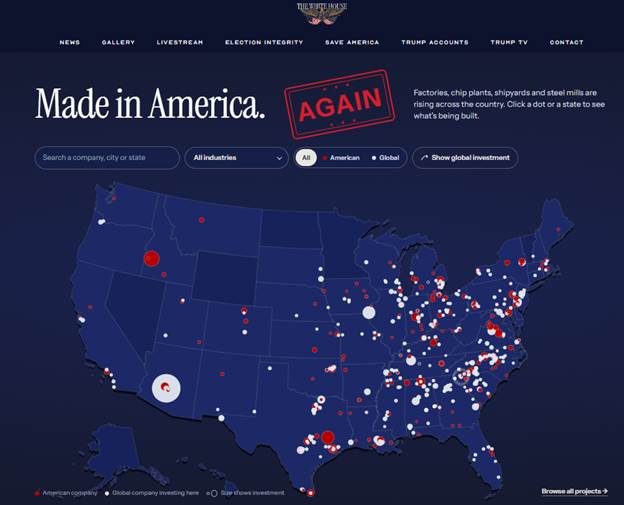
A few highlights by the White House include Becton Dickinson with a $19 billion multiyear U.S. investment (with $3 billion directed to manufacturing expansion) aimed at producing 100% of the needles it sells in America using American-made steel and increasing domestic output of essential medical consumables. Other investments include AstraZeneca’s $1 billion expansion in Massachusetts and a South Korean energy package of up to $200 billion.
The briefing listed $31.3 billion in new investment commitments for the week led by Becton Dickinson, Google and Constellation Energy at $4.3 billion, and Anduril, and a cumulative figure of $11.3 trillion in U.S. and foreign investments since President Trump’s swearing in.
Learn more at the White House release on American industry page and the Manufacturing Investments Map.

Author: Mario Lotmore