

A little-known polling outfit that had quietly inserted itself into major election averages this cycle acknowledged Tuesday that the vast majority of its surveys were fabricated, describing the effort as an experiment to expose weak vetting in the political research industry.
Wedgewood Polls issued its statement hours after FiftyPlusOne, an election analysis site, contacted the firm about irregularities in raw data from a recent Mississippi Senate survey. The Wedgewood Polls website is no longer available online.
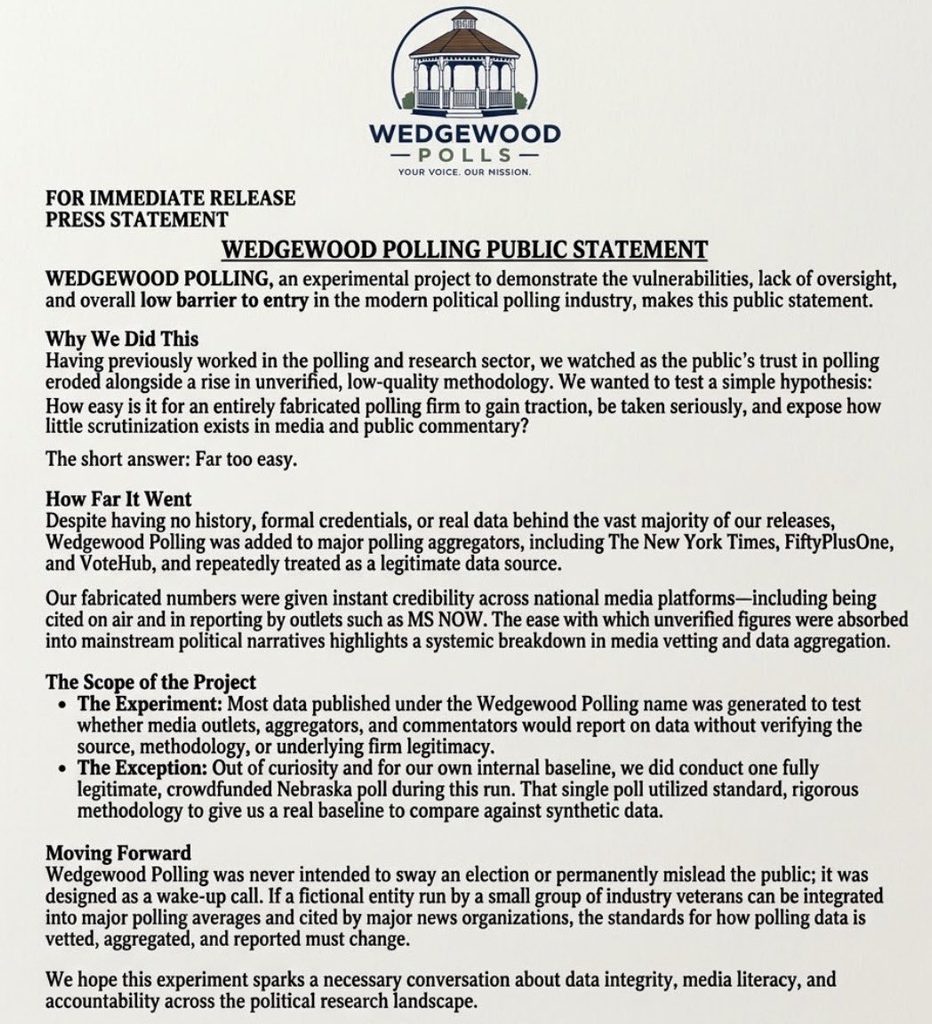
Wedgewood Polls wrote that its polling was “an experimental project to demonstrate the vulnerabilities, lack of oversight, and overall low barrier to entry in the modern political polling industry.”
It continued: “Having previously worked in the polling and research sector, we watched as the public’s trust in polling eroded alongside a rise in unverified, low-quality methodology. We wanted to test a simple hypothesis: How easy is it for an entirely fabricated polling firm to gain traction, be taken seriously, and expose how little scrutinization exists in media and public commentary? The short answer: Far too easy.”




The poling firm said most of its surveys were synthetic.
“Despite having no history, formal credentials, or real data behind the vast majority of our releases, Wedgewood Polling was added to major polling aggregators, including The New York Times, FiftyPlusOne, and VoteHub, and repeatedly treated as a legitimate data source,” the statement said.

Wedgewood Polls pointed out in its statement that its fabricated polling numbers received airtime and coverage from outlets including MS NOW. It claimed it did conduct one genuine, crowdfunded poll in Nebraska using standard methods as an internal baseline.

The polling scandal unraveled when FiftyPlusOne researchers requested the underlying respondent-level data from Wedgewood’s Oct. 12–14 Mississippi survey, which the firm said was fielded via the Pollfish platform. Analysis of the file revealed anomalies inconsistent with authentic Pollfish records, including irregular respondent identifiers, timestamp patterns and other markers. When confronted on Oct. 20 with the findings and a request for comment, Wedgewood posted its admission that it was an “experimental project” rather than providing a detailed response.
FiftyPlusOne’s investigation also pushed back on Wedgewood’s claim that aggregators had accepted its numbers with almost no scrutiny. When researchers first contacted the firm months earlier to learn who was behind it and to review its methodology statement, Wedgewood provided the names Jack Sims and Andrew Prater.
FiftyPlusOne independently confirmed that Sims had prior experience in the polling industry, which helped explain why the new firm was initially treated as a plausible entrant rather than an obvious fabrication. However, Wedgewood had presented itself as legitimate by collecting donor money for crowdfunded polls and, on October 15, by sharing raw survey data—data that FiftyPlusOne investigators later confirmed was fraudulent.
Major polling aggregators moved quickly to purge Wedgewood Polls numbers. The New York Times removed 15 Wedgewood polls from its tracking project. Decision Desk HQ said it deleted 17 from its race-level lists and averages. Other platforms that had incorporated the data, including VoteHub and Nate Silver’s Silver Bulletin, also dropped them.
Industry group AAPOR condemned the fabrication, stating there is “no basis for intentionally fraudulent behavior that misleads the public” and that such actions undermine legitimate survey research. Mary Losch, AAPOR’s president, said the episode was part of a pattern of bad actors distributing made-up data.
Surveys function as a litmus test for candidate viability, donor interest and media narratives, yet the same numbers can shape voting behavior through bandwagon effects, strategic decisions by campaigns and shifts in volunteer or contributor enthusiasm.
In Michigan’s Democratic U.S. Senate primary, a late-June Wedgewood survey showed state Sen. Mallory McMorrow at 9%, trailing Abdul El-Sayed and Rep. Haley Stevens. McMorrow later said the release dried up donations, demoralized volunteers and intensified pressure to exit; she dropped out July 5.
In Mississippi, a Wedgewood poll released around the time Sabato’s Crystal Ball shifted its rating of the race from Safe Republican to Likely Republican showed incumbent Sen. Cindy Hyde-Smith leading Democratic challenger Scott Colom by only a narrow margin. Days later, Senate Majority PAC—the primary outside spending vehicle aligned with Senate Democrats—announced a $1.2 million television and digital advertising buy supporting Colom in the very deep-red state won by President Donald J Trump with an almost 23-point spread.
This is not the first recent case of admitted fabrication. In August, Median Strategies publicly stated that polls it had released on the Wisconsin gubernatorial primary and the Los Angeles mayoral primary were not based on real interviews, describing the work as a “short-term social experiment.” That earlier admission prompted similar removals from aggregators and renewed scrutiny of low-barrier entrants that rely on online panels and limited transparency about personnel or methods.
Wedgewood framed its project as a wake-up call rather than an attempt to election interference.
“If a fictional entity run by a small group of industry veterans can be integrated into major polling averages and cited by major news organizations, the standards for how polling data is vetted, aggregated, and reported must change,” the statement said.
Critics, including researchers at FiftyPlusOne and officials at AAPOR, countered that the timing of the admission—coming only after a request for comment on specific evidence—undermined the claim of pure experiment, and that collecting money while distributing fabricated results raised separate ethical and potentially legal questions.

Author: Mario Lotmore