

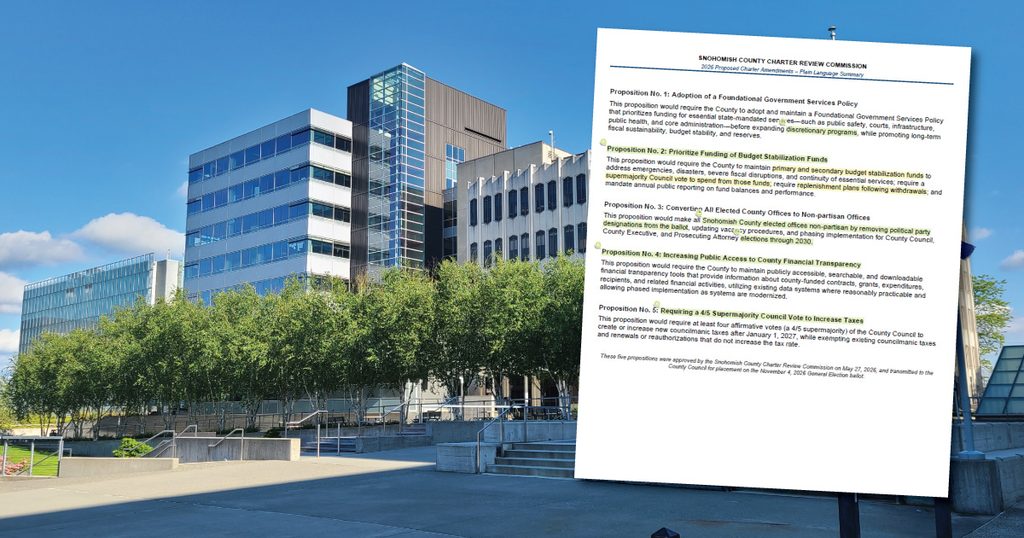
EVERETT—Snohomish County voters will decide five proposed amendments to the county’s home rule charter on the November 3 general election ballot. The measures, forwarded by the 15-member Charter Review Commission after months of meetings, would require prioritization of core government services, create a dedicated catastrophic reserve fund, convert all county elected offices to nonpartisan status, expand public access to financial data, and raise the threshold for new council-imposed taxes.
The 2026 Snohomish County Charter Review Commission consists of Chair Mark James of District 1, Vice Chair Janelle Cass of District 3, Rob Toyer of District 1, Don Vanney of District 1, Demi Chatters of District 2, Shawn O’Donnell of District 2, Jennifer Gregerson of District 2, Patrick Decker of District 3, David Preston of District 3, Ben Mahnkey of District 4, Dale Kaemingk of District 4, Amanda Dodd of District 4, Robin McGee of District 5, Carolyn Eslick of District 5, and Steve Ewing of District 5.
Brett Gailey of District 5 served as chair for most of the commission’s work before resigning in early May 2026 to relocate out of the state for work. Steve Ewing was then appointed to fill the vacancy left by Gailey and Mark James assumed the role of chair.
The commission, elected in November 2025 and seated in January 2026, reviewed 25 sponsored proposals before advancing the final five propositions to voters. Four commissioners declined to sign the formal transmittal letter, concerned that public input was sidelined and that several measures lack sufficient vetting. Charter Review Commission leadership told the Lynnwood Times that an established process was followed that produced the super majority-supported propositions that are now in front of voters.


How the commission works and how it selected the five
The Snohomish County Charter, adopted by voters in 1979 and effective in 1980, functions as the county’s local constitution. It replaced a three-member commission form of government with a five-member County Council and an elected county executive, separating legislative and executive powers. The charter requires voters to elect a 15-member Charter Review Commission — three from each of the five council districts — at least once every 10 years to examine the document and propose updates.

Charter Review Commissioners serve unpaid one-year terms. The 2026 body held 13 public meetings totaling 26.95 hours of testimony and debate between Jan. 14 and May 27, meeting in Everett, Lake Stevens, Arlington, Monroe and Mountlake Terrace. This included three public hearings on the final proposals. Public ideas could be submitted, but only those sponsored by a commissioner advanced to discussion for consideration.

According to Chair Mark James and Vice Chair Janelle Cass the narrowing process from 25 proposals to five involved staged votes. A proposal needed five votes to receive staff research, including financial-impact analysis. It then needed seven votes to proceed to legal review by commission counsel with final advancement to be placed on the ballot requiring eight votes.
James described the deliberations as involving “robust debate and discussion.” Cass shared that several proposals reached legal review but did not advance because they appeared unlikely to withstand a legal challenge. One public submission, a voter-identification idea, was never sponsored.
On May 28, the commission transmitted the five approved measures to the Snohomish County Council. On June 3, Council Chair Megan Dunn (D-Everett) directed the clerk of the council to forward the five commission-approved amendments to County Auditor Garth Fell for ballot placement.
County Treasurer Brian Sullivan (D-Everett) was instrumental in developing two of the five amendments — Proposition 1 and Proposition 2 — Charter leadership told the Lynnwood Times. The proposed five amendments require a simple majority approval on the general election ballot to be incorporated into the charter.
Proposition 1: Foundational Government Services Policy
This measure would require the county to adopt and maintain a Foundational Government Services Policy that prioritizes funding for essential state-mandated services — such as public safety, courts, infrastructure, public health and core administration — before expanding discretionary programs.
In plain terms, the county would have to prioritize things like public safety (sheriff’s deputies and the prosecutor’s office), the courts, core infrastructure such as roads and bridges, public health, and the basic administrative offices needed to run county government. Only after those “gotta-haves” are covered could the county expand other programs. The goal is to protect long-term fiscal stability, keep the budget balanced, and maintain reserves. The amendment would add a new section to Article 6 of the charter and direct the County Council to adopt implementing policies by ordinance.
County Treasurer Sullivan, who has worked in city and county government since 1985 and calls himself a “budget hawk,” proposed the idea to the commission. He told the Lynnwood Times that governments are often poor at protecting core services once special interest groups lock in long-term funding for projects that start as temporary.
“Oftentimes that turns into long-term funding,” Sullivan said. “It’s not meant to, but often once a commitment’s made.”
Modeled in part on a similar policy in Sonoma County, the measure would use the charter to require the County Council and executive to put constitutionally and state-mandated functions first.
Sullivan pointed to real pressures he sees impacting the county: the prosecutor’s limited ability to handle serious misdemeanors and an estimated shortage of roughly 100 sheriff’s deputies across a county that runs from Puget Sound to the Cascade Mountains. He shared that the that Snohomish County went nine years without taking the annual 1% property-tax increase that Pierce County has regularly used—a choice he said has left Snohomish County with a general fund roughly $120 million smaller than Pierce’s comparable one.
“Putting the bookends on it provides future county councils and future executives to help them make those tough decisions,” Sullivan said, so they can tell residents in a tight budget year that the priority is “the sheriffs and prosecutors in the courts.”
Commission Chair Mark James described the measure as focusing on the “basics”—public safety, courts, infrastructure, public health and core administration—because those are easier to define than discretionary spending.
The proposed amendment, sponsored by Commissioner Shawn O’Donnell after Sullivan submitted it, advanced the 15-member commission unanimously.
Proposition 2: Budget Stabilization Funds
This measure would require the county to maintain primary and secondary budget stabilization funds to address emergencies, disasters, severe fiscal disruptions and continuity of essential services. It would require a supermajority council vote to spend from the funds, require replenishment plans after withdrawals, and mandate annual public reporting on fund balances and performance. It adds a new section to Article 6.
County Treasurer Brian Sullivan, who created the existing primary stabilization fund in 2009, told the Lynnwood Times the idea grew directly out of the 2014 Oso landslide. From 2009 to 2017, he said, only about $10,000 was deposited in that fund. When the slide hit — a declared statewide emergency — the county spent roughly $20 million in six weeks.
“We went from the 11 reserves… down to literally almost nothing,” Sullivan said. “And if it wasn’t for the refunds from the state and federal government, the county would have been in default.”
The experience showed the danger of relying on one-time reimbursements that may not arrive quickly, or at all, Sullivan shared. The new secondary fund is designed so that any state or federal reimbursements must go back into the reserve rather than the general fund, keeping it available as “insurance.”
“The one thing that governments are bad at is plugging one-time monies into long-term programs,” he said.
The primary stabilization fund now holds about $16.5 million and has been cited by Moody’s as a factor in the county’s AAA rating. Sullivan later learned that this primary stabilization fund was being counted inside the county’s required operating liquidity reserve rather than sitting above it as intended, risking its availability for a true catastrophe.
The proposed secondary catastrophic fund would be held separately under the treasurer’s administration, initially seeded with 10% of the primary fund’s balance, and grown with investment earnings and one-time revenues.
Access still requires four council votes — the same threshold that has always applied to the primary fund, Sullivan told the Lynnwood Times. Any state or federal reimbursements would return to the fund rather than be absorbed into the general fund.
Chater Commission Vice Chair Cass added that the primary stabilization fund “can be tapped into so readily” for general-fund shortfalls that it may not be there for “the next Oso or the next big crisis.” She said that the secondary stabilization fund would be a true rainy-day reserve for events such as a major earthquake, landslide or wildfire.
The proposal, sponsored by Commissioner Demi Chatters after submission by Sullivan, advanced unanimously by the commission.
Proposition 3: Nonpartisan county offices
This measure would make all Snohomish County elected offices nonpartisan by removing political party designations from the ballot, updating vacancy procedures, and phasing implementation for County Council, County Executive and Prosecuting Attorney elections through 2030. It amends Sections 4.15 and 4.80 of the county charter and adds transitional provisions.
“There’s a place for partisanship and it’s state and federal,” said Commission Chair James, who sponsored the measure. “That’s where it should stay.”
He argued the change would require voters to evaluate candidates on their records and positions rather than party labels, calling it “more inclusive” than critics claimed. Vice Chair Cass said most county services are nonpartisan in nature and that many residents already elect nonpartisan city officials.
Commissioner Chatters, who voted against the measure, said it would reduce transparency by removing a key piece of information voters use to evaluate candidates.
“Every political party has a full public policy platform that they publicly post,” Chatters told the Lynnwood Times. “If you know what party someone’s affiliated with, you can go right to that party and find what their public policy platform is.”
She added that every public comment she has received calls for more transparency, not less, about candidates’ values and alignments.
“This is essentially a process of a job interview,” Chatters said. “When someone is seeking to be elected, they are asking the public to hire them for a job. So right off the bat, Proposition 3 starts by eliminating access to a very important data point.”
If passed, implementation is phased in over four years: candidates for Council Districts 2 and 3 and for county executive would appear without party designation in 2027; remaining council seats in 2029; and the prosecuting attorney in 2030. The current prosecuting attorney, elected in 2026, would complete a full partisan term.
The measure advanced 11-4. It was sponsored by James and drew support from a letter signed by nine Snohomish County citizens.
Proposition 4: Financial transparency
This measure would require the county to maintain publicly accessible, searchable and downloadable financial transparency tools that provide information about county-funded contracts, grants, expenditures, recipients and related activities, utilizing existing data systems where reasonably practicable and allowing phased implementation as systems are modernized. It adds a new section to Article 6.
Commission Vice Chair Cass, who sponsored the measure, said she revised the language after the chief budget officer analyzed the cost. An earlier version would have created a significant burden because the county is already under contract for a multi-year upgrade of its financial system. This final version focuses on modest improvements to what the county already collects so it can be made more usable without requiring major new investment.
“This is actually pretty common,” Cass said, pointing to “open checkbook” portals used by New York City, Buffalo and other large jurisdictions. “They have a page on their website that says, ‘Hey, look at our checkbook.’ You can sort, you can filter, you can download the data.”
There is no fixed deadline for full implementation. Commission Chair Mark James said the charter language still functions as a directive: the county “shall make available, where reasonably practicable through existing systems or future modernization efforts.”
Cass described the amendment as expressing voter intent rather than prescribing a rigid technical build-out.
“It’s sort of almost like a referendum of ‘please show us, please be more transparent with how you spend our money,’” she said.
Commissioner Chatters, who voted against the measure, called it “transparency theater,” arguing that a requirement for the county to “do its best” lacks enforceable standards or a timeline and that a more specific public proposal linking campaign donations to public contracts was rejected by the commission.
The measure advanced 11-4.
Proposition 5: 4/5 supermajority for new councilmanic taxes
This measure, that if passed would amends Section 2.20, would require at least four affirmative votes of the five-member County Council to create or increase new “councilmanic” taxes — those the council can impose without a public vote — after Jan. 1, 2027. Existing taxes and renewals or reauthorizations that do not increase the rate are exempt.
Commissioner Cass, who sponsored the measure, said the change is simply “one more person,” and not an extreme threshold. She said the idea grew out of conversations with residents frustrated by rising taxes and what they see as a lack of financial discipline by the Snohomish County Council.
“Every time taxes go up it has a really huge impact to the people who are on the fringes,” Cass said. “It just makes everything else cost more.”
She argued that requiring four votes would force broader consensus before new taxes are levied by the council alone. As an example of financial discipline, she pointed to Montgomery County, Maryland, which requires a unanimous vote to raise taxes and has maintained a AAA bond rating for 40 years.
Commissioner Demi Chatters, who voted against it, called the requirement a “super duper majority” that risks minority rule.
“We are a democracy and a democracy… is really a majority rule system,” Chatters said. “It’s just undemocratic for that to be the normal course of day-to-day operations.”
She alleged that the commission resisted seeking data on the potential effects of a 4 of 5 supermajority to pass tax increases, including an attempt to limit on-the-record discussion with the county’s chief budget officer. No outside experts, such as economists from the University of Washington, were called she said.
Chatters added that research she reviewed shows that supermajority tax rules can harm bond ratings, raising the cost of debt for taxpayers, and that the measure does not address the regressive tax structure many working-class residents complain about.
“The solution is not to grind our ability to operate our governments to a halt,” she said. “The solution is to look at how do we change our tax system so less of the burden falls on those working-class people.”
The measure advanced with a vote of 10-5.
The dissent letter and the debate over process
Four commissioners — Demi Chatters of District 2, Jennifer Gregerson of District 2, Amanda Dodd of District 4 and Robin McGee of District 5 — declined to sign the May 27 transmittal letter and submitted a statement of dissent to the Snohomish County Executive’s Office and the Snohomish County Council.
“This Commission did not meet its obligation to ensure that public voices were fully and fairly considered,” they alleged in a submitted letter of dissent.
In the memorandum signed by Chatters, Gregerson, Dodd, and McGee, they “respectfully decline to sign the transmittal letter” because of “serious concerns regarding the integrity, inclusiveness, and deliberative quality of this process.”
They wrote that public efforts “were too often met with procedural barriers, limited consideration, or outright dismissal” and that community-driven proposals “were effectively terminated at early stages without substantive discussion or analysis.”
Critically, they alleged in the letter that “the vast majority of substantive votes on proposed amendments occurred prior to the Commission’s public hearings,” so that by the time public comment was formally invited, “the proposals had already been largely decided.” This, they argued, “deprived the public of any meaningful opportunity to influence outcomes and reduced the hearings to a procedural formality.”
They also expressed concern that multiple amendments “will have the effect of reducing transparency, limiting public oversight, or otherwise undermining the interests of the voting public” and “were not sufficiently vetted for their long-term implications on democratic accountability.”
In a separate 37-minute interview, Commissioner Chatters told the Lynnwood Times that the ideal process would have begun with public hearings to let residents set the agenda rather than elected officials arriving with preset priorities.
“We really did this process backwards,” she said.
She described the amendment process as top-down and said proposals with broad public support were rejected while ideas advanced by officials—referring to County Treasurer Brain Sullivan (D-Everett)—with institutional power moved forward.
“It shouldn’t take that kind of power to be able to get your ideas heard with regard to how we modify our founding documents,” Chatters said.
Chatters told the Lynnwood Times that she assessed the process from the standpoint of whether it served the public and concluded it did not, which is why she signed the dissent rather than the transmittal.
She referred to two of her early proposals that were dismissed as examples of the commission not considering proposed amendments from the general public — a ban on county employees and elected officials engaging in paid lobbying, driven by concerns related to the commission coordinator’s appointment, and a measure she said was intended to align facility standards with nondiscrimination principles which was recorded in documents as “Requiring feminine hygiene products in county bathrooms.”
She also pointed to a rejected public proposal on campaign-finance transparency linking donations to contracts.
On the unsigned letter, Chatters said signing the transmittal would have been “a betrayal of what I promised the voters I was going to do.”
Chatters explained that she ran as a community advocate pledging to increase efficiency, transparency and the voice of residents and that the dissent letter was her “communicating to the public: I am here with you. I am in solidarity with you.”
She told the Lynnwood Times that she was grateful for the opportunity to witness the process and educate residents so the next cycle, in 10 years, can be improved.
Chair James said the dissent from the four commissioners appeared at the end of the final meeting and that the rest of the commission “had no idea that that was coming.” He called it “a little disappointing,” adding that once a group decision is made, members typically move forward even if they disagree.
In prior charter review cycles of 1986, 1996 and 2006, the transmittal letter carried all 15 signatures; and in 2016 only the chair and vice chair signed. The 2026 commission returned to the full-signature format even though there is no legal consequence for incomplete signatures on transmittal letters to the Snohomish County Council. The propositions proceeded to the auditor after the County Council accepted them.
Chair James viewed the dissent as the opinion of four individuals rather than an action of the commission. He and Cass described the overall consensus as strong, with an average of roughly 11 of 15 commissioners supporting the five measures.
James clarified with the Lynnwood Times that every meeting included public comment and procedures were followed with legal counsel present. Both he and Vice Chair Cass expressed pride in the commission’s work under a compressed timeline and respect for the voluntary service of all 15 members.
“I’m really proud of the work that the commission did… And then to carefully consider, you know, 25 proposals in less than five months, really, was a lot,” Cass said. “I have a lot of respect for each and every one of our commissioners that dedicated this their time and energy to the charter review.”

Author: Mario Lotmore