

SEATTLE — Washington voters on Tuesday decisively rejected Initiative 645, defeating a measure that would have repealed the state’s new 9.9% tax on annual individual income over $1 million before it takes effect. Early returns showed the “no” vote leading by a wide margin, roughly 58% (1,152,229 votes) to 42% (830,106 votes), with the measure trailing in King County by nearly two-to-one and also failing in other populous counties including Snohomish, Pierce, Clark, and Thurston.
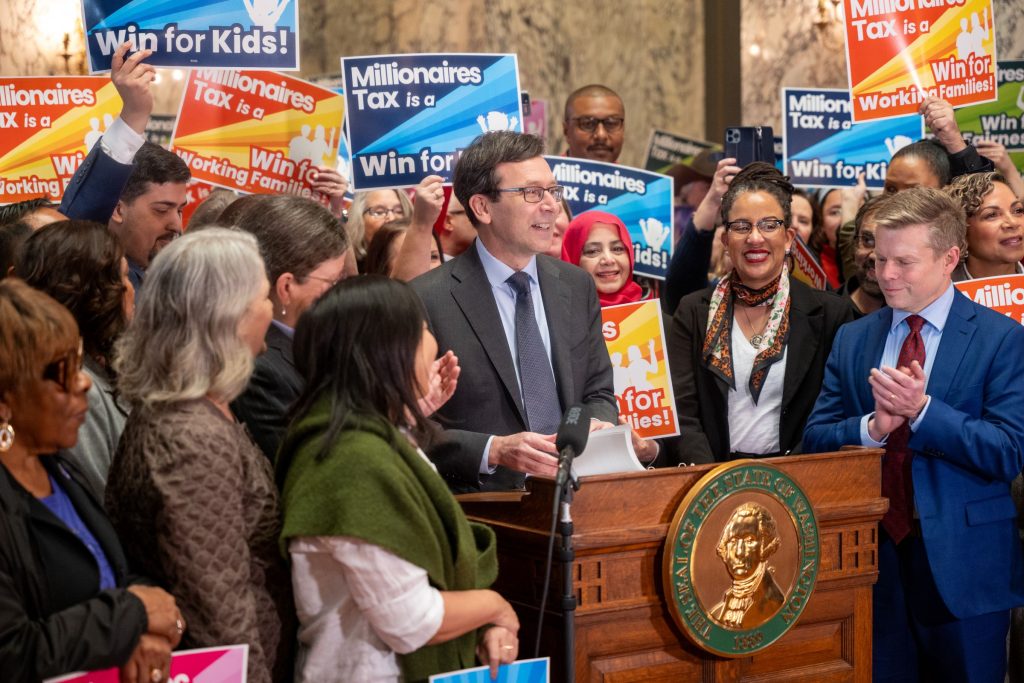
For now, the tax enacted earlier this year by the Democratic-controlled Legislature and signed into law by Gov. Bob Ferguson on March 30, remains in place.

SB-6346 passed the full Senate on a 27-22 party-line vote Feb. 16 and the House on a 51-46 vote March 10 after a near 25-hour Republican-led marathon debate. The new statewide income tax applies to both residents and nonresidents with Washington-sourced income, hits pass-through entities such as LLCs and S-corps while exempting C-corps, and carried a $1 million standard deduction.
The legislation aims to expand the Working Families Tax Credit to 460,000 additional families, fund free breakfast and lunch for every K-12 student, invest more than $300 million in affordable child care, reduce or eliminate the business-and-occupation tax for 138,000 small businesses, and remove the sales tax on baby diapers, over-the-counter drugs and hygiene products. However, none of this is specifically earmarked in the legislation as all of the revenues less 5% for attorneys, are deposited into the General Fund.




The income tax followed earlier revenue measures, including a capital gains tax enacted in 2021 and estate tax adjustments signed March 24, amid repeated budget shortfalls that reached $2.3 billion in the current biennium.

The bill took effect immediately upon signing, with collections scheduled to begin in 2029 and generate an estimated $3.5 billion annually from approximately 21,000 filers (or less than 0.3% of residents).

On the day of the bill signing, the Citizen Action Defense Fund (CADF) announced it was preparing to file a lawsuit challenging the income tax’s constitutionality. The group retained former Attorney General Rob McKenna to lead the litigation.
“Washington’s constitution is clear, and the courts have been equally clear for nearly a century—income is property, and progressive income taxes are unconstitutional under existing law,” McKenna said. “If the State proceeds with the new income tax, it will create a direct conflict with binding precedent and the constitutional protections that safeguard taxpayers. We are preparing to challenge the tax in court.”
Washington’s constitution has long-prohibited graduated income taxes, and any income tax is capped universally at 1%. A tax on one must be applied to all people and not a segregated class.
Separately, Let’s Go Washington announced it was launching a referendum to repeal the income tax. Founder Brian Heywood said the group filed the referendum because lawmakers and the governor ignored the state constitution.

A referendum allows voters to reject a law already passed by the Legislature. Citizens collect signatures to force the law onto the ballot for an up-or-down vote and is considered the “people’s veto” process. However, SB-6346 had a “necessity clause” in the income tax bill which normally blocks a referendum; once this is included, the law takes immediate effect (or on its stated date) and cannot be referred to voters for a repeal vote.
The referendum was rejected by the Secretary of State’s Office over the “necessity clause” and on Monday, May 4, 2026, Washington’s Supreme Court denied Let’s Go Washington’s request to pursue an attempt to repeal the state’s new income tax law with a referendum for the fall.
Then on Tuesday, May 12, Let’s Go Washington launched a signature-gathering campaign for initiative IP26-645 to repeal Washington’s newly enacted 9.9% tax on household income above $1 million and place the issue before voters on the November 2026 ballot. And on July 2, Let’s Go Washington delivered 511,408 signatures to the Washington Secretary of State’s office for Initiative to the People IP26-645,
Tuesday night’s election result marks a historic shift the electorate’s sentiment regarding income tax. Washington voters had rejected personal or corporate income tax proposals roughly a dozen times over the past century, most recently Initiative 1098 in 2010. Now, as the first statewide endorsement of an income tax with a rejection of the Heywood-backed initiative, Washington voters have handed lawmakers in Olympia the green light to implement a California-style income tax system.
Because Democrats achieved a supermajority in the House on Tuesday and are poised to gain the two seats needed for a supermajority in the Senate in 2028, constitutional amendments to allow an income tax scheme could be proposed to Washington voters for a second vote. Now if CADF wins their State Supreme Court case, the Democrats do have the votes now to implement a tax over multiple income brackets as long as it is the same percentage. However, in another scenario, if the court rules that income is not property, then, an income tax scheme can be signed into law without a final vote to the people.


Since 2004 California has had and continues to have a “Millionaires’ Tax” which started at 1% and now 14.3%.
In 2004, California voters approved Proposition 63, known as the Mental Health Services Act, which imposed an additional 1% tax on taxable income exceeding $1 million. This was explicitly described as a “millionaire tax” in economic analyses and was designed to fund mental health services. It took effect in 2005 and remains in place today.
In 2012, Proposition 30, introduced by former Gov. Jerry Brown (D), imposed higher marginal income tax rates for high earners, including a top rate of 13.3% on incomes over $1 million (for single filers; brackets are doubled for joint filers). Proposition 30 added three new personal income tax (PIT) rates for “very-high-income” earners in California through 2018:
- A 10.3 percent tax bracket for single filers’ taxable income between $250,001 and $300,000 and joint filers’ taxable income between $500,001 and $600,000;
- An 11.3 percent tax bracket for single filers’ taxable income between $300,001 and $500,000 and joint filers’ taxable income between $600,001 and $1 million; and
- A 12.3 percent tax bracket for single filers’ taxable income above $500,000 and joint filers’ taxable income above $1 million.
So, the California Millionaires’ Tax expanded to a “Very-High-Income” Tax starting at $250,001. This were to sunset in 2018, but was extended through 2030 with the passage of Proposition 55 in 2016. Combined with the 1% Millionaires’ Tax passed in 2004; this resulted in an effective top state income tax rate of 14.3% for those earning over $1 million.
A proposed new “Billionaire Tax” in California, Prop 40, was rejected by voters on November 3, 2026, with a “no” vote of 4,280,110 votes (55.6%) to 3,419,652 votes (44.4%).
The 2026 Billionaire Tax Act proposed a 5% annual tax on California’s billionaires’ net worth exceeding $1 billion, starting January 1, 2027, to raise $20-40 billion yearly for healthcare, but included residency rules that taxes former residents for five years post-departure.

Author: Mario Lotmore