

Four years after an analysis by the Lynnwood Times framed Russia’s early wartime pivot toward Chinese payment systems as evidence that the yuan stood at the precipice of becoming a genuine alternative global reserve currency, recent data now shows the experiment has largely stalled under the weight of U.S. secondary sanctions.
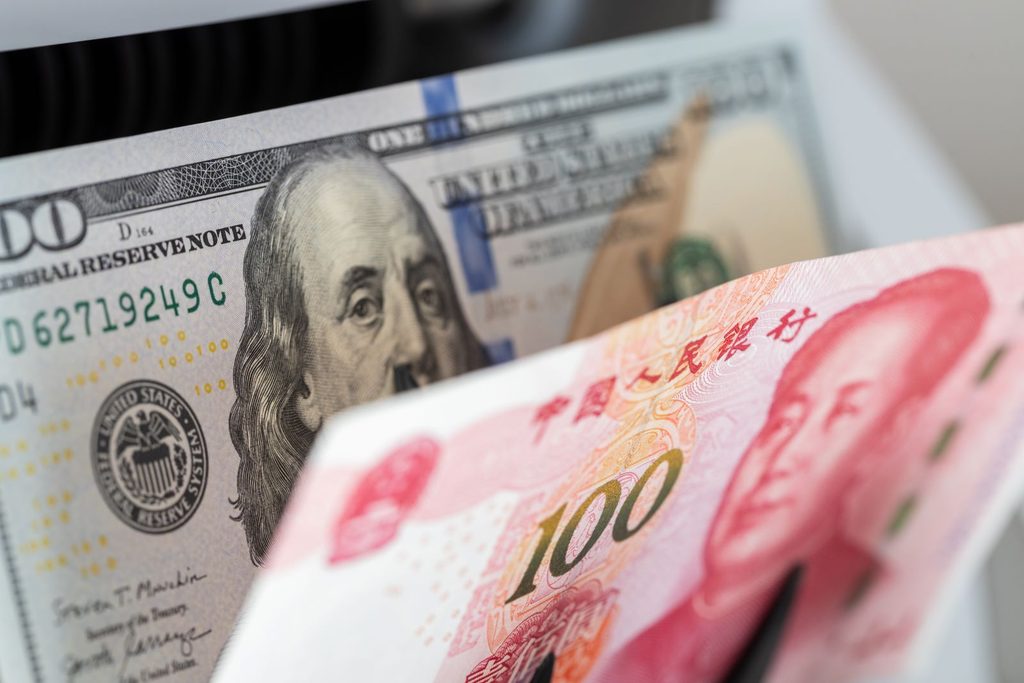
Bloomberg reported this week, drawing on Russian central bank figures, that the yuan’s share of settlements for Russian exports has fallen by roughly half from its mid-2024 peak to 22 percent. In trade with Asia, Russia now receives about 69 percent of its export revenue in rubles.
The shift followed the June 2024 expansion of U.S. secondary sanctions, after which many Chinese banks restricted or halted cooperation with Russian counterparties, froze payments, and returned funds to avoid exposure to American penalties. Some channels via intermediaries continue to operate, but sources, according to Bloomberg, familiar with the flows described them as slower, costlier, and unreliable.
The yuan’s share of global payments has also returned toward pre-war levels, according to SWIFT data in the same reporting. At its peak in mid-2024, the yuan ranked fourth in SWIFT international payments (4.7 percent) behind the dollar, euro, and pound. It has since dropped back to fifth place to around 2.7–3.3 percent.

This latest developments tested a thesis advanced in a March 6, 2022, article in the Lynnwood Times titled, Chinese Yuan at the precipice to becoming an alternative Global Reserve Currency, published days after the full-scale invasion of Ukraine by Russia and the suspension of Visa and Mastercard services in Russia.


Back in 2022, major Russian lenders including Sberbank, Alfa Bank, and Tinkoff Bank were moving to issue cards on China’s UnionPay network, then the world’s second-largest. The Lynnwood Times pointed to China’s Cross-Border Interbank Payment System (CIPS) as a parallel to SWIFT and argued that none of the other BRICS member states were joining Western sanctions. The article described the conflict as providing an “excuse” for the group—then accounting for roughly 41 percent of world population, 24 percent of GDP, and 16 percent of trade—to accelerate a move away from the dollar established under the 1944 Bretton Woods system.
The Lynnwood Times contrasted BRICS gold reserves of about 5,259 tons against the United States’ 8,133 tons, U.S. debt-to-GDP ratios above 130 percent with lower figures among the BRICS member states and highlighted rapid growth in the U.S. money supply. It warned that further integration of Russian banks with non-Western systems could prompt fellow BRICS members to follow, potentially enabling a remonetization of gold under a yuan-linked arrangement.
“The risk of Russia and China leading BRICS nations to transition from the U.S. dollar is a real threat,” the article stated, warning of possible further dollar devaluation and inflation if the shift materialized. China, the article concluded, was positioned as a key beneficiary of the global “banking war.”
Now, four years later has produced partial confirmation of the directional forecast with a reduced Russian dependence on Western financial infrastructure for specific trade corridors.
Russia did sharply increase yuan usage in foreign-trade settlements, with the currency at one point approaching half of such transactions and becoming the most-traded on the Moscow Exchange. Bilateral China-Russia commerce has remained elevated and is predominantly settled in local currencies rather than the dollar. BRICS expanded its membership and continued discussions of local-currency mechanisms and alternative payment arrangements.
The reversal in broader yuan adoption for Russian exports, however, shows the constraints that the 2022 analysis treated more lightly relative to geopolitical incentives.
Chinese financial institutions remained integrated with dollar clearing and global markets; secondary sanctions raised the commercial cost of facilitating Russian activity enough to prompt widespread caution. After the U.S. significantly widened the grounds for secondary sanctions on financial institutions and companies dealing with Russia in June 2024, “Payments were frozen or delayed for months, transfers were sent back, and China’s largest lenders stopped dealing completely with Russian counterparties.”
Even where bilateral local-currency settlement continues, payment routes have grown more complex, often requiring intermediaries in third countries and producing delays or rejections eventually resulting in Chinese banks “retreated in the face of threatened US secondary sanctions.”
The yuan simply has not evolved. Its share of official global foreign-exchange reserves remains in the low single digits (around 2 to 3 percent), while the U.S. dollar continues to dominate both reserves and transaction volumes at 56.70% or roughly $7.49 trillion. The Euro is third at 20.60% of global foreign-exchange reserves.
Observers have long pointed to structural limits on yuan internationalization, including capital controls that preserve Beijing’s policy autonomy but restrict offshore liquidity and the willingness of foreign holders to accumulate large balances. Now, four years later, the Russian case illustrates how those features interact with external pressure: when U.S. secondary sanctions widened, Chinese banks largely prioritized continued access to the U.S. dollar system over sustaining the full scope of Russia’s pivot to the yuan. The result has been a retreat from the yuan as a wide-ranging substitute to the U.S. dollar as the world’s reserve currency, greater reliance on the ruble for Asian export proceeds, and higher transaction costs rather than a seamless parallel architecture.

Author: Mario Lotmore