

WASHINGTON, D.C — The Federal Communications Commission on Wednesday authorized SpaceX to deploy up to 1 million satellites called “Starmind” that would serve as orbital data centers, the first U.S. approval of its kind for space-based computing infrastructure.
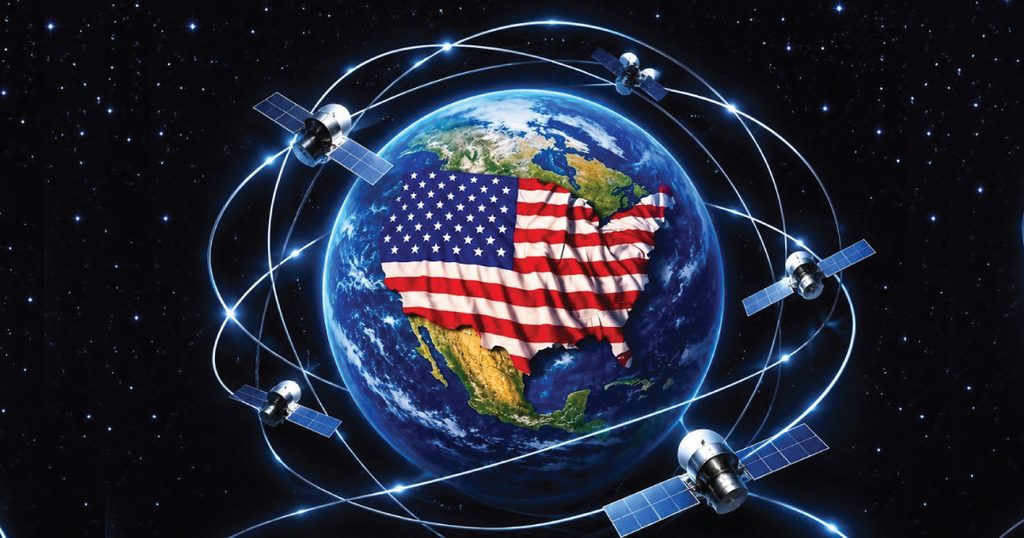
The Space Bureau’s order, released Nov. 25, grants Space Exploration Holdings LLC authority for the “Starmind” constellation of non-geostationary satellites. The system is designed primarily as solar-powered compute modules to process data for use on Earth, with the FCC describing it as advancing American leadership in artificial intelligence and bringing the planet closer to a Kardashev Type II civilization capable of harnessing the full power of the sun.
“America is leading the world into the era of super intelligence,” FCC Chairman Brendan Carr wrote in teh announcement. “Under President Trump’s leadership, the United States is moving decisively to ensure that this breakthrough technology creates opportunity, drives investment, and delivers lasting benefits for the American people. The FCC supercharges that effort today by granting, for the first time ever, authorization to deploy 1 million orbital compute modules for data centers in space. This action opens a bold new frontier for the computing infrastructure needed to power America’s leadership and growth.”
SpaceX CEO Elon Musk replied on X to the announcement, writing, “Much appreciated. This will be a great asset to America and the world.”


DATA CENTERS IN SPACE🇺🇸
Today, in a historic first, the FCC approved SpaceX’s request for 1 million satellites (orbital compute modules) to create data centers in space
The Starmind & competitor constellations will use solar power to extend America’s lead in Super Intelligence pic.twitter.com/VJinjK5e5E— Brendan Carr (@BrendanCarrFCC) November 25, 2026

The authorization covers satellites in orbital shells spanning 50 kilometers at altitudes from 500 to 1,002 kilometers, in roughly 30-degree and sun-synchronous inclinations. Primary communications will rely on optical inter-satellite links, including connections to SpaceX’s existing Starlink network. The order permits backup and emergency telemetry, tracking and command only in the 18.8-19.3 GHz (space-to-Earth) and 28.6-29.1 GHz (Earth-to-space) bands, on an unprotected, non-interference basis.
Several waiver requests were granted, including for processing-round rules, surety bonds and prior milestone schedules.
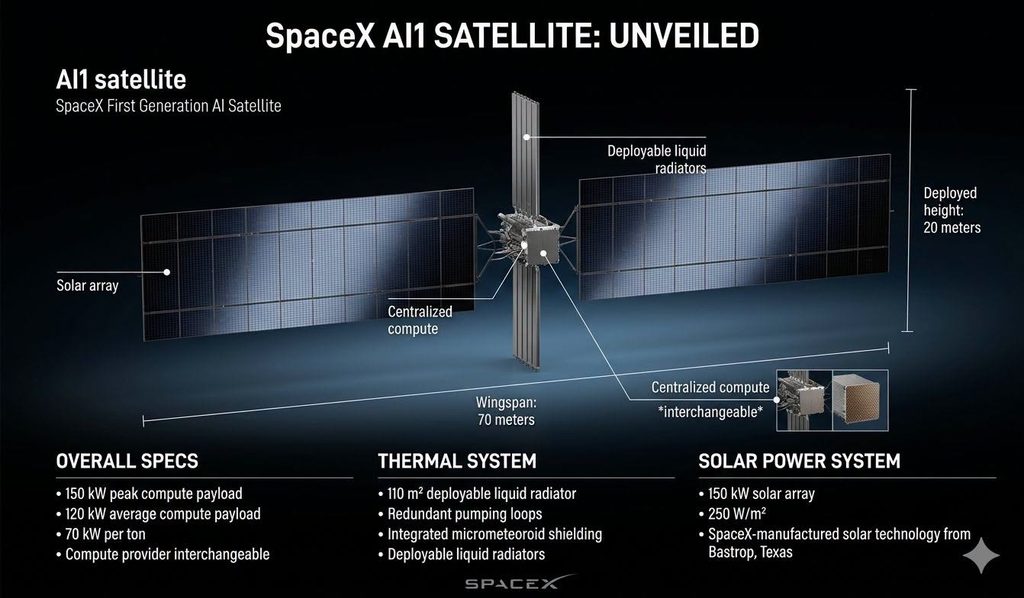
The first-generation AI1 satellites are large by current standards. Designs call for a deployed height of about 30 meters, a solar-array wingspan of up to 75 meters, and mass of up to 4,000 kilograms. Each is planned to carry Nvidia Vera Rubin NVL72-class compute hardware rated for up to 250 kilowatts peak and roughly 175 kilowatts average, powered by large solar arrays and cooled by liquid radiators that reject heat into space. The satellites will operate in clusters of roughly 10 units linked by high-bandwidth optical connections to create coherent compute capacity.
SpaceX is building a Gigasat manufacturing facility in Bastrop, Texas to support AI1 satellite production, and has contracted with Germany’s Singulus Technologies for high-efficiency heterojunction solar-cell production equipment, with the first line valued at more than $67 million and targeted for delivery in the first half of 2027.
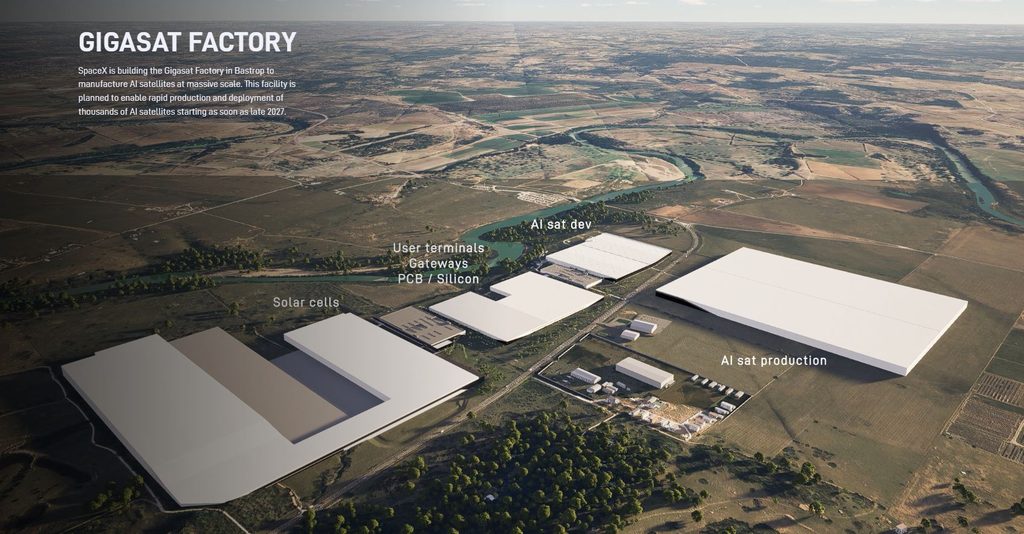
SpaceX has described ambitions to scale solar manufacturing equipment toward 100 gigawatts of capacity.


Deployment of the AI1 satellites is expected to rely on Starship launches from Starbase in Texas, with additional capacity potentially coming from a planned Louisiana site. Musk has estimated that initial Starmind computers could reach orbit as early as the third quarter of 2027. The FCC order requires the first satellite to be deployed and operated by Nov. 25, 2033, with 10% of the constellation by 2035, 50% by 2038 and the full 1 million by 2040, or the authorization becomes null and void.
The push for orbital data centers stems from constraints facing terrestrial facilities such as limited land and power, local community opposition, water use for cooling, and electric grid interconnection delays as demand for AI computing surges. In space, continuous or near-continuous sunlight in sun-synchronous orbits supplies energy without nighttime batteries on the same scale, and the vacuum of space allows radiative cooling without water or large mechanical chillers.
However, technical challenges remain. Radiation in low Earth orbit—including galactic cosmic rays, solar particle events and effects from solar flares or coronal mass ejections—can cause single-event upsets, bit flips in memory and long-term degradation of chips and solar arrays. Space weather can also increase atmospheric density and drag. Thermal management is constrained to radiation only, requiring large radiator surfaces that add mass and can degrade over time.
At the proposed scale, collision avoidance, orbital debris mitigation and the logistics of replacing hardware every few years pose further difficulties. The order requires SpaceX to provide additional debris-mitigation details before operating satellites above 600 kilometers.
Beyond dedicated data-center workloads, the Starmind platforms’ large solar arrays, laser mesh and modular design could support distributed edge inference (AI model predictions across many smaller compute nodes rather than a central data center) or other compute-intensive applications that benefit from the same power and communications architecture.
Independent cost estimates for a full million-satellite AI data center constellation vary widely into the trillions of dollars depending on Starship launch economics and hardware pricing, though SpaceX has not published an official valuation. The optimistic volume-production is estimated at roughly $1–5 million per satellite with a high-end cost of $50–500+ million for early production unit. Launch-only costs are in the $20+ million range at current Falcon 9 prices.

Author: Mario Lotmore