


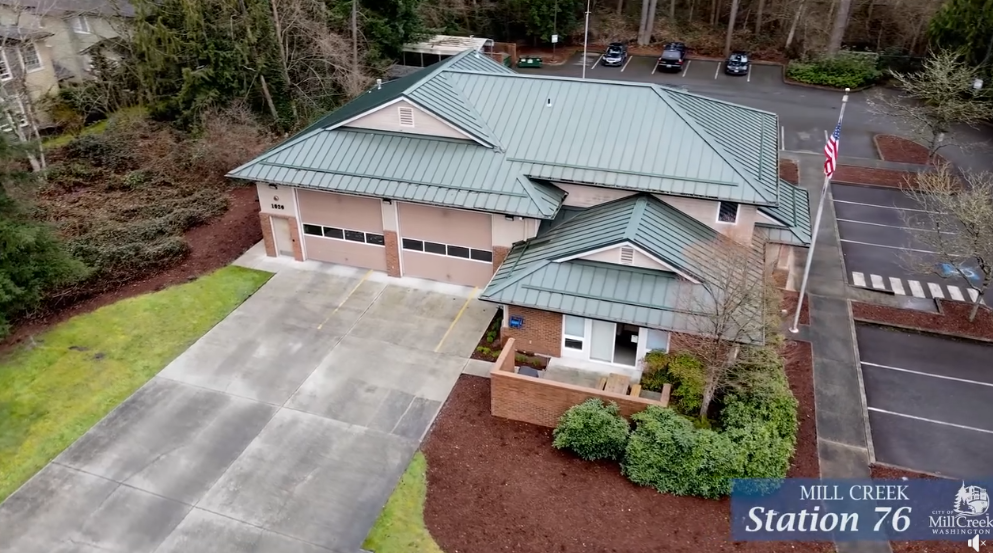
MILL CREEK—Both Mill Creek residents and Mill Creek City Council are furious with South County Fire for violating its contract and relocating Station 76 staff to Martha Lake with little to no communication or public outreach. The South County Fire Board of Commissioners is set to continue the discussion at its upcoming board meeting scheduled for Wednesday, August 6, at 7 p.m.

Back in April of 2022, Mill Creek residents overwhelmingly voted in support of Proposition 1 (75.42%) in favor of annexing into South Snohomish County Fire & Rescue Regional Fire Authority (South County Fire) to provide fire and emergency medical services.



As part of that agreement, South County Fire promised to staff the Mill Creek Fire Station (Station 76) with the same number of firefighters, paramedics, and emergency personnel as before the annexation was approved. However, the Fire Authority broke that promise by transferring Station 76 paramedics to Station 21 in Martha Lake where they said the demand for medical services is much larger.
In addition to this, there was virtually no communication of this staff transfer with either the City of Mill Creek or Mill Creek residents.




South County Fire Chief Bob Eastman, joined by Commissioner Jim Kelly and three assistant Chiefs, met with Mill Creek City Council during a Special Session July 29 to address how the shift would impact services in the community.


During that meeting, Chief Eastman said throughout the beginning of 2025 the RFA determined that if every city was a part of the RFA they would not have to “look at the prescriptiveness of contracts.”
South County Fire currently serves nearly 300,000 residents but that number has been rapidly increasing over recent years, Chief Eastman said. To keep up with the pace, the fire authority has been paving its long-term goals by reviewing things like staffing and need for capital (future fire stations in this case).
“If you look at where this organization needs to go, you can’t just look at it at a year-by-year timeline. You have to look at the long term,” said Chief Eastman.
Stations 18, 19 (Brier, Mountlake Terrace), 20, 16, 17 (Edmonds) are all cross staffed, for example, meaning each of those stations have an engine and a transport vehicle (this can be either advanced life support with paramedics, or basic life support with EMT’s), and the type of call would determine which unit the three fully staffed firefighters took.
In other words, if the type of call requires an ambulance and a transfer to a hospital – which tends to be a longer call – it effectively leaves that station unprotected, Chief Eastman explained.
“You can’t think of individual stations anymore, you have to look at the network of stations,” said Eastman.
South County Fire Assistant Chief Jason Isotalo added that RFA’s response data shows a bigger need for staffing in areas of higher call volumes (such as the I-5 and 99 corridors).
Mill Creek Mayor Brian Holtzclaw asked Chief Eastman what was done to reel in community input noting that it took the city “off-guard” when they learned about it at public comment.
Chief Eastman admitted that the conversations were had during internal board meetings and there was no community outreach, or official press releases published. These meetings are, however, open to the public (both in-person and remotely).
In fact it wasn’t until Monday, August 4, when South County Fire notified the public, via a press release, of its new emergency services model, a week after the City of Mill Creek voiced their disappointment.
Mill Creek City Council member John Steckler echoed Mayor Holtzclaw’s sentiments saying he is “not happy with” the decision to relocate Station 27 given the “long conversations” about annexing to South County Fire, having been promised the fire house would stay the same.
Steckler called the move a “bait and switch” seeing as the city awarded the contract with South Fire but then received reduced services, with the on-site paramedic at Station 76 having been already relocated to Martha Lake.
“You made a comment that you were concerned about your city contracts, and I think you should be because in the spirit of those contracts I think you violated it,” said Steckler. “That was not what we agreed to, that was not what we thought we were getting into a partnership with you for.”
Last year when the City of Mill Creek published a press release for Mill Creek voters – regarding the annex – it promised the Mill Creek station would continue to operate 24 hours a day with the same number of firefighters and apparatus, based on conversations they had with South County Fire. What would change, that release stated, is only how voters would pay for fire services. But that has not been the case.
“I get the operational issues. I’m not a firefighter and it probably makes complete sense but what baffles me is the lack of public engagement,” said Mayor Holtzclaw. “That’s what is disappointing and frustrating to me. I would not rely on the public attending board meetings to get their information and it’s going to reflect poorly on us. They’re not going to look at you guys they’re going to look at the seven people on this council and, when they go to make a decision on something, they’re going to say, ‘well you told us nothing was going to change with our fire department’ so how can we trust you with this?”
Mayor Pro-Tem Stephanie Vignal echoed Mayor Holtzclaw’s sentiments hammering in that there must be a better line of communication between the city and the Fire District going forward, as well as with the public.
Holtzclaw asked Assistant Chief Isotalo if South County Fire took into consideration, regarding their data, the City of Mill Creek’s recent Comprehensive Plan which expanded zoning in a subarea south of the city. Isotalo replied that he was “not aware” of the new city boundaries.
Chief Eastman added that the Fire Authority receives a monthly data dump and staff reallocation in the future can be adjusted according to demand.
Mill Creek Vincent Cavaleri chimed in to say it appears as though South County conducted its research, and decision to reallocate resources, in a “vacuum,” also voicing his disappointment with South County Fire’s lack of transparency.
South County Fire’s new emergency services deployment model will add three additional firefighters each day across 15 fire stations, it says. In total, 69 firefighters will be on duty during the day and 67 at night. Fire apparatus will be mostly dedicated and not cross-staffed, meaning the same crew will not be used to staff multiple apparatuses such as an ambulance and fire engine, except in times of high need and increased staffing. This will make those engines and ambulances more reliable.
A minimum of 22 firefighters respond to a house fire and a minimum of 34 firefighters respond to a commercial building fire, according to South County Fire.
The decision to relocate medical personnel from Mill Creek to Martha Lake, according to the Fire Authority, is because Station 76 (in Mill Creek) is surrounded by four other South County Fire stations within a roughly four-mile radius. Martha Lake, where call demand is much higher, is centrally located to other communities in the RFA and houses a technical rescue engine and the only emergency vehicle carrying whole blood in all of Snohomish County.
Mill Creek City Councilman Sean Paddock agreed the decision to do this makes a lot of sense but the means in which it was done, with no communication with City Council or the public, “doesn’t feel right” and it’s “not the type of relationship” the City wants to have with the Fire Authority.
The South County Fire Board of Commissioners is set to continue the discussion at its upcoming board meeting scheduled for Wednesday, August 6, at 7 p.m.

Author: Kienan Briscoe





2 Responses
It’s interesting that Assistant Chief Isotalo who drives a South County Fire issued SUV to and from his home in Cle Ellum after his Monday – Thursday schedule wouldn’t be so quick to support staffing cuts. Which also probably explains why he is not familiar with the service areas either.
It’s also interesting to note that Fire Commissioner Jim Kenny was the front runner at the Mill Creek meeting to cut their staffing. He very publicly, in Open Public Meetings voiced his position while serving on the “vote no” committee to keep Mill Creek out of the RFA so he could keep his position to continue being a puppet master and bully staff to make him feel better about himself. As chair of the RFA with projected $80 million in reserves you would think he would have other things to do than focus on cutting staffing in a city he didn’t want to join the RFA, especially as the City’s included in the RFA are facing major budget deficits and our property taxes are going up.
Are the transporting patients, units fee for service and if so, whar demographic gives most of their money? –