
LYNNWOOD—With ballots beginning to mail out, and the November 4 General Elections just a little over two weeks away, Lynnwood Times Senior Reporter Kienan Briscoe sat down with Lynnwood Mayoral candidate George Hurst to hear where he stands on certain topics the city is currently facing.
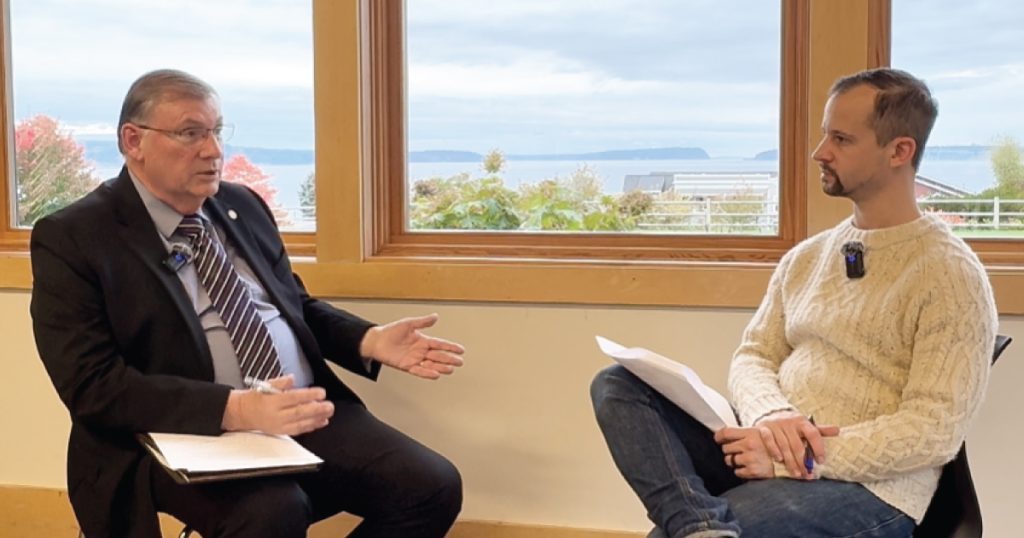
The Lynnwood Times also reached out to current Mayor, and Mayoral candidate, Christine Frizzell, but she was unable to make it to last week’s event.

George Hurst is currently in his third term on the Lynnwood City Council where he’s served as the Council President three times. Hurst has also served on the Snohomish County 911 Board, Community Transit Board, Puget Sound Regional Council Executive Board, Snohomish Emergency Radio Advisory Board, was Chair of the Lynnwood Finance Committee, Chair of the Lynnwood/Fire District 1 RFA Planning Commission, and has invested his free time in various community service pursuits such as the Lynnwood Transportation and Traffic Task Force, the Lynnwood Planning Commission, Sonrise Christian Center, Leadership Snohomish County and Second Chance Foundation Board of Directors.
Separate to his elected and volunteerism experience, Hurst believes he is qualified to serve the residents of Lynnwood as Mayor based on his professional experience, working 30-years as a Factory Agent for a lighting manufacturer where he dealt with million-dollar projects, in the municipal, private, and military sectors.


“If you ever want to be challenged, it’s dealing with the military,” Hurst joked. “I have a lot of background to let me deal with situations and problems.”
Budget dilemma
When asked about the budget, which has been a hot topic in Lynnwood as of late due to the city’s $10.7 million deficit for the 2025 budget cycle, according to Finance Director Michelle Meyer citing factors like lower than projected revenues from sources such as sales tax, fees, and red light cameras, rising operational costs for utilities and maintenance, and delays in major private investments such as Northline Village, resulting in less revenue generation for the city.
Current Mayor Christine Frizzell put forth a plan to course correct, involving layoffs of nine employees, eliminating seasonal staffing, a 6% reduction to the police department, a 10% reduction for all other general fund departments, and reductions to non-personal expenditures, travel, training, and eliminating non-critical purchases. Still, this leaves a budget shortfall of $3 million through 2025 and $8 million through 2026.
However, Hurst claims that despite Mayor Frizzell stating the city is experiencing a decline in revenue, this isn’t the case, adding that Lynnwood has had “more revenue coming in this year” than last.
“The problem is those poor economic forecasts that created this big gap that we’re now dealing with, and really, for me, the gap is almost closer to $5 million for 2025. That is the challenge because I think some of these faulty economic forecasts are not going to be fixed by some sort of economic boom or something like that,” said Hurst. “We’re going to have to really deal with some hard decisions in 2025, and we’re running out of time to make these decisions.”
Hurst continued that Finance Director Meyer has stated that if the city changes its financial policy by limiting its reserve fund to two months (instead of the current two and-a-half), that the city will still comply with the state (Washington State has requirements for cities to finish a budget season with a balanced budget).
One of Hurst’s solutions is to take a “hard look” at salary increases and promotions – with 70% of the city’s expenditures going towards wages and benefits, something he claims the current Mayor has “not even addressed”. With most of Lynnwood’s revenue coming from sales tax Hurst also said that needs to be protected and, with it, public safety because “people who feel safe in this city will come and spend money in it.”
Related to the budget and public safety, Hurst revealed that Lynnwood Police Chief, Cole Langhdon, was recently told his department needs an additional 5% reduction by not funding eight Officer positions (bringing the total reductions to 11%), which is something he wants to address.
“This is probably the reason why the Lynnwood Police Guild has given me the sole endorsement on the mayor race. I think they have a real lack of confidence in this mayor,” said Hurst.
Retaining city staffing and restoring trust in city government
Hurst was then asked about the several city executive leadership positions that have been left vacant as of late, including the resignation of former Council member Shirley Sutton (who cited a lack of leadership in the current administration as her reason), former City Administrator Art Ceniza, and Parks and Rec Deputy Director Sarah Olsen who retired after Joel Faber was appointed to the Director position despite former Director Lynn Sordel’s recommendations.
Hurst chalks this up to an “atmosphere at City Hall that is not conducive to having people stay there,” he said.
“I know there have been positions that the mayor specifically has forced people out. You can talk about the assistant city administrator position, procurement city clerk position, the strategic planner. Those were all people that were forced out by this mayor. And so this is the atmosphere I think that’s there, is that people, staff are really somewhat hesitant to even push back on the mayor because she’s shown that she can force people out,” said Hurst. “I think that the morale at the city is really low right now, not only because of layoffs, but because of just this kind of person in charge that doesn’t want to listen to people.”
Hurst continued that’s one of the first things he plans to do if elected: open up discussions and ensure directors can ask questions.
“There’s not going to be these silos that are out there, and there’s not going to be a fear of a mayor who will react negatively towards somebody,” said Hurst.
Youth violence
Pivoting towards youth violence, which is an ongoing issue for Lynnwood with statistics showing an increase in juvenile case reports and arrests driven by factors such as gang activity, assaults, and shootings, Hurst said he wants to address the root causes.
Hurst said it starts with a healthy home environment. With 15% of Lynnwood residents at or below the poverty level, Hurst wants to put policies in place that will increase the household incomes of those living in the city. With talks of increasing the minimum wage, Hurst said he’d want to tread carefully on that issue and ensure the proper studies were in place to ensure it was feasible.
Another way, Hurst continued, is to have more well-paying jobs in Lynnwood with good benefit packages. That’s why he’s been pushing to get project labor agreements and community workforce agreements on city projects which would draw from the city’s residents for employment.
“The current mayor expressed that, well, there’s not enough workers here. There’s 300 union carpenters in Lynnwood…So I think it is a possibility,” said Hurst.
Preparing for growth, innovating revenue
With Lynnwood’s Link light rail station now open, and its projected growth to top 65 million by 2044 (Lynnwood’s population has been growing at a rate of 3.88% since 2020), the city will need to carefully manage itself to properly absorb, and prepare, for that growth. Just some necessary improvements include traffic congestion management, stormwater/wastewater improvements, and accessibility, with all this obviously costing money. Hurst was asked what kinds of innovative funding models he would propose to diversify revenue for the city to ensure it could meet its growth projections.
Hurst said that Lynnwood, already, has a far more diverse revenue model compared to other cities in the area – with sales tax being its most reliable (compared to property taxes in other cities), red light cameras bringing in approximately $4 to $5 million a year, and property tax falling in fourth.
However, the problem is, according to Hurst, that Lynnwood has a lot of projects that are going to cost a lot of money – one of those being replacing its outdated wastewater treatment plant, a projected $260 million project.
“We can’t do that on our own. We’re going to have to rely on federal funds and state funds. The treatment plant does dump into Puget Sound, so I hope the state will come forward with some funds. But it’s the EPA, the feds, who have fined us for some of the high nutrient levels that go out of our wastewater treatment plant,” said Hurst. “I know the atmosphere is not very conducive in D.C. for getting funding, especially for states that are, quote, blue. But I think our congresspeople have the power and have the committee chairmanships that we should be able to get some funding.”
When Hurst was asked about possibly annexing nearby, currently unincorporated, land, to generate more funds he said he would tread carefully and really study whether the city could support an annex by accurately, and efficiently, delivering services such as first response.
Housing
Regarding housing, with Lynnwood recently passing a 52% property tax increase which disproportionately impacts seniors and those living on fixed incomes, Hurst was asked what would be done to ensure Lynnwood remains a livable, and attractive, city.
Hurst answered that he has already begun working on that issue by partnering with his wife Pam Hurst, Legislative Lead for Washington Low Income Housing Alliance, and with Manufactured Homeowners, fighting for those living in manufactured home communities who are being priced out by corporate investors who are buying up their plot of land and charging premiums. The two have testified at both the House and Senate Housing Committees for the Rent Stabilization bill (HB1217, signed into law back in May) which offers protection for manufactured home owners.
“The city needs to, again, look at the housing action plan, and ask for more protections for renters and such. And I think that’s what we need to continue to look at, maybe a rental inspection. There are all kinds of things that we can do,” said Hurst.
From sitting on the Finance Committee Hurst has witnessed, firsthand, already the good work done by the Human Services Coordinator and Kyle Ward, with the Snohomish PUD, in helping seniors qualify for utility rebates.
Responsible development
Last week the City of Lynnwood greenlit a development agreement with the PFD (Public Facilities District) to actualize its $600 million vision to redevelop the downtown core, of which the city would be responsible for the construction of 194th and Ring Road. Hurst was asked what he would do, as Mayor, to ensure the contractors in this development agreement are paying their workers a fair wage and adhering to state and federal labor standards.
Hurst replied that he would like to see the City of Lynnwood have a wage theft ordinance that would make sure employees are being paid fairly or paid at all. He also wants to make sure that every contract is a responsible bidder and meets certain requirements.
Lastly, Hurst wants to push project labor agreements or community work agreements.
Green spaces
Hurst was then asked about Lynnwood’s parks and trails and how he would go about improving the city’s green spaces.
Despite being in a budget crises, Hurst wants to ensure the city’s Parks Department is properly funded.
“We do have some green spaces that haven’t even been developed. And, just recently, we approved to hire a consultant for Row Park, which in 2004 was listed as a park that was going to be in the capital improvement plan, but it never happened,” said Hurst. “So we need to be aware, first of all, where the open spaces are, that we own but have not created a park out of yet.”
Closing statements
Concluding our interview, the Lynnwood Times awarded Hurst the opportunity to address Lynnwood voters on why he believes to be the best pick as Mayor.
“I think I would appeal to the voters of Lynnwood because I’ve proven that I’m the one that is willing to do the work to solve the [budget] crisis,” said Hurst. “My vision for this city is to have housing that’s not only affordable but attainable and to have a safe city and really a city that’s going to be able to grow. We’re going to have density in the city center. Neighborhoods are going to be neighborhoods. So, I just would appreciate, and ask for, your vote. Thank you.”
This article has been a summary of a 30-minute-long interview. To watch the interview in its entirety, in video format, visit the lynnwoodtimes.com or visit our social media pages on X, Facebook, and YouTube.

Author: Kienan Briscoe