

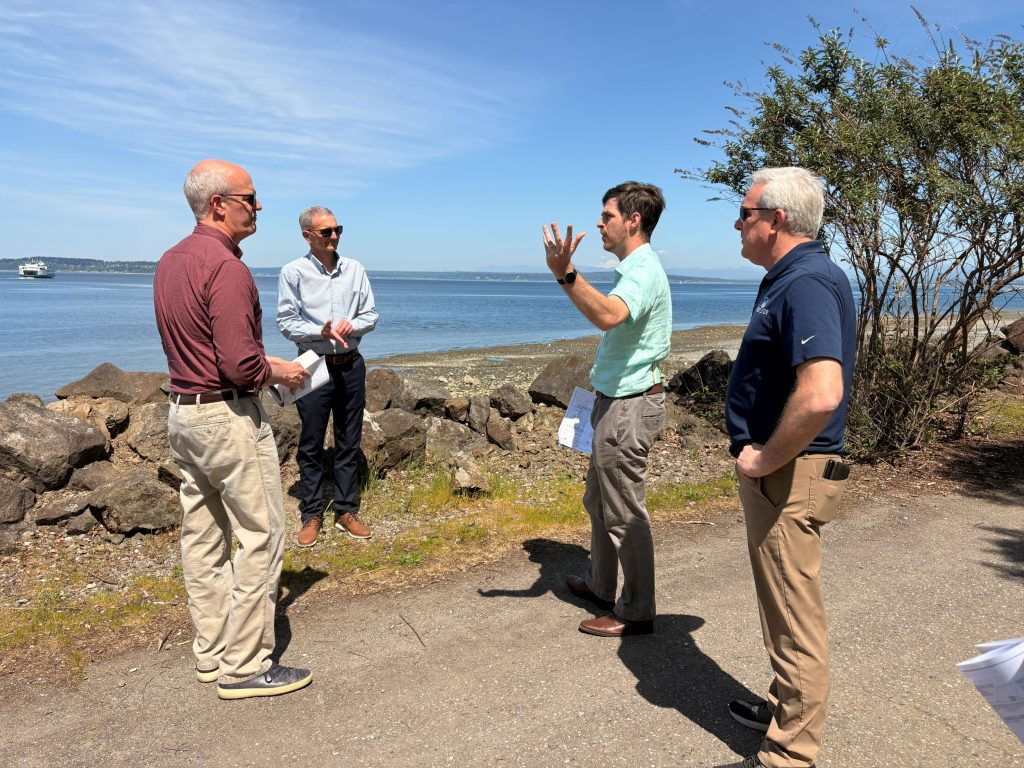
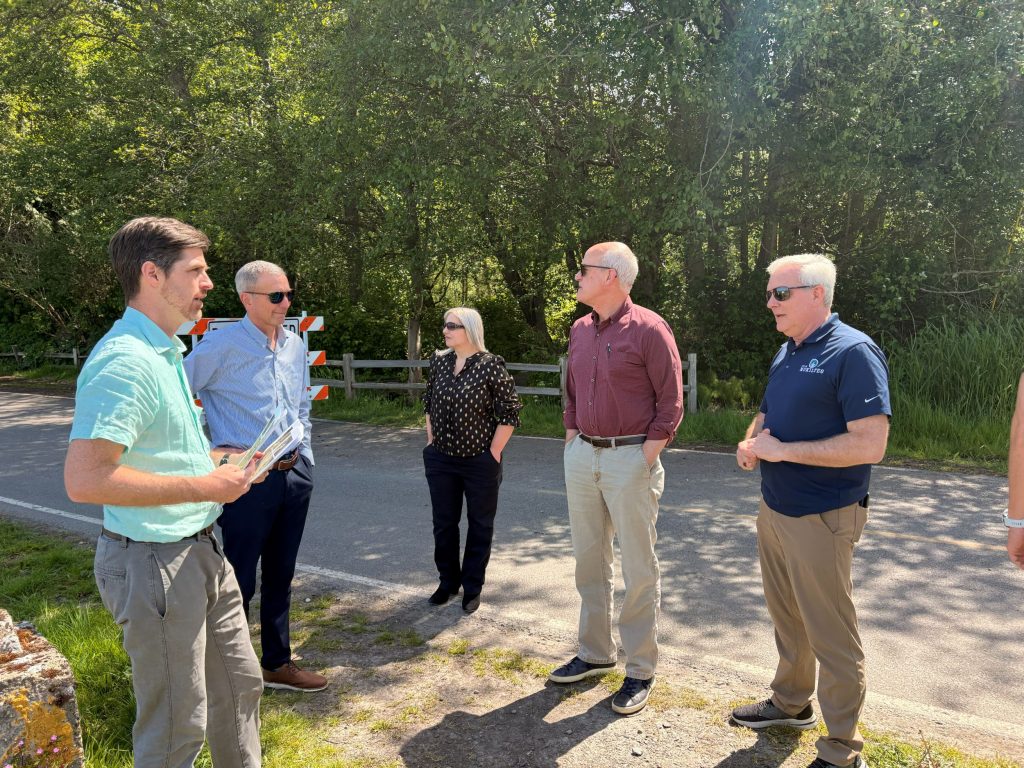
MUKILTEO—Congressman Rick Larsen (D-02) paid a visit to a vacant city-owned property near the Mukilteo Waterfront Monday, to hear, from city officials, how a proposed park would improve shoreline habitat for fish and other species, beautify the waterfront, and ultimately fit into the city’s downtown Waterfront Master Plan.
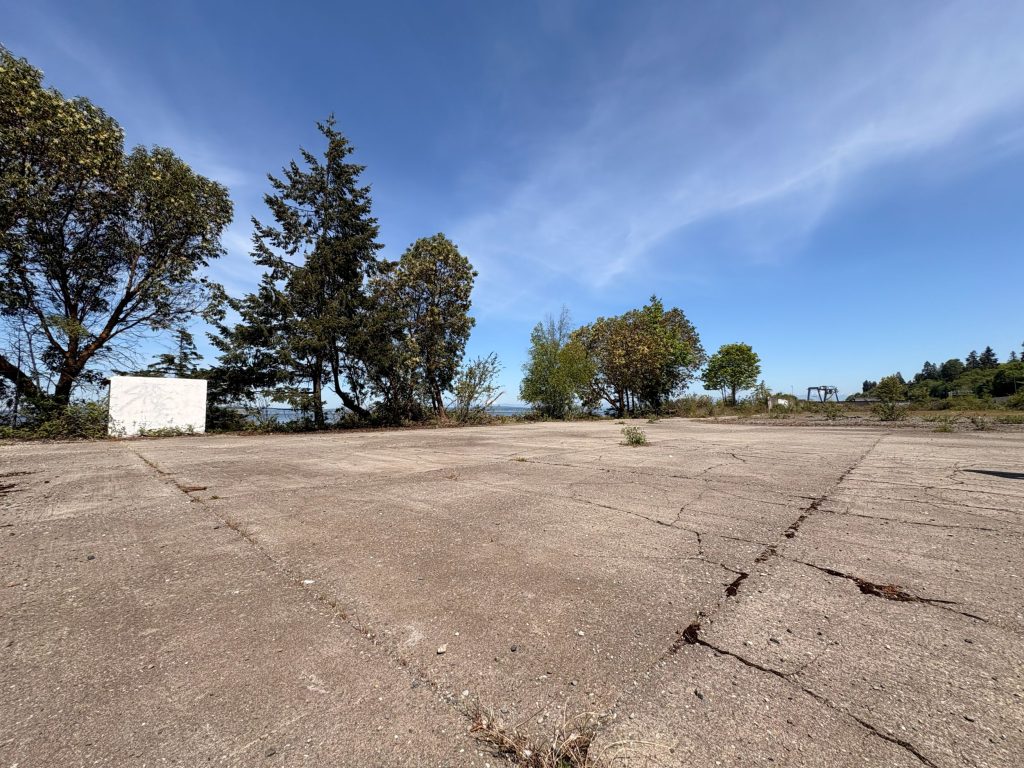
The upcoming project, the Japanese Gulch Park, will be located on a one-acre parcel immediately east of the Washington State Ferry terminal. The parcel is wedged between 1st Street (across the train tracks from Mukilteo Lane) and the gravel beach that stretches into Possession Sound. To its east is a half-mile long plot of land owned by the Tulalip Trips before becoming Everett-owned (but Mukilteo maintained) Edgewater Beach Park.



The City hopes to work closely with the Tulalip Tribes to figure out how to develop the adjacent property in a way that aligns with the overall vision.
Historically, this property was an undeveloped pocket estuary featuring near shore habitat. Waters from Japanese Gulch Creek flowed down from the hillside into the estuary and then entered Puget Sound. When the US Department of Defense fuel tank farm was constructed approximately 70 years ago, the Japanese Gulch Creek estuary was filled and rip rap installed. Creek waters that had flowed to this estuary were diverted into a pipe.




Consistent with this vision, the current project design seeks to restore the site and emulate the estuary that was once there while integrating design elements sensitive to the location’s cultural significance (a tori gate and a Zen-inspired garden).


The idea was, according to Mukilteo Community Development Director Andy Galaska, to add imported Japanese plants but environmental studies prefer planting more native plants.

Phase 1 of the project includes baffles and rock for fish passage, Phase 2 involves stacked culvert fish ladder, Phase 3 involves relocating stream to natural channels, Phase 4 involves connection to wetland and Phase 5 involves daylighting/estuary/public.
Overall, the project, upon completion, will have a tidal estuary restoration, Japanese Sea Garden, a Pavilion with an overlook, a cultural interpretive station, a boardwalk, parking, first street crossing, buffer adjacent uses, and beach access.
How this fits in with the Downtown Waterfront Masterplan’s preferred alternative is potentially adding a parking garage in Lot 7 (directly west of the Japanese Gulch Park), adding a café, elevated promenade, view deck, and stairs/elevator to the ferry terminal, potentially restoring the connected beach (gravel beach material placement, anchored logs, and dune grass/riparian planting), and potentially adding a city dive park off Edgewater Beach (with a dive area and potential reef or wreck to explore).
At Edgewater Beach, the city plans to retain existing parking, add an active space and view point, add an interpretive station, have buffer adjacent uses, hold access along the beach, and add a restroom, shower, and a dive platform.

The city is also exploring adding a potential one way traffic lane with parallel parking on the south side.
The project is currently “shovel ready”, says Andy Galuska, Mukilteo Community Development Director, and is 95% complete through its design (awaiting permits). The city just needs the $6.75 million to ground break, hence Rep. Larsen’s visit yesterday. The survey costs alone, the city said, will run about $25,000.
Rep. Larsen has already requested $2,124,000 in next year’s federal spending bills to daylight Japanese Gulch Creek.
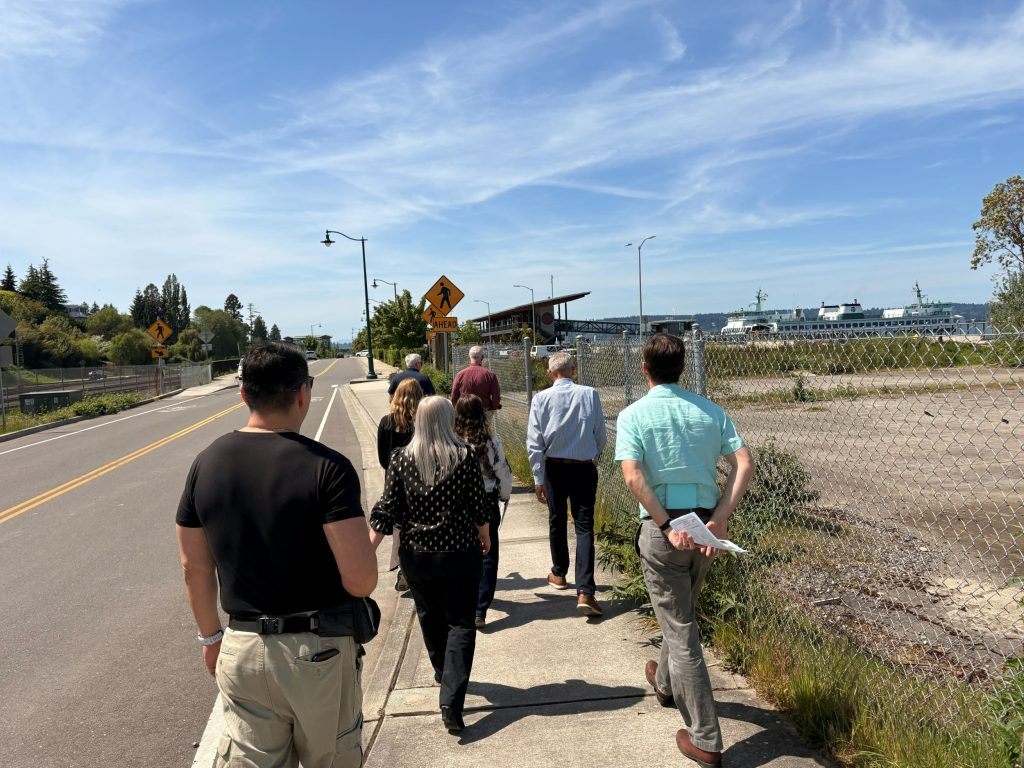
At Monday’s tour, Larsen joined Mukilteo Mayor Joe Marine, Mukilteo City Administrator Steve Powell, Community Development Director Andy Galaska, and Mukilteo City Council member Jason Moon to walk the site – beginning across the train tracks on Mukilteo Lane, and ending near the water, hearing details of the project that he will then bring back to Washington D.C. in hopes to secure the necessary funding to begin construction.
About the Japanese Gulch and its cultural ties to Japan
From the late 1800’s through the 1930’s Washington State’s lumber industry had reached its prime. Logging camps quickly settled in Mukilteo, with its dense forests of Douglas fir and cedar trees being an abundant resource to meet the building needs of the Greater Seattle area and beyond.
By 1903, however, the Mukilteo Lumber Company experienced a tremendous labor shortage likely driven by a general shift in the U.S. workforce toward professional and service-oriented jobs – with blue collar jobs (such as lumber mills) becoming less desirable and prestigious.
Around this time, Japan was undergoing a societal and economic metamorphosis. The Meiji Restoration had officially brought Feudalism to a close, returned power to the emperor, and for the first time in roughly 200 years rural Japanese workers sought opportunities elsewhere. They were attracted to Washington State for its robust lumber industry and the recent completion of the Transcontinental Railroad.
For the Mukilteo Lumber Company (which became the Crown Lumber Company in 1909), it seemed like a natural fit to hire the influx of Japanese immigrants to fill the gaps in labor. Many of these Japanese lumber workers lived in a residential area which was referred to as “Japanese Gulch.”
Most of Japanese Gulch’s residents were men until the 1920’s when women, and children, began to move in, according to Census data at the time. Despite Caucasian workers willingly leaving the industry, these Japanese immigrants were frequently met with hostility and discrimination from Mukilteo residents and lumber workers with threats of strike. Still, these workers were integral to building many of Washington’s cities such as Tacoma, Snoqualmie, Port Townsend, and Wenatchee, according to the Burke Museum.
When the Crown Lumber Company closed in 1930 due to the Great Depression, many of these Japanese workers left the area seeking work elsewhere. Over the years the gulch had many functions. It served as a military base during the Second World War and underwent a contentious bidding war in the early 2000’s where developers considered both building residential houses or expanding nearby Paine Field Airport.
In 2014 the City of Mukilteo purchased a portion of the gulch from the Metropolitan Creditors Trust of Coeur d’Alene for $5.4 million. It was then preserved by the city as a public park.

Author: Kienan Briscoe