

OLYMPIA — The Washington State Economic and Revenue Forecast Council (ERFC) on June 26, 2026, released its official June economic and revenue forecast, projecting a net $7.916 billion General Fund revenue increase over the next six years “driven mostly by legislative changes.”
“The Washington state economy has been dealing with another headwind associated with the Iran war and the economic outlook is less optimistic than it was in February,” wrote Dave Reich, forecast council executive director. “The state economy is expected to continue to grow, but with little employment growth and elevated inflation.”



According to the June report, key economic drivers leading to a reduced projected General Fund forecast of $998 million are:
- Weaker job growth across the state
- Higher near-term oil prices tied to the war in Iran and the closure of the Strait of Hormuz
- Investment of AI as a growth driver
- Slight tick up in Consumer inflation in the last few months
- Tariff Uncertainty (effective rate of 11.8%)
However, non-economic factors (legislative action, policy/administrative updates, settlements) “driven mostly by legislative changes” per the report, will yield a $8.914 billion in revenue increases from $7.632 billion in new taxes and other changes enacted in the 2026 legislative session.



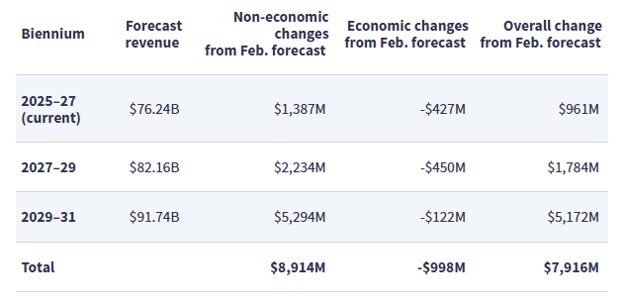
Legislation from the 2026 session increased projected General Fund-State revenue in each biennium through a new tax on high incomes, reduced sales tax exemptions, and higher business and occupation tax rates on prescription drugs. In the current biennium, these non-economic factors from the supplemental 2025-27 budget added a net $38.4 million. Legislative and budgetary changes are projected to add $2.516 billion in the 2027-29 biennium and $5.078 billion in the 2029-31 biennium — totaling $7.632 billion.


The June forecast places General Fund revenue at $76.24 billion for the 2025-27 biennium, up $961 million from February. The 2027-29 projection rises to $82.16 billion, an increase of $1.784 billion from February. The 2029-31 forecast reaches a record $91.74 billion, driven largely by legislative changes—an 80 percent ($40.75 billion) increase since the June 2017 forecast and a 20 percent increase from the current 2025-2027 biennium budget.


The state is seeing increases in housing permits and higher-than-expected capital gains tax receipts. Because current law directs all capital gains tax revenue into the Education Legacy Trust Account to fund the operating budget, these higher receipts appear as non-economic changes rather than economic growth.
Economic Forecast Breakdown
The Economic and Revenue Forecast Council projects real gross domestic product growth of 2.0% in both 2026 and 2027 for the United States, down from the 2.1% assumed in the February forecast. Growth is expected to hold steady at 2.0% annually from 2028 through 2030 before slowing to 1.9% in 2031 to align with the most recent Blue Chip consensus forecast.
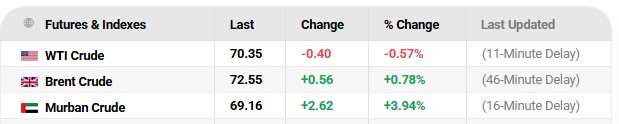
ERFC projects high price of crude oil, as of June 9, with an average of $99 per barrel in the second quarter of 2026, up from $59 per barrel in the February forecast. Prices are expected to ease overtime and reach $65 per barrel in the fourth quarter of 2031. However, current WTI ($70.32) and Brent ($72.55) crude prices has fallen sharply since President Donald J Trump announced Sunday, June 14, that the U.S. and Iran have reached a memorandum of understanding to end active fighting and authorized the immediate toll-free reopening of the Strait of Hormuz lifting of the U.S. naval blockade on Iranian ports.
In Washington, total seasonally adjusted nonfarm payroll employment fell by 3,800 jobs in the four months since the February forecast, compared with an expected gain of 3,600 jobs. Large downward revisions to historical data compounded the shortfall, leaving the employment level 21,900 jobs below the February projection.

Construction employment rose by 200 jobs, driven by nonresidential gains. Manufacturing added 5,500 jobs, primarily in durable goods. Computer systems design gained 1,900 jobs in the private service sector.
The largest decline came in education and health services, which lost 4,500 jobs, while government employment fell by 2,000, including a 4,700-job drop in state and local education.
Washington’s unemployment rate held at 5.2% in May, up from a recent low of 4.3% in December 2023. The labor force participation rate remained at 62.5%, down from its peak of 64.2% in May 2023.
Because of these factors, the June forecast calls for employment growth of just 0.1% in 2026, revised down from 0.4% in February. Growth is then projected to average 0.8% per year from 2027 through 2031. The unemployment rate is expected to rise to 5.3% in 2027 before declining to 4.6% in 2031.
Aerospace employment reached a low of 79,200 jobs in September 2025 after strike-related layoffs and has since recovered to 82,700 jobs in May 2026—driven largely by Boeing. The forecast projects further gains, reaching 87,500 jobs by the fourth quarter of 2031.
Nominal personal income in Washington grew 3.1% at a seasonally adjusted annual rate in the fourth quarter of 2025, reaching $727.0 billion. Net earnings rose 1.9%, trailing the national 4.0% pace, while property income grew 1.8% and transfer receipts increased 10.0%.
The June forecast projects nominal personal income growth of 4.1% for 2026, down from 4.7% in February, followed by an average of 5.2% annually from 2027 through 2031. Washington personal income in 2031 is now projected to be $880 million, or 0.1%, below the February forecast level.
Seattle-area home prices continued to decline, the report says. The S&P CoreLogic Case-Shiller index fell 1.0% in March, the third straight monthly drop, and stood 2.5% below year-ago levels.
Statewide housing permits for new residential construction jumped to a seasonally adjusted annual rate of 53,000 units in April, including 36,900 multi-family units. The forecast does not expect multi-family activity to remain at that elevated level and instead projects permits rising gradually to 36,600 units for 2026 and averaging 39,200 units annually from 2027 through 2031, reaching 41,200 units by the end of 2031.
Consumer prices in the Seattle area rose 4.9% year over year through April, compared with 3.8% nationally. Energy prices surged 23.7% over the year. Shelter costs rose 2.4% in Washington and 3.3% nationally with core inflation standing at 3.8% in the Seattle area.
Washington exports grew rapidly, rising 17.2% year over year in the first quarter of 2026 after a 15.5% increase in the prior quarter. Transportation equipment exports rose 25.1%, petroleum and coal products jumped 83.5%, and agricultural exports increased 14.6%.
New vehicle registrations rose 2.5% in May from April to a seasonally adjusted annual rate of 274,800 but remained 3.9% below year-ago levels.
Cumulative major General Fund-State revenue collections since the February forecast came in $135.4 million, or 1.2%, below projections. Revenue Act taxes fell short by $106.8 million, or 1.3%. All other tracked sources were $74.9 million, or 3.5%, lower. Real estate excise tax collections were $29.1 million, or 7.3%, below forecast.

Author: Mario Lotmore