

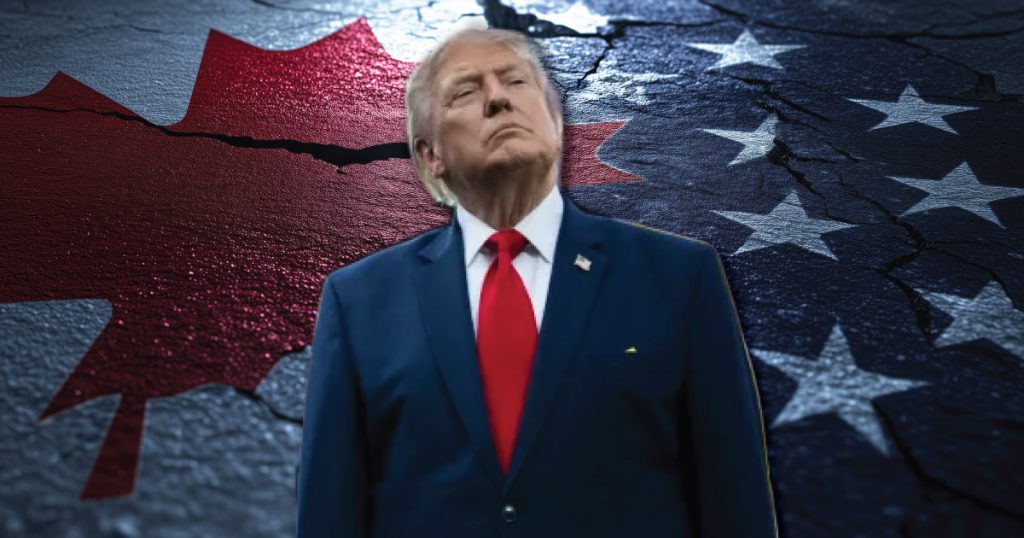
WASHINGTON, D.C.—President Donald J Trump on Monday signed three proclamations imposing additional 50% tariffs on certain Canadian goods, in what the White House described as Canada’s “discriminatory treatment of U.S. commerce” of U.S. motor vehicles, alcoholic beverages, and dairy products.
“I find that it is necessary and appropriate and in the public interest to impose an additional ad valorem duty of 50 percent on certain products of Canada, as identified in Annex II to this proclamation, effective as of 12:01 a.m. eastern time on August 19, 2026,” the proclamation states. “I determine that the additional ad valorem duties imposed in this proclamation, as described below, will offset the burden or disadvantage on U.S. commerce from Canada’s discrimination or unequal and unreasonable imposition.”




The action, taken under Section 338 of the Tariff Act of 1930, applies to products in the motor vehicles, alcoholic beverages, and dairy categories, with examples including wine, car parts, cement, clothing, furniture, technology items, swimming pools, wigs, hockey sticks, and other consumer and construction goods. The tariff will apply even if they qualify for preferential treatment under the U.S.-Mexico-Canada Agreement (USMCA). It excludes energy products, potash, fish, critical minerals, and goods already covered by Section 232 national security tariffs.
Canadian Prime Minister Mark Carney in an official response wrote that the United States’ decision to impose new 50% tariffs is the latest in a series of unilateral U.S. trade actions that violate the Canada-United States-Mexico Agreement and threatened to “match those measures.”



“In all circumstances, Canada will work relentlessly and take any measures necessary to build our strength at home and to support Canadian workers, farmers, businesses, and families,” Carney wrote.
My statement on the United States administration’s intention to impose new tariffs on Canadian goods: pic.twitter.com/wl8JtbQjyC

The 50% tariff increase effect August 19 is also a response to what the Trump administration called a retaliation by Canada against President Trump’s tariffs rather than negotiate a deal with the United States.
According to administration officials, Canada has maintained tariffs and quotas on U.S. motor vehicles that are not applied equally to imports from other countries, halted or restricted the sale of U.S. alcoholic beverages in most provinces and territories (while not imposing similar measures on other nations), and enforced restrictive tariff-rate quotas on U.S. dairy products, including cheese, that are more burdensome than those applied to European Union imports.
From April 2025 through March 2026, Canadian imports of U.S. motor vehicles decreased by approximately 22%, or $5.6 billion, compared to the same period in 2024-2025. Exports of motor vehicles from other countries to Canada have increased to meet the demand previously filled by U.S. exports, the White House released in its facts sheet.
From March 2025 through February 2026, Canadian imports of U.S. alcoholic beverages decreased by about 81%, or $582 million, compared to the same period in 2024-2025. All but two Canadian provinces and territories have halted the purchase, distribution, or retailing of U.S. alcoholic beverages.
Nearly $80 million worth of American alcohol was pulled and stored by the Liquor Control Board of Ontario alone, CBC reports.
Canada established tariff-rate quotas on U.S. cheese that are much more restrictive than the tariff-rate quotas imposed on similar imports of cheese into Canada from the European Union, despite Canada having trade agreements with both the U.S. and the EU, the White House says.
Before the July 20 announcement, a 25% tariff has been imposed on non-USMCA qualifying Canadian goods.
Impact on Washington state
Washington state maintains extensive trade ties with Canada, its largest source of imports and a top export market. In recent data periods, the state exported roughly $7 billion in goods to Canada annually and imported about $15 billion, with significant volumes qualifying for USMCA treatment.
The major risk to Washinton lies with the potential Canadian retaliation through its own tariffs or barriers on U.S. exports, which could affect Washington’s agricultural shipments, manufactured goods, and other exports to Canada. Trade-dependent sectors, such as the Port of Everett and border communities will also be impacted.
Port of Everett CEO Lisa Lefeber at her annual Port Report publicly stated last week that Trump-era tariffs have had a noticeable negative impact on the port’s operations, primarily through reduced cargo volumes and revenue.
According to Lebeber, tariffs caused at least a 10% drop in cargo revenue at the Port of Everett. For the first six months of 2025, cargo revenue was $13.4 million, down from $15.3 million during the same period in 2024. Cargo volume declined by another 10% heading into Q3 2025.
The Port of Everett receives roughly 60% of its revenue from its international seaport operations. In anticipation of tariff impacts, the port reduced its overall 2025 budget by 10%.

Author: Mario Lotmore