

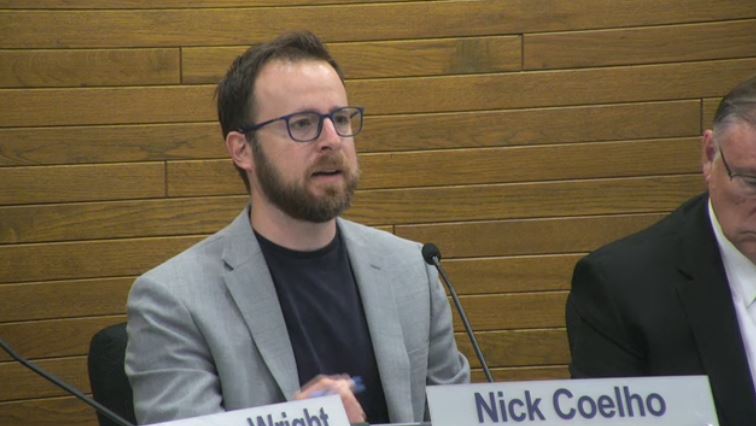
LYNNWOOD — The Lynnwood City Council on Monday appointed a labor leader Charles Burgess to the Public Facilities District board, adopted updated environmental regulations and a decade-long water plan, and held an extensive discussion on public safety funding that included pointed questions from Council President Nick Coelho about placing restrictions on how police should use state safety grant money.
The business meeting closed with authorization for Coelho to advocate a compromise position on Snohomish County’s proposed upcoming public safety sales tax.


The longest discussion on Monday centered on an update from Lynnwood Police Chief Cole Langdon on the city’s public safety sales tax and a related Criminal Justice Training Commission grant of roughly $2.5 million.
In 2025, the Washington State Legislature approved HB 2015, which aimed to improve public safety funding by providing resources to local governments and state and local criminal justice agencies through the authorization of a local 0.1% sales tax (Public Safety Sales Tax) as well as a grant administered through the Washington State Criminal Justice Training Commission.




In January of 2026, the Lynnwood City Council passed the Public Safety Enhancement Sales Tax to be used for criminal justice purposes. To qualify for both the sales tax and grant, the Police Department was required to meet specific training and policy requirements which It did.

The Lynnwood Police Department then applied for the Washington State Criminal Justice Training Commission grant, to further fund specific public safety projects. The acceptance vote of the HB 2015 Public Safety Grant was officially held at the Lynnwood City Council’s Business meeting on Monday, July 13, 2026, where it was approved unanimously, despite some concerns voiced by Councilwoman Isabel Mata.
Lynnwood Police plan to use their newly awarded $2.5 million grant to fund the following:
- Overtime – DFR, CIT, Bod Scanner, and PTI: $426,029.92
- Social Worker: $263,161.26
- Custody Officer: $186.968.36
- DFR (Drone First Responder): $398.516.68
- Radar for Jail: $591,259.77
- Drones (interior and patrol): $167,591.21
- Training – Body Scanner, DNT and FARO: $133,744.25
- Computers – CID and FARO: $49,456.70
- Exercise Equipment – Jail & Officers: $27,452.12
- Therapy/Wellness Dog: $20,000
- Software Licenses: $69,000
- Health Assessments: $56,364
- Misc. Equipment: $77,172.33
- Electric Bikes: $17,933.40
- LEMAP: $10,000
- Business Card: $5,350.00
There is a potential financial impact relating to the social worker and custody officer positions as the funding for these positions would lapse in June of 2028. Langdon stressed most items have a clear shelf life or can be discontinued, and the two staffing positions would be reassessed before the grant ends.
“Everything else in there has a shelf life,” he said. “We are fully funded for that for the social work position for the corrections officer position… We’re not getting married to any of this. We have an ability to break up.”
Council President Coelho pressed repeatedly on restrictions and controls over the grant money and the broader public-safety sales-tax revenue. He first sought clarity on local-match requirements for positions and then asked whether community engagement outside the department had shaped the grant asks.
Turning to the sales tax itself, Coelho expressed what he believed to be its original intent of placing revenue in a special fund (Fund 105) rather than the general fund precisely so the council could curtail uses.
“One of the reasons they voted this in in the first place was because there was a discussion, and in fact I guess it’s in the ordinance itself, that we would be creating a special fund that would allow us to kind of curtail uses of these monies to things that maybe we’re not comfortable with,” Coelho said.
He asked Chief Langdon and Assistant City Administrator Monesha Harrell to detail existing restrictions and what additional restrictions the council could reasonably consider without becoming counterproductive, particularly if the council later wanted to prioritize behavioral-health uses.
Harrell explained that public-safety sales-tax uses are broad under state law—covering domestic violence services, indigent defense, reentry, substance-abuse intervention, homelessness reduction and behavioral health—but that loading ongoing general-fund-style expenses into Fund 105 would require new financial parameters, such as reserves, the fund currently lacks.
Coelho proposed circling back in the first or second quarter of 2027 after the current budget deficit is addressed, stating the conversation was “really about enhancing the transparency of what’s going on in our police department with the community as we request more funding from the public.”
Other council members echoed fiscal caution that effectively supported tighter oversight of grant spending.
Vice President Derica Escamilla questioned the potential “financial cliff” when the grant expires and urged the department to decide now which items could be dropped if the city’s finances worsened.
“Have you guys made the hard decision now of like, okay, maybe we don’t need 2.5 [million dollars], maybe just like 1.5 [million dollars] because we’re going to want these… We need to be realistic here and we need to be fiscally responsible on what can we get right now and be able to sustain it,” she said, comparing unrestricted spending to buying a luxury car with lottery winnings without budgeting for maintenance.
Council member Chelsea Wright stressed intentional, conservative financial review: “I’m hopeful that when it does come up that you are looking at your finances intentionally. Conservatively. We’ve gotten in trouble before with over projecting… and now we’re in a hole and we don’t want to see that again.”
Council member David Parshall asked specifically whether any grant items carried large ongoing costs after 2028 and whether radar or drone programs could simply be discontinued; Langdon confirmed both could be scaled back or ended without multi-year contracts.
The Drone program listed follows in the footsteps of Everett, which passed a Drone as a First Responder (DFR) program on April 9, 2025, following a Everett City Council vote of 5-1. The drones are reported to reduce response times by up to 63 percent—to just under 90 seconds!
The drones fly up to 53 mph, have thermal and nighttime vison capabilities, a 400X zoom, and can cover up to 38 square miles per deployment. The drone assigned to the south precinct will fly at an altitude of 400 feet, whereas the north drone will fly at 200 feet. The Everett drones are not equipped with facial recognition software, nor track a vehicle’s speed, nor are used to aid in parking enforcement.
The First Responder Drones integrate with Sno911 to provide real-time caller information to the certified officer pilot. The drone pilots are certified and trained by officers with an existing FAA Part 107 certification. The drones are also equipped with a collision avoidance system for added community safety.
Langdon shared that his department consulted the chief’s advisory group and that the grant process was compressed when compared to state deadlines.
Council members did praised LPD for securing one of only 21 awards by the Washington State Criminal Justice Training Commission and specifically for including community-health and officer-wellness items rather than sole enforcement tools.
Revenue from the new 0.1% sales tax, effective April 1, reported (60-day delay) roughly $2,373 in May, $260,350 in June, and $281,485 in July.
Public Facilities District appointment
Charles Burgess received four votes (Owings, Leutwyler, Wright and Parshall) to Jacqueline Manlestas two votes (Escamilla and Coelho) as the top contender for Position No. 2 on the five-member PFD board. The volunteer post carries a term ending Oct. 18, 2028, and focuses on economic and community benefits from the event center and planned redevelopment that could include retail, dining, a hotel, housing and public park space. The city sought candidates with experience in economic development, commercial real estate, housing, finance, or tourism and hospitality.
Council member Parshall moved to appoint Burgess; the motion passed unanimously. Councilwoman Mata was absent.
“Two really great candidates,” Parshall said. “Charles, we look forward to working with you… Congratulations.”
Burgess, a labor leader representing construction craft laborers and a former Everett Housing Authority board member who lives in the Meadowdale neighborhood, shared his devoting to civic pride, workforce opportunities and community engagement.
“I believe in civic pride,” Burgess said. “I’ve seen the value of civic investment… Civic investment came in the form of a hockey arena in the early 2000s… [it] totally flip[ped] the city upside down in a positive way.”
He stressed project labor agreements and apprenticeships as a priority saying, “Let’s put our money where our mouth is and let’s allow apprentices to have access. Let’s allow city residents to have access to work on these projects. Let’s give space for females and minorities.”
Critical-areas regulations
The Council adopted Ordinance 3513, creating a new Chapter 8.10 of the Lynnwood Municipal Code for critical-areas regulations, updating related chapters, and repealing the existing Chapter 17.10.
The ordinance incorporates what city staff described as the best available science for fish and wildlife habitat conservation areas, updates permit processing and definitions, and addresses wetlands, streams, geologically hazardous areas, frequently flooded areas and critical aquifer recharge areas.
Community Planning Manager Karl Almgren, and Principal Planner Rebecca Samy told the council no additional public feedback had arrived since earlier presentations and a July 27 public hearing that followed a Planning Commission hearing and that fees remained unchanged with only a municipal-code reference was updated.
Councilman Leutwyler moved adoption of the ordinance, praising the Development and Business Services Department for their efforts: “They’ve done a great job explaining the process they followed, where best available science fits in, and they’ve done a great job benchmarking against what neighboring jurisdictions are doing.”
Water system plan
The council then adopted Ordinance 3514, formally approving the 2026-2036 Water System Plan. Water system plans in Washington state include a recommended 10- and 20-year capital improvement programs (CIPs). Public Works Director Jared Bond stated in late 2025 that the city’s water utility had identified $445 million in needed projects over the next 20 years.
The adopted plan itself is a 10-year guiding document through 2036 that evaluates system conditions, projected demand, regulatory requirements, and infrastructure needs. The overall 20-year capital needs are funded primarily through utility rates and the new water general facility connection charges adopted in late 2025, which shifted more cost burden onto new development to mitigate massive monthly rates increases for existing customers.
The city completed its environmental review of the plan under the State Environmental Policy Act (SEPA) and issued a Determination of Nonsignificance in June 2026, concluding that adopting the plan itself would not have significant environmental impacts. Individual capital projects identified in the plan will still undergo separate environmental review when they are proposed for construction.
Council VP Escamilla moved adoption of the ordinance. Council President Coelho applauded the Public Works Department for their efforts towards compiling the 2026-2036 Water System Plan.”
Joint statement on county public safety sales tax
The council unanimously authorized Council President Coelho to provide oral and written testimony supporting Snohomish County Ordinance 26-030, the proposed countywide public safety sales and use tax.
The motion called for automatic, source-based distribution of 20% of tax receipts generated inside each city to that city, with the county retaining the remaining 80% of city-generated revenue plus 100% from unincorporated areas, and requiring the municipal share be used exclusively for criminal-justice purposes under state law.
Coelho described his proposal as “a really good, sensible compromise” that mirrors other county sales-tax sharing arrangements and would also serve as a natural annexation incentive.
Other Business
The council awarded construction bids for two transportation projects through its unanimous consent agenda.
One is the 44th Avenue West/I-5 Underpass Pedestrian and Bicycle Improvements Project, which will create a shared-use path connecting the Interurban Trail and Lynnwood City Center Station with neighborhoods south of Interstate 5.
The project calls for a 10- to 12-foot-wide shared-use path along the east side of 44th Avenue West, along with retaining walls, drainage improvements, pedestrian-scale lighting, navigation signals, signage and landscaping. The city says the project is intended to address the area’s existing narrow sidewalks, lack of bicycle facilities and conflicts between pedestrians, bicyclists and vehicles.
The project has received $5.4 million in federal grants, $1.9 million from Sound Transit and $1 million through the Washington State Transportation Improvement Board’s Complete Streets program, in addition to local funding. Construction is planned for summer and fall 2026.
The second bid award involves the city’s 2026 Paving and Meadowdale ADA Project, which combines pavement work with pedestrian accessibility improvements.
The project includes pavement repairs, grinding and overlays, curb-ramp replacements, flashing crosswalk improvements and sidewalk construction or preservation. Work is planned at locations along 66th Avenue West, 188th Street Southwest and 44th Avenue West.
The council also issued a Labor Day proclamation, sponsored by Councilmember Bryce Owings, before opening the meeting to public comment.
Other business included approval of previous meeting minutes, vouchers and an amendment to a previous council motion concerning a position number.

Author: Kienan Briscoe