

SPOKANE — Gov. Bob Ferguson on Thursday laid out the details of a proposal that would require every public school in Washington state to keep students’ cellphones and other personal electronic devices powered down and out of reach for the entire school day, even including lunch.
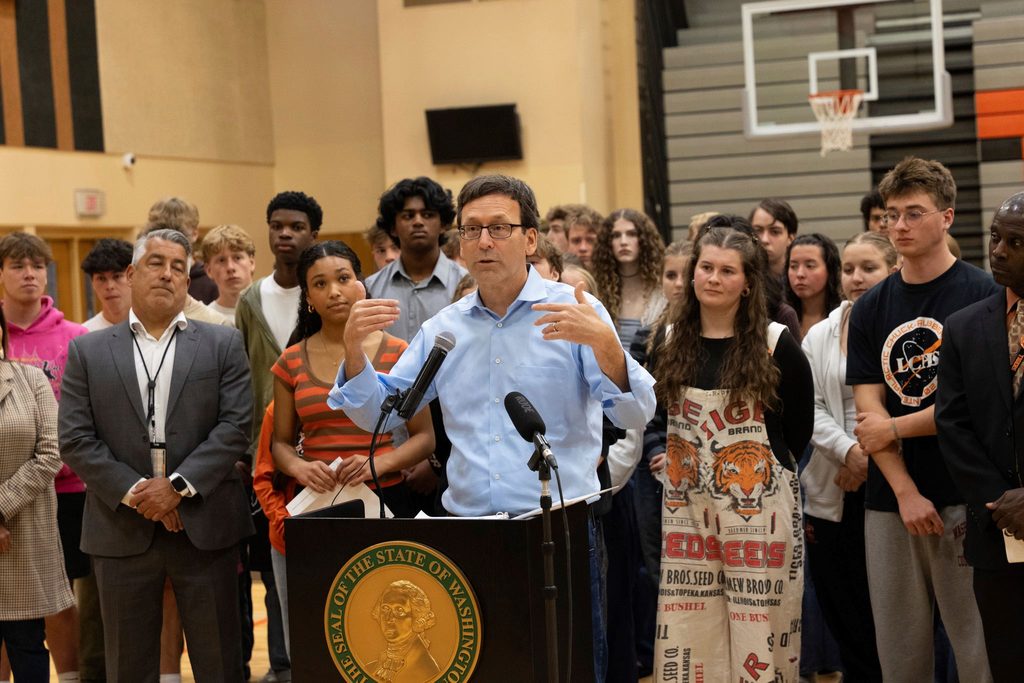
Speaking in the gymnasium at Lewis & Clark High School, Ferguson called the Phone-Free Schools Act one of his top priorities for the 2027 legislative session. He was joined by administrators, teachers and students from Spokane Public Schools, a district that already limits phone use during instructional time but does not go as far as the statewide rule he is asking lawmakers to adopt.


“The research is clear — school-day phone use has a negative impact on student learning, ability to focus, attendance and mental and emotional health,” Ferguson said. “We don’t allow smoking on planes anymore. I’m confident that in a few years, allowing cellphones in schools will feel just as wrong. Phone-free schools will improve academic performance, the classroom environment and the school environment. My mission as governor is to get this legislation across the finish line and sign it into law.”
Ferguson plans to prefile his Phone-Free Schools Act on December 7, the day prefiling opens. If the Legislature passes it, the act will take effect on July 1, 2027, and districts would have to carry it out beginning with the 2027-28 school year, which starts in September 2027.



The bill would amend RCW 28A.320.135, the statute that now says school boards may limit student phones. Beginning in 2027–28, every public school district must adopt a policy that, at minimum:


- Bans student use of personal electronic devices for the whole school day, not just class time. “School day” includes instructional time and noninstructional time, including lunch. Before- and after-school extracurriculars under RCW 28A.320.530 are excluded.
- Requires devices to be off (powered down or otherwise inoperable) and stored in a secure, inaccessible place. Allowed storage is a locked pouch the district provides or approves, a main-office group lock box, a designated classroom spot that is not a backpack, or another system that actually blocks student access. Backpacks and pockets do not qualify.
- Sets parent/guardian contact protocols so families can still reach a child during the day.
- Bars suspension or expulsion solely for a phone violation in 2027–28. Starting in 2028–29, districts must describe enforcement that fits chapter 28A.600 RCW and disability law.
The same rules would bind charter schools and state-tribal education compact schools.
The definition of a personal electronic device, according to the proposed bill covers smartphones, cellphones, Bluetooth-enabled devices, tablets, smartwatches and other wearable technology, portable gaming devices, and other existing and emerging technology that can provide voice, messaging or data communication, or that can connect to a phone, the internet, or a cellular or wireless network. School-issued devices, including laptops and Chromebooks, are excluded, as are portable devices that meet the federal definition of a medical device.
A student could use a device if an individualized health care plan documents a medical necessity required by state or federal law, or if an individualized education program or Section 504 plan explicitly identifies an educational or assistive-technology need and no reasonable alternative exists.
A school psychologist, social worker, counselor or principal could also approve access for a student who routinely cares for a family member, such as an aging parent, or whose personal safety has been documented as at risk.
The bill does not give teachers general discretion to allow phones, and it does not write in a student emergency-use exception. Contact in case of an emergency would run through the district’s parent-communication protocol.
In the United States, 95% of teenagers have smartphones – and 97% of these teenagers use them during school. Studies show teenagers spend, on average, roughly a quarter of their school day on their cellphones – more than 41 instructional days over the course of a school year.
One-third of public K-12 teachers nationwide say students being distracted by cellphones is a major problem in their classroom, according to Pew Research Center. Research shows school-day phone use negatively impacts students’ learning, ability to focus, attendance and mental and emotional health. Without phones, students are more engaged socially and academically.
At least 31 states and the District of Columbia now restrict students’ use of cellphones in schools, according to Education Week. Of those states, 22 have a bell-to-bell ban.
Current law, Senate Bill 5346, sponsored by Sen. Marko Liias, D-Edmonds, which Gov. Ferguson signed in March of 2026, lets districts only limit cellphones use but does not require them to, encourages school districts to consider recommendations from the Office of Superintendent of Public Instruction (OSPI), and directs OSPI to report by the end of 2027 on district policies, barriers and evidence-based options.
Liias has called the law that passed the bare minimum as it was originally to banned cellphones but was narrowed down in the 2026 legislative session.
State Superintendent Chris Reykdal challenged districts in 2024 to adopt device policies, and a state survey this year found that most of the responding districts surveyed have some rule in place, while nearly a third do not. Where policies exist, the common approach is to keep phones off and away during class, often in a backpack, and to allow them at lunch or between periods.
For example, the Spokane Public Schools policy restricts phones during instructional time; whereas Seattle’s newer procedure is bell-to-bell in grades K-8 and limited to class time in high school. Ferguson’s Phone-Free Schools Act would replace that patchwork with a statewide standard: the full day, including lunch, and storage that students cannot reach.
The proposed act does not appropriate any money for pouches, lock boxes or staff time. Ferguson has described a uniform state policy as having virtually no cost, however locked pouches for every student would not be free and would require staff time to manage.

Author: Mario Lotmore