

EVERETT — Snohomish County voters approved three of five proposed amendments to the county’s home rule charter in unofficial results from the Nov. 3 general election, backing measures to strengthen budget reserves for disasters, expand public access to financial data and raise the bar for new taxes imposed by the County Council alone. Residents rejected a policy requiring prioritization of core government services and a plan to strip party labels from county elected offices.
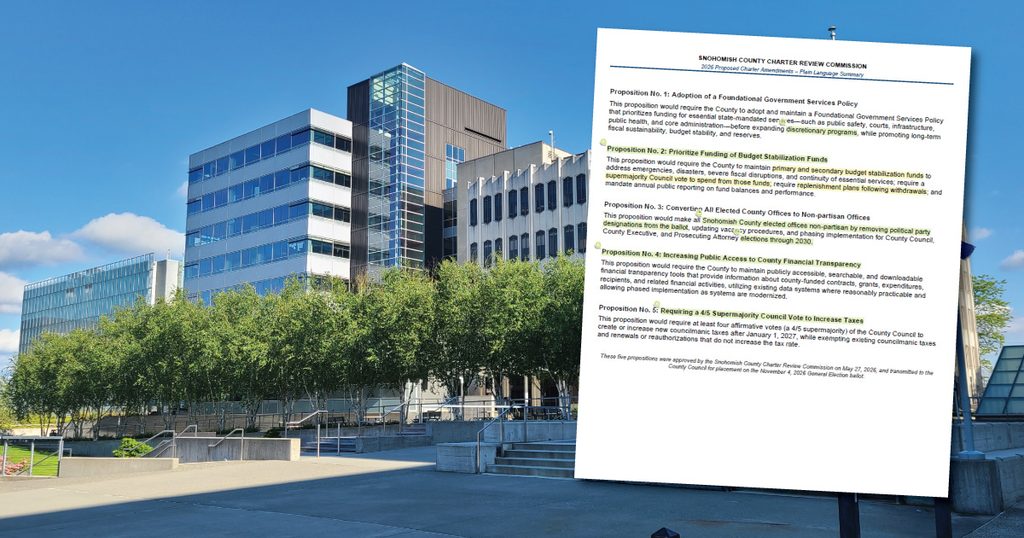
With 325,371 ballots cast out of 548,600 registered voters — a turnout of 59.31% as of Friday, November 6 — the five measures advanced by the 15-member Charter Review Commission after months of meetings.
Proposition 2, which requires the county to maintain primary and secondary budget stabilization funds for emergencies, disasters and severe fiscal disruptions, passed with 158,600 yes votes (52.11%) to 145,778 no votes (47.89%). The measure, sponsored by Commissioner Demi Chatters after submission by County Treasurer Brian Sullivan, advanced unanimously from the commission. It adds a new section to Article 6 of the charter, mandates a supermajority council vote to spend from the funds, requires replenishment plans and annual public reporting, and directs that any state or federal reimbursements return to the reserve rather than the general fund.
Sullivan, who created the existing primary stabilization fund in 2009, tied the proposal to the 2014 Oso landslide, a statewide emergency during which the county spent roughly $20 million in six weeks and nearly exhausted reserves.

“We went from the 11 reserves… down to literally almost nothing,” he told the Lynnwood Times. The primary fund now holds about $16.5 million and has factored into the county’s AAA rating; the secondary fund would be held separately under the treasurer and initially seeded with 10% of the primary balance.
Proposition 4, requiring the county to maintain publicly accessible, searchable and downloadable financial transparency tools covering contracts, grants, expenditures and recipients, passed by a wide margin: 200,396 yes (64.97%) to 108,027 no (35.03%). Sponsored by Commission Vice Chair Janelle Cass and advanced 11-4, it adds a new section to Article 6 and emphasizes use of existing systems with phased implementation. Cass described it as expressing voter intent for greater visibility, citing “open checkbook” portals in other jurisdictions. Commissioner Chatters, who opposed it, called the language “transparency theater” for lacking enforceable standards or a firm timeline.
Proposition 5, requiring at least four of five County Council votes to create or increase new “councilmanic” taxes — those the council can impose without a public vote — after Jan. 1, 2027, passed 165,374 yes (53.30%) to 144,909 no (46.70%). Existing taxes and non-rate-increasing renewals are exempt. Sponsored by Cass and advanced 10-5, the measure amends Section 2.20. Cass framed it as requiring broader consensus amid resident frustration with rising costs, while Chatters called a 4-of-5 threshold a “super duper majority” that risks minority rule and could harm bond ratings. No outside economic analysis was sought during commission deliberations, according to Chatters.
Voters rejected Proposition 1, which would have required the county to adopt and maintain a Foundational Government Services Policy prioritizing funding for essential state-mandated functions — public safety, courts, infrastructure, public health and core administration — before discretionary programs. It failed 141,162 yes (46.72%) to 160,955 no (53.28%). Sponsored by Commissioner Shawn O’Donnell after Sullivan’s submission and advanced unanimously, it would have added a new section to Article 6 and directed the council to adopt implementing policies by ordinance. Sullivan, a self-described “budget hawk,” argued governments often convert temporary commitments into permanent ones, citing the county’s nine-year stretch without taking the annual 1% property-tax increase and an estimated shortage of roughly 100 sheriff’s deputies. Commission Chair Mark James said the measure focused on the “basics.”
Proposition 3, converting all Snohomish County elected offices to nonpartisan status by removing party designations from the ballot, updating vacancy procedures and phasing implementation through 2030, failed decisively: 93,908 yes (30.32%) to 215,766 no (69.68%). Sponsored by James and advanced 11-4, it would have amended Sections 4.15 and 4.80. James argued partisanship belongs at the state and federal level and that the change would push voters to evaluate candidates on records rather than labels. Chatters, who opposed it, said removing party affiliation reduces transparency, noting that parties publish public policy platforms and that public comments she received sought more information, not less. Implementation would have been phased: Council Districts 2 and 3 and the executive in 2027, remaining council seats in 2029, and the prosecuting attorney in 2030.
The Snohomish County Charter, adopted in 1979 and effective in 1980, replaced a three-member commission with a five-member council and elected executive. It requires voters to elect a 15-member Charter Review Commission — three from each council district — at least once every 10 years. The 2026 commission, seated in January after the November 2025 election, reviewed 25 sponsored proposals and advanced five after staged votes requiring increasing thresholds for research, legal review and ballot placement. It held 13 public meetings totaling nearly 27 hours, including three hearings on the final measures. Four commissioners declined to sign the formal transmittal letter, citing concerns that public input was sidelined and some measures lacked sufficient vetting. Leadership maintained that an established process produced supermajority-supported propositions.
Former County Councilman and current Treasurer Sullivan was instrumental in developing Propositions 1 and 2, according to commission leadership.

Author: Lynnwood Times Staff