

LYNNWOOD—With a vote of 6-1, the Lynnwood City Council adopted its 2027-2028 biennium budget with a balanced general fund a $149.6 million, down 5.3% from the previous biennium of $158 million. The adopted budget includes a two-month reserve policy, which equates to $6 million, that Council approved in March 2026 and does not draw from reserves as in the previous biennium to balance the budget.
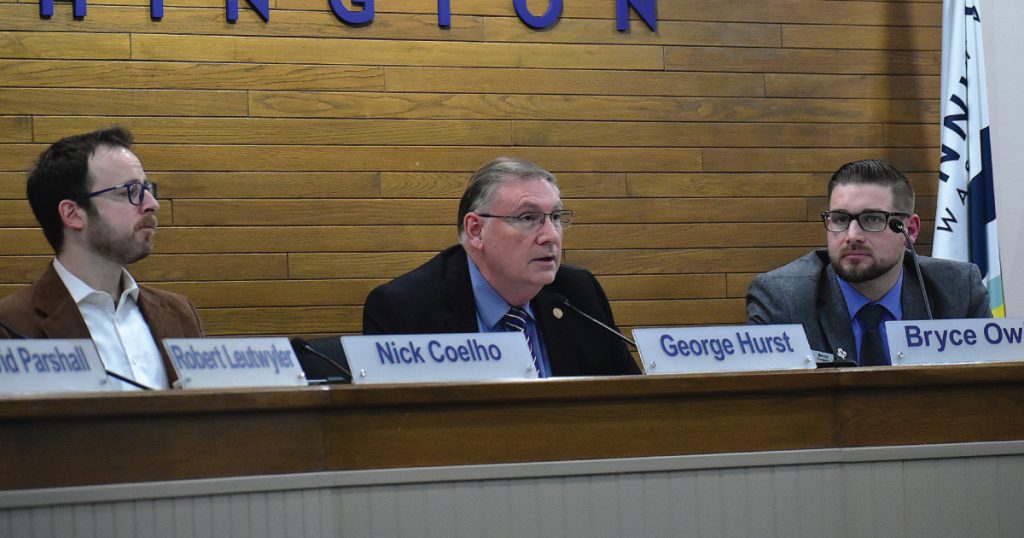
Prior to the final vote, the council adopted several amendments to the final budget bringing the final figure to $149.6 million (expenditures) resulting in a net impact of +$512,600 to total revenues—$1,144,821 increase in expenditures that were offset by $1,657,421 in new revenues via amendments.
“The budget process wasn’t perfect,” said Councilman Robert Leutwyler who voted to adopt the budget. “The tools we have to solve our budget problems are not perfect. The budget is not perfect. But I think taking the steps that we can take right now is at least moving us in the direction that we need to be moving the city.”
Council President Nick Coelho was the lone “no” vote. “I didn’t vote for the budget, but we passed it together as a council,” Coelho said. “If anyone here thinks that we’re done, this is the easy part. The next two to four years are going to be quite dramatic. Annexation is going to change everything.”


In Mayor George Hurst’s message in the 2027-2028 Budget booklet, he identified several future items that will need to be considered to keep Lynnwood’s financials healthy. There were:


- Annexation: As the cities of Everett, Mill Creek, and Edmonds are prioritizing growth, he stated that the next biennial budget (2029-2030) must put Lynnwood in a financially secure position to “responsibly accommodate this growth.” The Council has until July 1, 2028, to take advantage of the state’s sales-tax credit to accommodate annexation.
- Municipal Jail Caucus: Hurst initiated this year the creation of a Municipal Jail Caucus. With the assistance of our State lobbyist, Lynnwood along with 11 other cities that operate municipal jails in Washington state, will approach the State Legislature for financial assistance to offset approximately medical service costs for jails. For Lynnwood, this represents an expense of approximately $2 million per year.
The combined efforts of the Council and city staff under the leadership of Mayor Hurst closed a preliminary 2027-28 General Fund forecast deficit of $21.4 million — 15.68% above revenue projections. A one-page budget summary compiled by the Lynnwood Times coupled with Mayor Hurst’s Sept. 14 memo put proposed operating, transfer and other revenues at $135.8 million against $157.1 million in expenditures and other uses. Operating revenue alone would fall $16.3 million from the prior 2025-2026 biennium.
Hurst and Assistant City Administrator Monisha Harrell, who was also the Interim Finance Director in September, shared that their original $148.45 million proposed 2027–2028 Biennial Budget was meant to “realign City expenditures with a more realistic, base-case revenue forecast” based on historical data, current market trends, and normal operating conditions; not favorable conditions, such as significant sales increases as in the previous biennium budget.
Assistant City Administrator Harrell briefed the council on the city’s recent S&P Global Ratings downgrade from AA+ to AA, explaining that the credit rating company interviewed the city earlier than hoped, before the 2027-28 budget was finalized.
“The rating action reflects our view of the city’s trend of operating deficits, which have reduced reserves,” Harrell told the council. “So, what they’re essentially saying is they lowered our rating because we continue to eat into our reserves and not replenish them.”
Harrell added that S&P acknowledged the steps the city has already taken such as including the public safety sales tax, use of banked levy capacity, and cuts to discretionary programs as positive and expects the city to return to largely balanced operations beginning in 2027.
However, because of the lower rating, it will now cost the city more in debt servicing in the future until the rating improves.
“If the city were to establish a track record of substantially stronger operations underpinned by robust financial planning and forecasting, thereby materially increasing reserves, we could raise the rating,” Harrell said. “They didn’t hint around at that. They gave us pretty much the homework ahead of us.”
AA+ to AA credit rating is a one-notch difference on S&P’s scale. Both are still strong, investment-grade ratings, but the move from AA+ to AA signals a modest weakening in credit quality for the City of Lynnwood. The S&P’s scale runs from AAA (highest) down to D (default)—the city is far from economic insolvency.
The inherited projected 2027-2028 deficit that led to the S&P downgrade was driven by a “realignment” in revenues that never matched the growth assumptions in the November 2024 adopted budget. The drivers of a $23.9 million revenue collapse in the projected 2027-2028 forecast prior to the officially proposed budget the council voted Monday on were:
- Fines and forfeitures (photo enforcement) drop by $8.8 million (from $20.3 million to $11.5 million).
- Sales tax drops by $6.1 million (from $65.3 million to $59.2 million).
- Development services charges drop by $5.6 million (from $10.2 million to $4.6 million) indicating a slowed permitting and project backlog.
- Transfers and other revenues drop $3 million.
- Recreation charges, charges for services, intergovernmental, licenses/fees, franchise fees, and other taxes also decline.
To close the net $21.4 million looming budget deficit, the Lynnwood City Council approved the following actions:
- Banked capacity property-tax increase, November 9, 2026 – $4 million biennium
- Convert school-zone cameras to speed cameras off-hours, November 23, 2026 – $8.2 million biennium
- Authorizes the use of Fund 116 to pay the salary and benefits of the existing Arts, Culture, and Heritage Coordinator position, November 23, 2026 – $252,619 biennium
- A 0.1% Public Safety Sales Tax, January 12, 2026, that took effect April 1, 2026 – $5 – $6 million biennium
- A 6 to 7% (with a 20% ceiling) increase of Parks, Recreation and Cultural Arts (PRCA) and Lynnwood Municipal Golf Course fees for the 2027–28 biennium
The mayor took the following administrative actions to further close the budget gap:
- Increased jail fees
- The cost transfer of five Utility Billing FTE positions to the Public Works Department that will now be funded through utility rate revenues collected to support the City’s utilities rather than through the General Fund.
- A hiring freeze with significant reductions in 2026: 14 staff reductions (layoffs), 8 vacant positions eliminated, and 7.5 vacant positions held vacant
“I do want to thank my colleagues and all of the directors…. I’ve been through budgets before, budgets through work, budgets through my HOA, nothing like this…. I do appreciate the time that directors and people have met with me and got us to a point where this is – past. The hard work really does begin after this. So, I appreciate everybody in any involvement that they had in this,” said Councilwoman Chelsea Wright after voting to approve her first municipal budget.
Prior to the final vote, the council adopted several amendments to the final budget that were vetted by the attorney. These were:
- Solid-waste utility tax revenue recognition (moved by Council President Nick Coelho who also discovered the error): Update the estimated solid-waste utility tax revenue (General Fund 011) to $1,411,155 per year or $2,822,310 biennium. This reflected the 2026 rate increase from 6% to 10% that was not captured in the budget resulting in a conservative Impact of $564,000 in additional annual revenue. The motion passed 7–0.
- Municipal court increase for traffic-camera caseload (moved by Councilmember Mata): Increase municipal court budget by $943,421.50 for the biennium to fund four Legal Specialist II positions with ramp-up to two from March 1, 2027 and two from May 1, 2027 plus additional judge pro-temp hours. This was tied to 24/7 Automated Traffic Safety Camera Program Expansion that would double caseload. This increased biennial expenditures by $943,421.50. The motion passed 7–0.
- Fines and forfeitures revenue offset for court (moved by Councilmember Mata): Increase fines and forfeitures by $943,421.50 for municipal court funding to balance the prior court amendment and accommodate camera-related needs. This increased biennial revenue by $943,421.50. The motion passed 7–0.
- Legislative Department / council executive assistant (moved by Council President Coelho): Increase Legislative Department (General Fund 011) by $51,400 revising the biennial appropriation to $1,246,303, covering omitted insurance costs and related operating adjustments and restoring the position toward full-time after an earlier miscalculation. This increased biennial expenditures by $51,400 biennial. The motion passed 7–0.
- Youth Council supplies transfer (moved by Council President Coelho): Decrease Legislative Department expenditure appropriation in General Fund 011 by $3,770 and increase Parks, Recreation, and Cultural Arts by $3,770 for youth-council supplies/operating expenses. This was a net zero impact as it was a reallocation of funds. The motion passed 7–0.
- Rec Center weekend hours (moved by Councilmember Mata): Increase Parks, Recreation, and Cultural Arts expenditure by $150,000 over the biennium to restore weekend operating hours at the Lynnwood Rec Center, offset by $150,000 in projected recreation-center revenues. This was a net zero impact as it was offset by existing funds. The motion passed 7–0
- Two street-maintenance worker positions (moved by Council President Coelho): Increase General Fund 011 transfer to Street Operating Fund 111 by $440,000 over the biennium and corresponding Fund 111 transfer-in and expenditure to fund two vacant street-maintenance worker FTEs for in-house paving, preventative maintenance, and snow response. This would be paid from the $564,000 in newly added revenue correction in the solid waste fund. The motion failed 3-4 with Councilmembers Mata, Coelho, and Owings voting yes; and Wright, Escamilla, Parshall, Leutwyler voting no.
Councilman David Parshall echoed the sentiment of the majority in voting against funding the new maintenance positions: “As much as I like the idea of street maintenance and that preventative work, and I know it will save us money. [But] do I know for sure it’s the most important thing we’re missing in the city? I don’t.”
Coelho had stated during the discussion regarding the maintenance positions that he would not support the final budget without the street positions and cast the sole “no” vote on the overall ordinance after his amendment measure was defeated.
“This process was definitely not for the faint of heart,” Councilman Bryce Owings told the Lynnwood Times. “I stand proudly behind a balanced budget without having to burden the taxpayers anymore than we already had this year.”

Author: Mario Lotmore