
LYNNWOOD—With ballots beginning to mail out, and the November 4 General Elections just a little over two weeks away, Lynnwood Times Senior Reporter Kienan Briscoe sat down with Lynnwood City Council candidate Bryce Owings to hear where he stands on certain topics the city is currently facing.
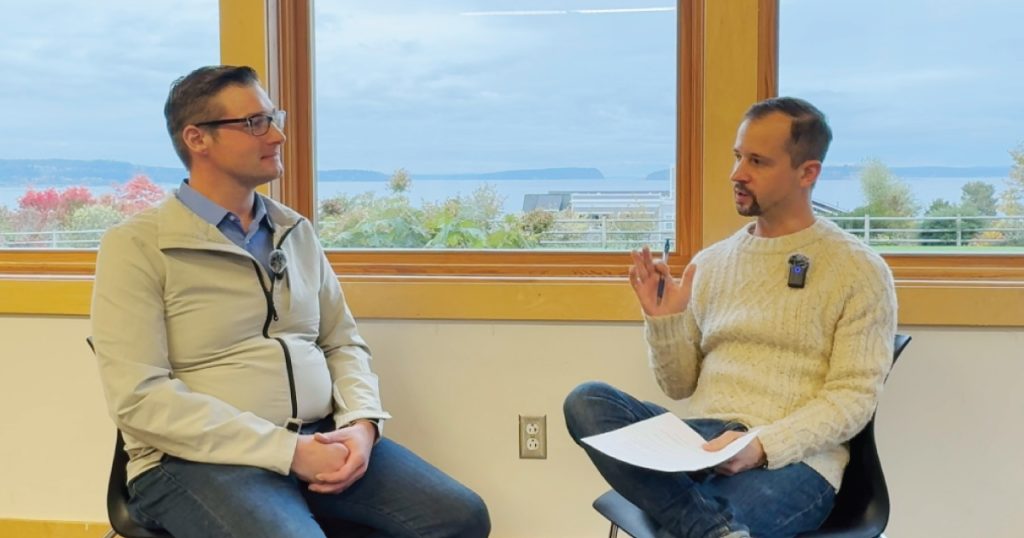
Bryce Owings, is a foreman, certified journeyman carpenter, and family man who served as the Political Action Committee Chair for the Carpenters Union Local 425 prior to running, shared that his priorities are managing the budget and public safety.
Owings is running for the Position 3 seat currently held by Lynnwood City Council Vice President Joshua Binda. The Lynnwood Times invited Binda to attend an interview but did not receive a response back.
Owings was first asked how he is uniquely qualified to serve on the council and what, if elected, his top priorities would be.




Owings referenced his time on the Carpenters Local 425, serving as treasurer, as a delegate, and chair of the political action committee, all of which has taught him how politics work within Lynnwood and its surrounding cities.
He also roped in his past, how he struggled with addiction which, in turn, led him down a path of criminal convictions. He added that these experiences, and how he subsequently overcame his addiction and set his life back on track to be an outstanding citizen, carpenter, teacher, and father, have allowed him to understand Lynnwood’s mental health and drug dependence issues on a deeper, more intimate, level.

“I suffered on and off for a good 10 years from drug addiction, homelessness, those kinds of things. And I can bring that lived experience to the table as in, what worked for me. Obviously, what worked for me is not necessarily going to work for everybody. But, you know, I can bring some new inventive ideas to the council, to the city, on what works and what doesn’t work,” said Owings. “It’s easy to just read something in a book, but when you’ve lived it and you’ve gotten over it yourself, it’s a lot different.”
Owings added that based on his lived experience he’s taken from it a real “passion to help people in need.”
“Nobody deserves to live a life like that and I’m going to really [drive] headway into that,” said Owings.
Lynnwood’s budget dilemma
According to Finance Director Michelle Meyer, the city of Lynnwood is facing a $10.7 million budget deficit for the 2025 budget cycle that the city council approved with a vote of 4-3 November 2024.
Even with Mayor Christine Frizzell’s plan to address that shortfall, this still leaves a budget shortfall of about $3 million through 2025 and $8 million through 2026.
Owings was asked how he, if elected, would propose to address these shortfalls.
“We’re going to have to use some inventive ideas. I struggle with saying that it’s going to get fixed overnight. I feel like this is going to be kind of an ongoing thing,” said Owings. “We’re going to have to constantly be working on it for the next few years, if not even longer.”
Just one of Owings’ “inventive” ideas is a parks sponsorship system which, he said, could generate revenue while building out the city’s green spaces. How this would work in practice, he said, is allow companies to get their names on a plaque in city parks for a donated price. He would also be open to having advertisements in park restrooms.
Owings would also suggest putting city-run events, such as the Fair on 44th Street, on pause until the city gets its budget under control.
“I hate saying that. I took my kids there. We had a great time. And it’s a great time every time we do go. But, you know, we’ve got to fix this budget right now,” said Owings. “And every officer that was working that event was on overtime. Could we really have afforded that? Maybe we should have explored maybe skipping certain things this year…It’s going to be tough. We’re going to have to make some hard calls.”
Restoring trust in city government
The city of Lynwood has been the subject of various political scandals involving city council members and controversies regarding hiring practices of various directors to Lynnwood departments.
Owings was then asked how he, as a council member, would work on restoring the public’s trust in city government.
“First, I’m going to be available. From my constant door knocking during this campaign, I’ve heard a lot of people say they just don’t feel like their voices are heard. I keep reminding people to hold on to my phone number. I could be an email away too, but I want to be a phone call away,” said Owings. “I want to be very accessible to the public so that way I can bring their issues to the forefront right away.”
Owings also suggested the City’s website track council members’ voting records so the public could easily access whether or not their decision-making properly aligns with their values.
“Sure, it’s all on public records, but you’ve got to do a lot of digging. If we can make that accessible immediately and easier to find, I think that that would restore some of that trust,” said Owings.
Youth Violence in Lynnwood
Youth violence is an ongoing concern in Lynnwood with statistics showing an increase in juvenile case reports and arrests driven by factors such as gang activity, assaults, and shootings.
The Council recently put forth a Youth Council, spearheaded by council members Derica Escamilla and Joshua Binda, but Owings was asked what could be done in addition to.
For one, Owings said, the city does not have enough officers to police the streets which is why he is championing for a restoration of public safety and is why he was endorsed by the Lynnwood Police Guild.
“If people don’t feel safe leaving their house, then what good is anything else, right? But that’s just reactionary, and that’s always the easy scapegoat, Band-Aid answer,” said Owings. “Long-term solutions, I want to look into advocating for trade schools, apprenticeships, those sort of things for kids when they start getting closer to getting out of high school.”
As a tradesman himself, Owings knows that college is not always accessible for most folk but if he could teach kids that blue-collar works is obtainable maybe they could see they have a future, he continued.
“Statistically, when you get people starting to make better wages, they tend to break the law less. So, if we could figure out career options for these younger folks, that could be their focus,” said Owings.
Absorbing and preparing Lynnwood for growth
If Lynnwood is going to be successful in absorbing its projected growth, it’s going to require some significant infrastructure improvements including traffic accessibility, and wastewater/stormwater improvements.
With federal and state support limited and the city currently in a budget crunch, Owings was asked what innovative funding models he would propose to diversify revenue for the city to ensure it can meet its growth projections.
Owings cycled back on what he said before concerning park sponsorships and potential advertisements in park restrooms, adding that the city could run a promotion to bolster out its adopt-a-road program.
Owings was also cautious about raising sales tax noting that when cities raise their sales tax it discourages people from shopping there, potentially being counterproductive. He wondered if rolling back Lynnwood’s sales tax, despite it being its primary money maker, would actually attract more shoppers and, in turn, generate more revenue.
Annexation, according to Owings, could also be another way the city could generate more funds.
Annexation is the process by which the city adds unincorporated areas of Snohomish County to the city’s boundaries. Following annexation, properties receive public services such as police services, road maintenance, planning, and permitting from the city, as opposed to the Snohomish County exchange for a city receiving additional tax revenues. Most recently, as an example, on July 12, 2025, the city of Mukilteo annexed commercial properties east of Mukilteo Speedway, adding some $500,000 annually to the city’s coffers.
Some potential areas of annexation, according to Owings, could be the area north of Walmart and Martha Lake. Still, Owings added, he would want to do his due diligence to ensure the city could handle an annex as far as delivery of services go.
Housing
Housing, rental and ownership are very expensive in the Snohomish County region, especially with seniors because they’re on a fixed income, disproportionately impacted by property tax increases.
Owings was asked how he would make Lynnwood more affordable for those living on a fixed incomes, excluding housing and zoning codes.
Owings prefaced his answer by stating he is not entirely against taxes, believing them to do a lot of good for a lot of people. However, he continued, the city needs to be mindful of how tax increases adversely affect vulnerable communities – particularly seniors.
“I’d also like to see some sort of incentivization to build cottage-style properties where they’re a little more affordable for people that don’t need a big house anymore,” said Owings. “It’s kind of similar to, like, RV parks, but they would actually be a fixed structure.”
Managing ethical development
Last week, on Monday, the city of Lynnwood greenlit a development agreement with the PFD to actualize its $600 million vision to redevelop the downtown core, which the city would be responsible for the construction of 194th and Ring Road.
Owings was asked how we would ensure these development projects pay their workers ethically and adhere to state and federal labor laws.
“Well, for one, we need a project labor agreement on that,” said Owings. “We’ve got workers that are being exploited in Lynnwood right now that it just kind of gets brushed under the rug.”
Owings continued that, as a carpenter and union member himself, he has a background in fighting for the working class and will continue to fight for blue-collar workers being paid a fair, and livable, wage. How we can do that as a council member, he continued, is ensure the city enters project labor agreements for large capital projects.
“It may look like it costs more on paper because usually the bid that’s put out by those companies will be a little bit higher, sure, especially with prevailing wage, things like that. But if you look statistically, they actually end up being a lower budget than a project that’s gone without any sort of project labor agreement on it. And they tend to be safer,” said Owings.
With project labor agreements, continued Owings, it also ensures that the work stays within the city, instead of sourcing labor in from surrounding areas, which stimulates the local economy.
“[But it] also gives you a sense of pride,” said Owings. “For me personally, I worked on the light rail project. I’ve worked on Spruce Elementary. I did a little bit of work on Edmonds College. And I drive by those projects all the time and point at it with my kids. If we can get the community building community projects, I think it’s better than bringing outside labor.”
Protecting Lynnwood’s parks and trails
Lynnwood is home to many parks and trails. Most recently completed parks projects include the Scriber Lake Boardwalk Trail, which is now fully accessible, and the Scriber Creek Trail Phase 2, which improved pedestrian access to the transit center and light rail stations.
Owings was asked what he would like to see continued being done to preserve, and enhance, Lynnwood’s green spaces.
“Some things I’ve heard while door knocking is certain parks don’t have as many activities as other parks,” said Owings. “You go to like Lyndale Park and there’s quite a bit of different things you can do there. But then you go to, like, North Lynnwood Park and there’s a good playground, there’s a big field. But, other than like the basketball courts, the field, there’s not as much there.”
In addition to adding more activities in more parks Owings would like to see “mini parks”, or green spaces, in condensed urban areas. These would be small in comparison to actual parks but still offer an opportunity to escape from an urban environment for a little bit, relax, reflect, and by extension take care of their mental health.
“I think it’s better for people’s mental health if they’re able to touch grass and look at trees more often,” said Owings. “With our budget the way that it is, these are more pipe dreams, right? But eventually, like I said, if we can get some of that ad revenue from park sponsorships after the budget’s figured out, we can continue that revenue to expand on our parks.”
Closing comments
Concluding our interview, we gave Owings the opportunity to address his voters and explain why, according to him, he deserves the residents of Lynnwood’s vote.
Owings said he was born and raised in Lynnwood, and he has a passion for it, so much so that he’s chosen to start his family in Lynnwood despite its rapidly increasing cost of living.
“Growing up here, I understand the identity of Lynnwood. And I think that we need to maintain that identity while we’re still growing, but not lose ourselves, in the process,” said Owings. “Lynnwood’s always been a blue-collar working-class city, and I think that we need to maintain that blue-collar working-class city and not try to grow too big, too quick.”
Owings continued that he brings a lot of lived experience to the position, having suffered from addiction, mental health, and homelessness. Through that lived experience, he continued, he can bring a fresh perspective to help Lynnwood tackle its homelessness, substance abuse, and mental health crises with new ideas the city has yet to explore.

Author: Kienan Briscoe