


SEATTLE — Sound Transit confronted a $34.5 billion budget shortfall for its Sound Transit 3 expansion as leaders searched for ways to deliver on voter promises amid soaring construction costs.
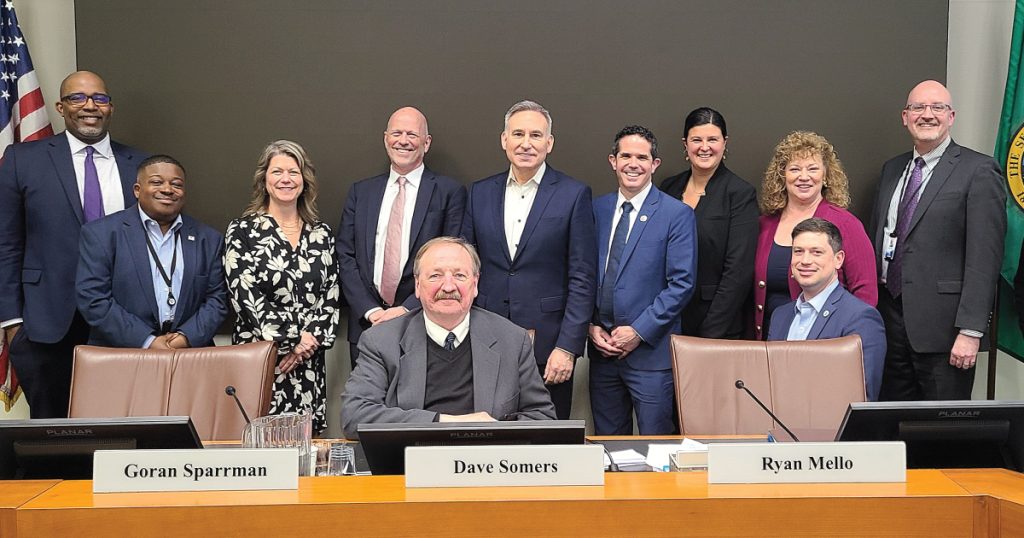
Snohomish County Executive Dave Somers, who chairs the Sound Transit Board, issued a statement outlining the board’s approach to the latest challenges.


“In the face of unprecedented inflation of construction costs, the Sound Transit Board is putting pressure on everything the agency does to find savings,” Chair Somers released in a statement. “By adopting an affordable system plan, the Board is committed to giving the region’s residents the benefits of Sound Transit 3. Since May of 2025, the agency has created a full toolbox of potential cost savings, and we look forward to analyzing the approaches offered by the agency to ensure revenues and expenditures are balanced and affordable while delivering on ST3 objectives. Sound Transit has a strong track record of delivering complex transit projects, and the Board has confidence in the agency’s ability to navigate these fiscal challenges and continue moving the region forward.”
Sound Transit’s updated “bottom-up” cost estimates in August and September 2025 revealed dramatic capital cost growth of $14 billion to $20 billion in 2025 dollars — or $22 billion to $30 billion in year-of-expenditure terms — across multiple Sound Transit 3 projects.


The West Seattle Link Extension ballooned from $4.2 billion in the finance plan to between $7 billion and $7.9 billion. The Ballard Link Extension climbed from roughly $11.9 billion to between $20.1 billion and $22.6 billion. Combined, the two lines exceeded $30 billion before adjustments.
During a board retreat held March 18, 2026, in Tacoma, Sound Transit staff presented three scenarios for closing the gap. All three approaches involved scaling back or shortening key projects, including the Ballard light rail extension, with trains potentially stopping at Seattle Center or Smith Cove instead of the originally planned terminus. The board also approved a 1% annual property tax increase in October 2025 and explored additional tools such as fare gates and carbon credits to boost revenue.
In November of 2016, voters in King, Pierce and Snohomish counties approved Sound Transit 3 (54.05%) with an original price tag of $54 billion and completion of 2041. The measure called for dozens of new light rail stations and more than 116 miles of track across the Puget Sound region.
Voters on November 5, 2019, with 52.99%, approved Initiative 976 sponsored by longtime anti-tax activist Tim Eyman. The measure sought to cap most annual vehicle registration fees (“car tabs”) at $30 for cars, trucks, motorcycles and other light vehicles under 10,000 pounds, which would slash funding for Sound Transit 3 by an estimated $7.2 billion.
A lawsuit was filed and on November 27, 2019, a judge blocked I-976 from taking effect.
The Washington State Supreme Court ruled unanimously in October 15, 2020 to strike down the entire initiative, finding it violated the state constitution’s single-subject rule. The justices also ruled that the ballot title was misleading. The Court’s ruling preserved the funding stream for the ST3 program that voters had approved in 2016.
Plans for the light rail system were realigned in 2021 after a $6.5 billion shortfall emerged.
Unprecedented inflation in construction and land costs, combined with higher material and labor prices plus supply chain issues during the COVID-19 pandemic, drove repeated cost overruns and delays on ST3 projects.
Construction defects on the I-90 floating bridge created one of the most significant setbacks in the Sound Transit 3 program. During construction of the East Link Extension, contractor Kiewit-Hoffman installed thousands of defective concrete plinths—the raised blocks that support the light-rail tracks. Issues with incorrect heights, voids, poor consolidation, failing mortar pads, and faulty fasteners first appeared in 2019 and escalated through 2022.
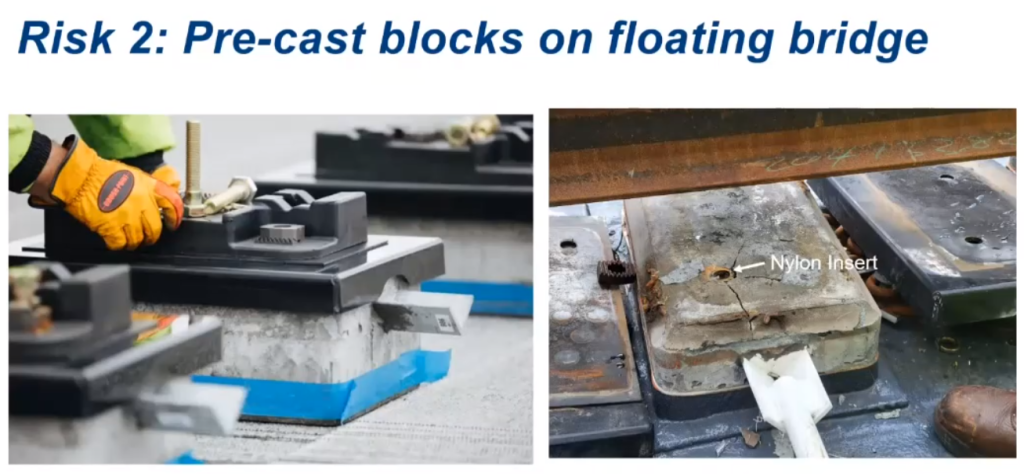
After initial repair attempts collapsed, Sound Transit ordered the complete demolition and reconstruction of approximately 5,400 to 6,000 plinths in 2022.
The plinth crisis repeatedly pushed back the opening of the Crosslake Connection that links the east and west sides of the 2 Line. Kiewit-Hoffman filed claims seeking roughly $184 million for the extra work, extended contracts, and related delays. Sound Transit increased the East Link project budget and drew down contingency funds to cover the fixes.
East Link had been targeted for service in mid-2023 when voters approved Sound Transit 3. The defects forced multiple schedule revisions—first to late 2024, then spring 2025, and ultimately now scheduled for March 2026.
The full seamless service from Lynnwood through downtown Seattle to Redmond across Lake Washington is scheduled to open on March 28, 2026, more than three years behind the original ST3 timeline.
To limit rider impact in the interim, Sound Transit opened a temporary Eastside starter line from South Bellevue to Redmond in April 2024 and extended it to Downtown Redmond in May 2025 while the floating-bridge segment remained under repair.
Preliminary discussions about a potential Sound Transit 4 (ST4) have taken place, but remain in the very early conceptual. Internal talks first surfaced in 2025 as part of Sound Transit’s Enterprise Initiative.
On September 4, 2025, staff presented to the board and explicitly referenced “Future System Planning (ST4),” noting that ST3 already supports advance planning for additional high-capacity transit corridors. The board then adopted Motion M2025-36, directing staff to develop a new Regional Transit Long-Range Plan—the first major update since 2014—for adoption in Q3 2026. This plan will create the framework for any future expansions.
Currently no formal ST4 package, cost estimates, nor ballot timeline exists. Officials have repeatedly stated that their focus is on delivering the voter-approved ST3 before any new major expansion program is to move forward.

Author: Mario Lotmore






One Response
Pierce County overwhelming rejected Sound Transit but was totally ignored. Voters knew it was subject to cost overruns. If construction continues, Tacoma’s line MUST be finished before any King County extension lines!