

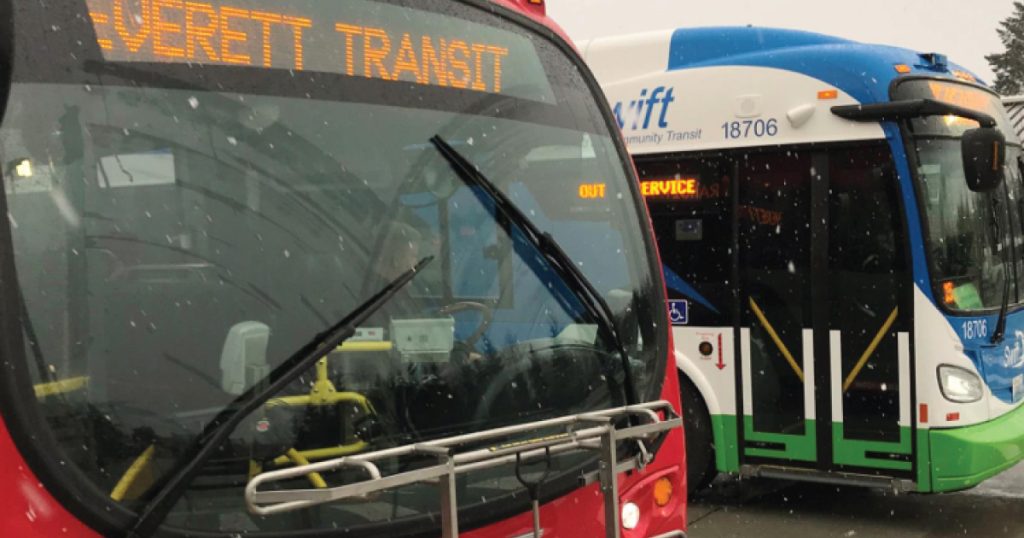
EVERETT—Everett Mayor Cassie Franklin and Community Transit CEO Ric Ilgenfritz announced Wednesday, April 22, the resumption of joint efforts to consolidate Everett Transit and Community Transit into a single, expanded network serving Everett and Snohomish County.
In the coming months, the two agencies will draft an interlocal agreement for the City of Everett’s annexation into Community Transit’s service district. The Everett City Council and Community Transit Board of Directors are expected to consider the proposal this fall.

The move addresses Everett’s growing population and transit demand as light rail service to Everett gains momentum. The consolidation will improve connections between local buses and Link light rail in Lynnwood and future stations in Everett, Mayor Franklin said.
“Consolidation will make it easier for people to travel between Everett and existing Link light rail service in Lynnwood, and throughout the county. It will provide the local bus connections essential to support future light rail service in Everett,” Franklin said. “The Sound Transit Board is currently debating the revised timeline for these once-in-a-lifetime Link investments in Everett. It’s now more important than ever to demonstrate to the Sound Transit Board that we’re ready to support a strong, regional transportation system that works in lockstep with Sound Transit’s network.”



Riders would see more frequent buses, fewer transfers and easier travel to and from Everett under the consolidation plan.

“Through this annexation we can offer Everett residents more connections, more destinations and more frequent buses. We can provide shorter waits, with more service all day long and through the evening hours,” Ilgenfritz said. “We are in a position to make travel smoother and easier between Everett and other destinations across Snohomish County and our entire region. Every current rider as well as every new rider we attract is someone who will experience access to faster and more frequent travel and more seamless connections.”
Snohomish County Executive Dave Somers called the plan a “positive and forward-thinking step” that will help residents commute, study and travel across the region.
“We need smart approaches to the future of a strong, connected, regional transit system that gets people where they need to go as our community continues to grow,” Snohomish County Executive Dave Somers said. “I think this is a positive and forward-thinking step by Mayor Franklin and our partners at Everett and Community Transit, who already do so much to connect our county. I believe this will help our residents as they work, learn, play, and otherwise move through our region.”
The renewed work builds on a 2022-2023 city study called Rethink Transit and a joint “More Transit Together” effort. The agencies released a report in September 2023 outlining a vision for consolidation but paused the process in early 2024 to address other priorities.
If approved, the reconfigured Community Transit Board — which would include new Everett representative seats — would lead planning and public engagement for the newly integrated network. Service changes would be phased in over about a year while existing routes remain largely unchanged. Planning would also cover microtransit, paratransit and vanpool services, with a focus on merging paratransit and creating a unified fare structure.
The interlocal agreement would follow a Washington state law sponsored by Sen. Marko Liias (D-Edmonds), allowing approval by the City Council and board after a public hearing.
“Snohomish County is growing, and the entire county deserves robust access to transit,” Sen. Liias said. “As Everett gets ready for a transformational investment in light rail, it just makes sense that the city expands local transit service to improve these connections. I appreciate Mayor Franklin’s leadership in exploring consolidation and look forward to a future with a truly regional multimodal transit system for all our residents.”
Economic Alliance Snohomish County President and CEO Ray Stephanson said a single integrated network is key to economic opportunity and quality of life for all residents.
“Transportation infrastructure represents one of the most important levers for promoting economic opportunity, jobs and a high quality of life,” said Stephanson. “Moving to a single, integrated network serving our county is important to every resident, whether they currently ride transit or not.”
When Community Transit was created in 1976, Everett chose to operate its own city-only system rather than join the countywide agency. Franklin said that separate system, now one of only a handful in Washington state and the only one in the Puget Sound region, is no longer sustainable for the county’s largest city.
The agreement will ensure Everett is fully compensated for any assets transferred to Community Transit. If approved by both the Everett City Council and the Community Transit Board, Community Transit’s 1.2% sales tax rate — twice the current rate in Everett — would apply citywide.
Ilgenfritz and Franklin said they recognize the proposal may raise concerns among employees and pledged to address them in compliance with state law.
“Community Transit owes its track record of achieving steady ridership growth to our dedicated union employees who keep our services running every day,” Ilgenfritz said. “With this annexation, our workforce will grow, both by welcoming Everett Transit employees and by hiring still more staff to support expected service growth in the near and long term.”
The Lynnwood Times is awaiting a response from Everett Transit Union ATU Local 833 on its thoughts of the potential merger.

Author: Mario Lotmore