
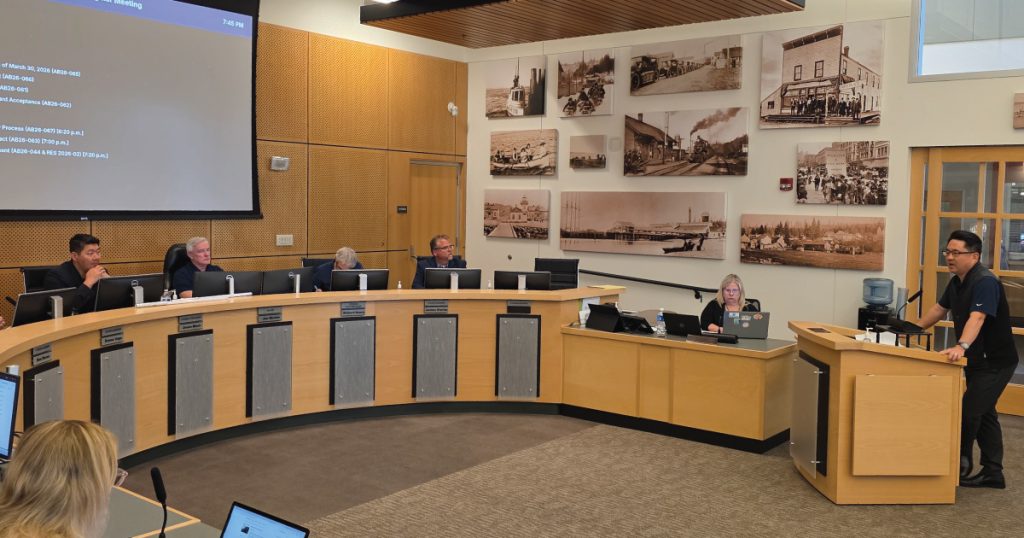
MUKILTEO—The Mukilteo City Council approved reducing the frequency of reading its Native Land Acknowledgement statement from each meeting to the first Monday of each month. Efforts to remove the acknowledgement from the council’s routine Order of Business, failed.
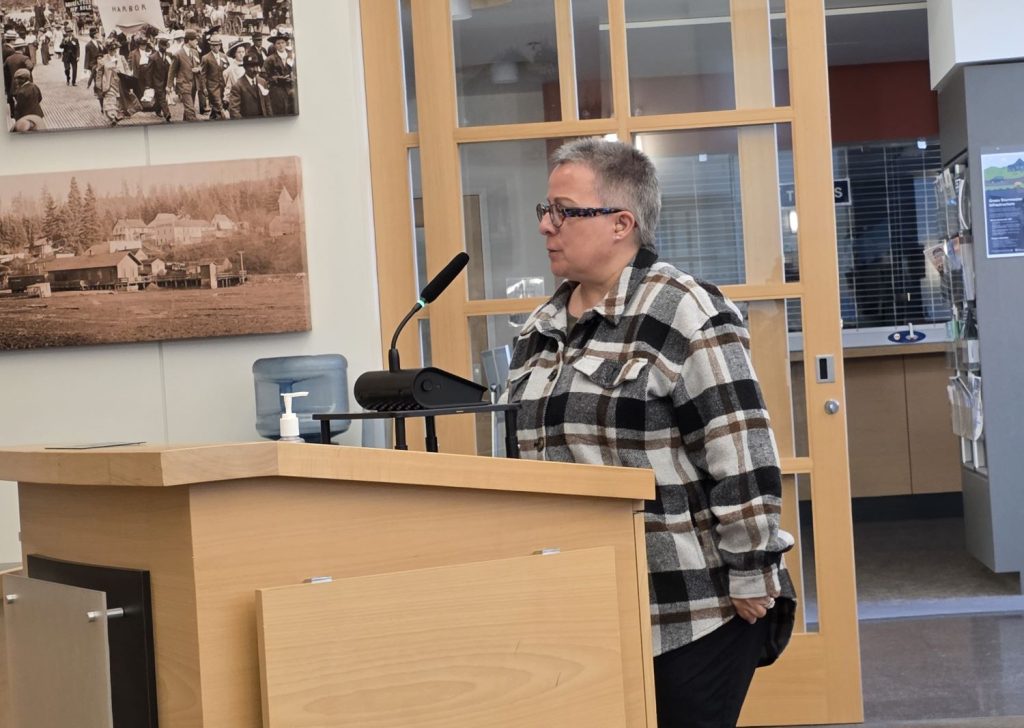
“I’m extremely disappointed and I think they [Mukilteo City Council members] messed it up because at the end, there was no option for the people who wanted to do away with it. They had no vote to do away with it,” Mukilteo resident Sharon Damoff, a vocal critic and primary advocate to removing the reading of the acknowledgement statement, told the Lynnwood Times.


Damoff’s remark stems from an amendment to the original motion that created a dilemma—Morton’s fork dilemma—resulting in whatever the outcome of the vote, the land acknowledgement statement would remain in the council’s standard Order of Business.
“As I just told the mayor, the vote tonight was going to make half the people happy and half the people unhappy,” DEI Commissioner Ilona Van Duser told the Lynnwood Times. “My personal opinion is I would have liked for it to continue to be read every business meeting…. We all need to do more to strengthen the relationship with the tribe.”




At Monday’s Business Meeting, Councilman James Sterba made the motion to “Amend Rule 5, removing the Land Acknowledgement Statement as a standing item on the regular meeting agenda,” which was seconded.

Deleting the acknowledgment from the council’s Order of Business would have resulted in the acknowledgment not being read for each council meeting following the flag salute. The Council could then decide when to read the acknowledgement such as at the beginning of the year or at a Council meeting nearest to the date of the Point Elliott Treaty signing (January 22).

Council Vice President Richard Emery prior to introducing an amendment that would guarantee the Land Acknowledgement would remain, emphasized the unique significance of the acknowledgement to Mukilteo unlike surrounding jurisdictions—Mukilteo is the location of the signing of the historic Point Elliott Treaty.
“So, we have a history that I think it’s honest to acknowledge and honest to try to work even more so than we have to have a good relationship with our neighbors,” Emery said. “Yes, it is political. Politics is actually relationship building, working with our neighbors to come to a mutual agreement to benefit both sides, to work together in a friendly, compatible, and mutually respectful way. That’s what politics is. So yes, it’s political. But it’s not a political statement to try and to divide people. It’s a statement to try and bring Mukilteo and the tribes together in a more productive reasonable way.”
The vote to amend the original motion to change reading the acknowledgement from every business meeting to the first Monday of each month passed 4-3 with Mayor Joe Marine breaking the tie vote and voting with council members Jason Moon, Bob Champion, and Emery.
At no point during the discussion of the proposed amendment by Council Vice President Emery was there a reading nor a written display of the proposed amended motion which led to confusion at the final vote of the approved amended motion.

“Now, the main motion has been amended,” Mayor Marine said, “So, if you vote yes on this, you are continuing the Land Acknowledgement statement but on the first Monday, so it will be read once per month.”
This was the first time the amended motion was read following Councilwoman Donna Vago asking for clarification on what is being voted on for the final motion.
Discussion then ensued on a conflict with the intent of the original motion that was to remove the Land Acknowledgement Statement from the regular meeting agenda to now it being read once per month.
The City’s attorney then clarified that, with the now approved amended motion, a yes-vote would mean the Land Acknowledgement will be read during the first Monday of each month and a no-vote would mean it is read for each meeting, negating the original intent of the motion which was for the Land Acknowledgement to not be read at all during regular meetings unless placed in the agenda—creating the Morton’s fork dilemma.
Meeting attendees then demanded to see the written display of the final motion, which the council agreed which now read: “Removing the Land Acknowledgement Statement as a standing item on the regular meeting agenda to the 1st Monday.”
The motion was tied 3-3 with Councilmembers Vago, Champion, and Sterba voting against the measure. Mayor Marine sided with councilmembers Moon, Emery, and Don Doran passing the final motion saving the Native Land Acknowledgment statement from being removed entirely from the council’s Order of Business.
Land Acknowledgement Statement, Mukilteo’s Controversy
The Mukilteo City Council formally adopted the Native Land Acknowledgement statement at its regular meeting on January 17, 2023. The Diversity, Equity, and Inclusion (DEI) Commission had developed and refined the statement over 2021–2022 with an updated version reviewed in August 2022 and initially recommended for council consideration in September 2022, but the council took final action on January 17, 2023.
At the meeting, the council voted to read the statement after the Pledge of Allegiance at each regular and special City Council meeting, as well as at meetings of city commissions. This went beyond the DEI Commission’s original recommendation of reading it only once per year or nearest to the Point Elliott Treaty signing date of January 22.
The original DEI Commission recommendation from July 28, 2021, read: “First, we want to begin by acknowledging that we are on Indigenous land, the traditional territories of the Coast Salish People, who since time immemorial have taken care of, hunted, fished, gathered, and buried their ancestors on these lands. We respect their sovereignty, their right to self-determination, and we honor their sacred spiritual connection with the land and water.”
City Council reviewed this on September 20, 2021, received public feedback, and sent it back to the DEI Commission for further work. The DEI Commission incorporated Tulalip Tribes input, added specificity about the Snohomish and Tulalip peoples, the Point Elliott Treaty, and a commitment regarding colonization.
The Council’s adopted version on January 17, 2023, read: “We acknowledge the original inhabitants of this area, the Snohomish people, and their successors, the Tulalip Tribes. Since time immemorial, they have hunted, fished, gathered, and taken care of these lands. We respect their sovereignty, their right to self-determination, and honor their sacred spiritual connection with the land and water. We understand the cultural and historic significance that the City of Mukilteo holds in respect to the signing of the Point Elliott Treaty of 1855. As a city we commit to being honest about the legacy of colonization on our indigenous predecessors and commit to bringing about a future that includes their people, stories, and voices to form a just and fair society.”
During the Comprehensive Plan review in 2024, Mukilteo resident Sharon Dahoff submitted a change request to remove references to “colonization” and “sovereignty.” However, these changes were rejected by the council.
Now fast forward to Monday’s Business Meeting on May 4, Mukilteo residents and Kamiak High School students offered sharply contrasting views during public comment on the need of the Native Land Acknowledgement Statement. While some praised it as “essential truth-telling” and “respect,” others called it “divisive,” “inaccurate,” and “inappropriate” for government proceedings.
Supporters, including several Kamiak High School students, argued that regular recitation honors the Mukilteo’s history on Snohomish/Tulalip ancestral lands and the significance of the 1855 Point Elliott Treaty having been signed several miles north of City Hall—a sentiment echoed by Councilman Emery.
“Repetition leads to remembrance,” said student Penelope Ross. “The land acknowledgement works the same way. It is a consistent reminder of history. If we reduce the amount of times it is said, we are also reducing how often we ask people to remember…. If something is important, we don’t say it once a year. We make it part of what we do regularly.”
Fellow student Josephine Davis, president of the Indigenous Peoples Club, added: “Consistency is a sign of respect… Reducing this to a quarterly or yearly event suggests that this part of Mukilteo’s history is only worth remembering… once a year rather than being a core part of our city’s identity.”
Critics contended the statement is not neutral city business but a political tool that undermines national pride.
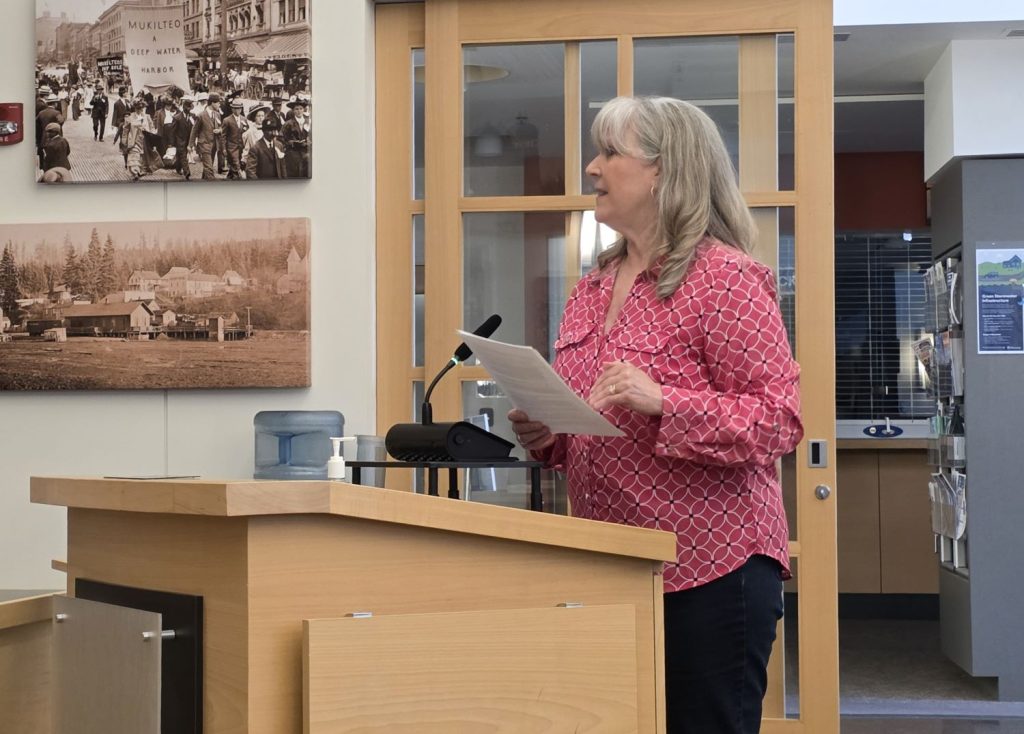
Sharon Damoff called the acknowledgement “a divisive political statement intended to undermine our country” and argued council meetings should stick to city business: “You don’t read a ritual apology every meeting to women apologizing that we were not allowed to vote until 1920, nor should you.”
Boris Zaretsky argued the statement is “historically inaccurate” for Mukilteo, noting no evidence of permanent pre-contact settlement — only seasonal use — and a peaceful, ethnically mixed founding in 1860. He warned it could be “legally problematic” and form the basis for future land claims.
Patricia Morrison raised First Amendment and property-rights concerns: “People have come up here and said, we have these treaties, we live by these treaties, and then they say, well, the treaties weren’t understood, therefore now the treaties are invalid, that we are on stolen land and we need to come to reparations. That’s where this is headed. That’s what they’re doing up in Vancouver, B.C.”
A British Columbia Supreme Court in August 2025 ruled the Cowichan Tribes hold title to roughly 740 acres in Richmond—recognizing Aboriginal title over developed land that includes private properties. Appeals are still pending as banks have refused mortgages in parts of Richmond, resulting in provincial financial aid for affected owners. The ruling has triggered new claims elsewhere and led the British Columbia government considering amending its 2019 Indigenous rights law to protect private property and development.
Despite the contrasting views on the Land Acknowledgement statement at Monday’s meeting, both sides expressed respect for The Tulalip Tribes calling them “neighbors” and shared some openness for the council to consider a volunteer or part-time tribal liaison to continue “building bridges,” as Councilman Champion said.
Mukilteo’s Rich History Honoring the Tulalip and Snohomish Peoples
Mukilteo sits on land long inhabited by the Snohomish people and their successors, the Tulalip Tribes. In 1855, the city was the site where representatives of several Coast Salish tribes signed the Point Elliott Treaty with the U.S. government. The city has long sought to honor the Indigenous tribes whose ancestral lands it occupies, most recently through prominent public artwork created in partnership with the Tulalip Tribes.
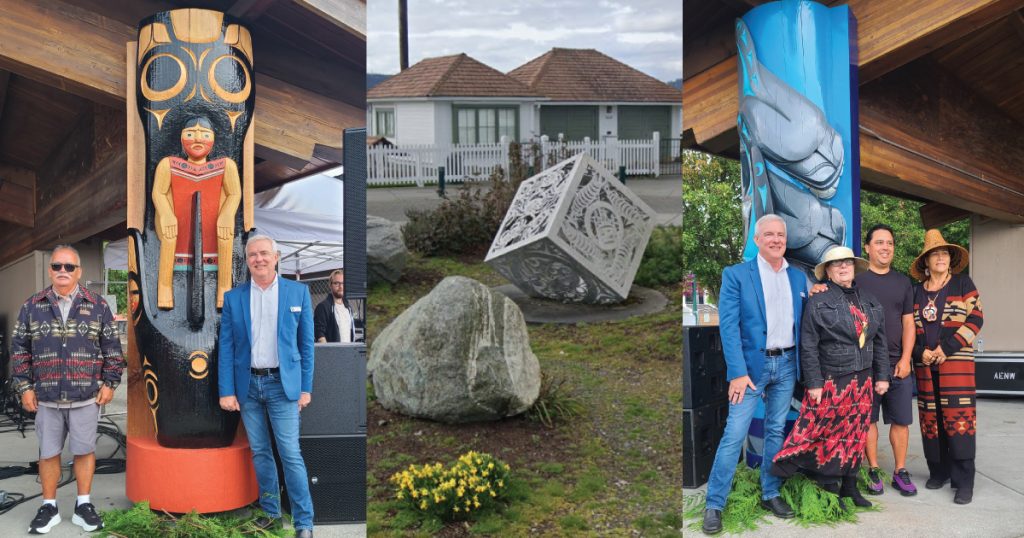
In September 2025, the city unveiled two 10-foot Welcome Poles at Lighthouse Park during its annual Lighthouse Festival. The red cedar story poles were carved by Tulalip master carvers Joe Gobin and James Madison in traditional Tulalip style. One represents the Tulalip Peoples and symbols of multiple Coast Salish tribes, including the Snohomish; the other tells a family story featuring orcas and other figures. The poles contain no weapons, emphasizing a spirit of welcome.
Since 2011, Joe Gobin has made significant contributions to public art in Mukilteo: a 4-foot aluminum six-sided metal cube sculpture located in the Lighthouse Park’s cul-de-sac area; traditional Salish design carvings scattered throughout the Lighthouse Park’s pathways, benches, and retaining walls, and features; and six pieces Mukilteo Ferry Terminal that opened in December 2020.
Madison has also contributed to Mukilteo’s public art scene: The two dual-sided glass displays in the elevator shafts of the Mukilteo Ferry Terminal; a massive 18-foot-old-growth cedar log sculpture located in the center of the roundabout at Lighthouse Park’s southern entrance called the Mother Earth Driftwood Log Sculpture; and a wood carving at Lighthouse Park portraying the legendary Tulalip Seal Hunting Brothers as orcas.

Author: Mario Lotmore