

LYNNWOOD—Lynnwood City Council held apublic hearing at its Business Meeting Monday, May 11, regarding a proposed interim ordinance that would temporarily allow paid surface parking lots citywide for six months.
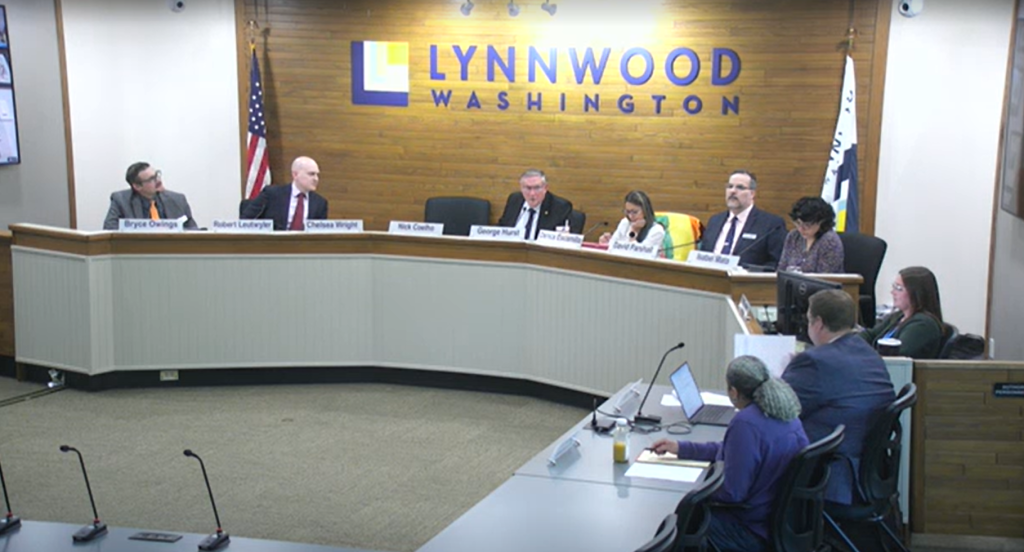
The ordinance would allow paid parking in Commercial Zoned areas beyond the current permitted General Commercial Zoning. The idea, according to City Planner Zach Spencer, is to temporarily relieve parking pressures in Lynnwood during a time when the public has expressed a shortage of available parking (especially ahead of the FIFA World Cup).
According to city documents, the ordinance would amend portions of Lynnwood’s Unified Development Code to permit surface public paid parking on an interim basis (six months) while the city evaluates longer-term parking policy needs. The proposal does not authorize construction of new parking lots but instead regulates the use of existing privately owned paved areas.
“The interim ordinance aims to increase utilization of our existing parking lots, balancing our current parking needs with the economics of land use within City Center,” said Spencer.



Under the draft ordinance, paid parking would only be permitted on sites where a principal use already exists. Operators would be required to maintain compliance with accessibility, paving and development standards, and the business operating the parking facility would need to hold a valid city business license. Public transit park-and-ride facilities operated by transit agencies would be exempt.

The ordinance would also explicitly allow operators to offer hourly parking, monthly leases or event parking depending on business needs.

The city previously issued a Determination of Nonsignificance under the State Environmental Policy Act, concluding the temporary code amendment would not create probable significant adverse environmental impacts.
The Planning Commission has previously held a Public Hearing on this ordinance; approving staff move ahead with bringing it forward to City Council in a 4-1 vote.
Staff also had conversations with the developers of Northline Village (an upcoming 19.1 Acre Development Site that will be the home of a mixed-use community in Lynnwood’s City Center) who shared some comments on the parking matter. Community Planner Manager Karl Almgrem clarified on Monday that changing the ordinance would not affect the Northline Village current development agreement.
A concern the developers had, however, is that they expressed concerns about how the city would manage a paid parking lot in the area when there are over 1,500 parking spaces across the street that are free, creating a market dynamic.

City Council President Nick Coelho asked Almgrem if the revenue generated from the parking could be potentially used to put back into the city, improving its pedestrian safety and walkability, for example. Algrem replied that that would be something needing to be discussed with the City’s Finance Department.
Chip Peterson, General Manager of the Hilton Garden Inn in Lynnwood, spoke during public comment that there is a need for additional parking in the city – calling the parking situation during the Seahawks parade as a “disaster” the city should not want to repeat.
Back in October, 2025, 40 drivers returned from the Seattle Mariners playoff game to find their cars had been towed after parking in a seemingly vacant lot that was private (the parking in and around the light rail station was reportedly at capacity).
Lynnwood resident, and former City Council member Ted Hickel, was critical of the ordinance warning that if it were approved the city would likely have paid parking for the next decade, or at least until the Light Rail expansion to Everett.
Almgrem returned that the six-month interim would be set in stone, adding that prior to the Light Rail station the Lynwood Transit Station’s car park was still regularly full. Even after Sound Transit built a 500-car parking garage, parking still becomes scarce.
To accommodate projected ridershare through 2028, Algrem continued, the City would need to build a total of eight new parking garages which he called “fiscally irresponsible.”
In response to Council President Coelho’s question how much a single parking spot costs to build, Algrem added that in 2018-2019 it cost roughly $25,000 per parking stall but Coelho mentioned he had seen prices as high as $278,000 per stall, according to a recent Sound Transit blog.
“Parking is one of our largest single lane uses in this city and it is significant to the residents of Lynnwood and dramatically impact our ability considering lane usage and transportation,” said Algrem. “It’s not a small conversation and it’s not a small lane use.”
The City Council will consider this ordinance at the next business meeting on May 26.

Author: Kienan Briscoe