

EVERETT— With a looming $34.5 billion budget deficit facing Sound Transit’s regional light rail over the next 20 years, Everett Mayor Cassie Franklin in an April 23, 2026, letter to the Sound Transit Board is laying a compelling case to keep a fully funded Everett Link in an upcoming ST3 System Plan vote expected no later than June 30.

“We are ready to support a strong, regional transportation system that works in lockstep with Sound Transit’s network,” Mayor Franklin wrote. “With a consolidated transit network, riders travelling both from and to Everett will benefit from more frequent service and fewer transfers which will make choosing transit more convenient.”
The letter comes a day after Franklin and Community Transit CEO Ric Ilgenfritz, announced the resumption of joint work toward the consolidation of Everett Transit with Community Transit, forming a unified and expanded transit network with the goal to better serve Everett and Snohomish County residents. The consolidation will result in nearly doubling our local transit service and providing seamless bus-transit integration with light rail, Franklin states.
“I am committed to our work to build the spine to Everett because I know how transformative this investment is and what it will mean for our growing community,” Franklin says. “Our City has put in place new transit oriented, middle housing and “middle plus” zoning; we have adopted incentives to encourage growth; we are implementing a Vision Zero plan to ensure pedestrians and bicyclists are safe in Everett and can choose to access transit as part of their trips.”



The total estimated remaining project cost to complete ST3 is projected at $149 billion by 2046 with a $34.5 billion cost avoidance need (up 25% since Fall 2024) no later than 2033 —approximately $30 billion of the cost overrun is attributed to capital cost growth. The West Seattle Link Extension ballooned from $4.2 billion in the finance plan to between $7 billion and $7.9 billion. The Ballard Link Extension climbed from roughly $11.9 billion to between $20.1 billion and $22.6 billion. Combined, the two lines exceeded $30 billion before adjustments—87% of the overall project cost overruns.


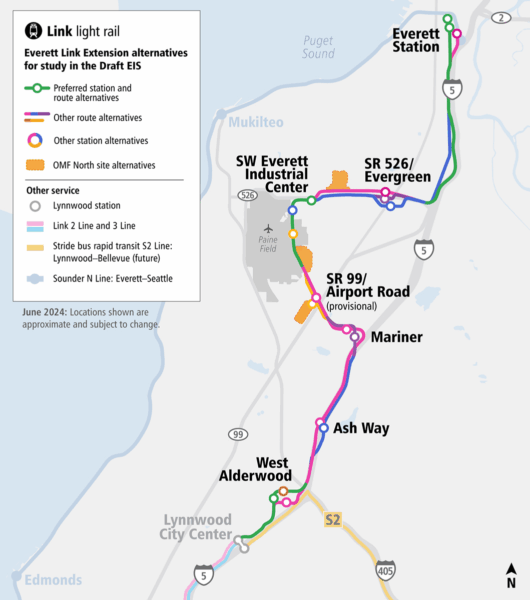
The 16-mile Everett Link Extension, expected to open between 2037 and 2041, has a 2025 estimated completion cost of $6.8 to $7.7 billion—up between $200 million to $1.1 billion since 2021 based estimate, far less than the $30 billion for the West Seattle and Ballard extensions.

The aerial guideway is the leading cost driver over 11.5 miles of the Everett Link track. Sound Transit’s capital delivery team feel very optimistic that building the tracks at at-grade or surface level (Ashway, West Alderwood, and SW Everett Industrial Center) along with design changes at SR 526/Evergreen Way, can reduce the Everett Link extension project costs to $6.4 to $7.3 billion.
In March 2026 the board held a retreat and reviewed three broad “approaches” for closing the gap. These include combinations of:
- Cost savings (e.g., design changes, value engineering, service adjustments).
- Project delays or deferrals (some options floated deferring stations like parts of Ballard or even pausing “shovel-ready” segments like West Seattle Link).
- New or enhanced revenue tools (higher rental-car taxes, longer-term bonds, fare increases, value capture from development near stations, etc.).
- Minor service or policy tweaks (parking fees, fares, etc.).
Sandra Fann, Director at Sound Transit in charge of the Central Corridor HCT Project, shared three “alternatives” that involve project delays or deferrals to reduce up to $30 billion in capital costs overruns:
- Approach 1: Keep active light rail extension projects moving. This funds Everett Link Extension, construct to Tacoma Dome, construct to South Center only, and construct West Seattle to Alaska Junction only; all other stations will be deferred: Graham Infill Station, Boeing Access Infill Station, T Line Extension, and South Kirkland–Issaquah Extension.
- Approach 2: Advance regional connectivity. This funds Everett Link Extension, construct to Smith Cove (located after South Center), construct to Tacoma Dome, and construct to South Kirkland–Issaquah Extension; all other stations will be deferred: West Seattle Extension, Graham Infill Station, Boeing Access Infill Station, and T Line Extension.
- Approach 3: Phase all light rail extension projects to advance other ST3 elements. This funds construction to Delridge (West Seattle), construct to South Center, construct to SW Everett Industrial Center (not downtown Everett), construct to Fife (not Tacoma Dome), construct to Graham Infill Station, construct Boeing Access Infill Station, construct T Line Extension (initial phase only), and construct South Kirkland–Issaquah Extension (initial phase only).
All three approaches deliver roughly 86–87% of the original ST3 rail ridership target and involve major cuts to the Ballard Extension. Everett Link is fully protected in Approaches 1 and 2 but truncated in Approach 3—this is what the Board will be voting on in its May or June meeting the future of the ST3 System Plan—Mayor Franklin and her team are pushing to ensure a fully funded Everett Link extension is part of that plan.

A key component to an Everett Link extension not only requires a “seamless bus-transit integration with light rail,” it also involves an expedited permit process. Everett city staff are currently working together with both Snohomish County and the City of Lynnwood to streamline permit review processes to aid in preventing project delays—cutting the bureaucratic red tape.
“We have heard from every corner of our city support for these initiatives,” Franklin said, “We are ready for the future and ready for light rail.”
The Everett Link extension project is currently in the environmental review phase, which includes preparing an Environmental Impact Statement (EIS). The EIS evaluates the potential adverse or beneficial effects of each alternative to the physical, human, and natural environment and also proposes measures to avoid, minimize, or mitigate significant adverse effects where appropriate.
The EIS will be published in two documents: a Draft EIS and a Final EIS. The Draft EIS will be available for public review and comment for at least 45 days. The Final EIS will address public, Tribe, and agency comments; will include any necessary revisions to correct technical errors; and will add any new information that became available since the Draft EIS was published.
This EIS will be prepared in compliance with both the National Environmental Policy Act (NEPA) and the Washington State Environmental Policy Act (SEPA). The Federal Transit Administration is the lead agency under NEPA, and Sound Transit is the lead agency under SEPA. Sound Transit conducted public scoping under SEPA in 2023 to begin work on the Draft EIS, and conducted a second public scoping process under NEPA in 2025.
Miranda Redinger, Development Manager for Everett Link shared the remaining key milestones for the EIS:
- Publication of the combined NEPA/SEPA Draft Environmental Impact Statement (EIS) and a 45-day public comment that will begin in Fall 2026.
- Sound Transit Board confirms/modifies preferred alternative for Final EIS.
- Publication of the Final EIS.
- Sound Transit Board selects project to be built.
- Federal Transit Administration issues the Federal Record of Decision to fund the project.
“Before we publish the draft EIS, if your property may be impacted by any of the alternatives we’re studying, you’re gonna get a letter,” Redinger said. “So, we again encourage you to come to the open houses for the draft EIS this fall. Sign up for email alerts.”
Mayor Franklin is encouraging Snohomish County residents, even those in cities currently with light rail, to advocate to the Sound Transit Board for Everett Link at Sound Transit meetings.
Board meetings are held on the fourth Thursday of each month from 1:30 p.m. to 4 p.m. unless a Special Meeting is called. The public can attend meetings in person in the Ruth Fisher Board Room located at 401 South Jackson Street or virtually via Zoom. To attend the meeting virtually, visit the Board of Directors event calendar and click on the Board or Committee meeting name for details to join.

Author: Mario Lotmore