

TAMPA, Fla.—Four U.S. service members were killed and at least five injured over the weekend in Iranian-linked attacks in Jordan and Iraq, following a new wave of military strikes launched July 7 by the United States against Iranian targets, U.S. Central Command (CENTCOM) reports. At least 17 U.S. service members have been killed and 413 wounded since Operation Epic Fury began on February 28, 2026.
“Every time Iran kills an American Soldier they will pay for that killing many times over!” President Donald J Trump posted on Truth Social on Monday morning. “This directive has been passed on to Secretary of War, Pete Hegseth, Chairman of the Joint Chiefs of Staff, Daniel Caine, and every Leader in the Military.”



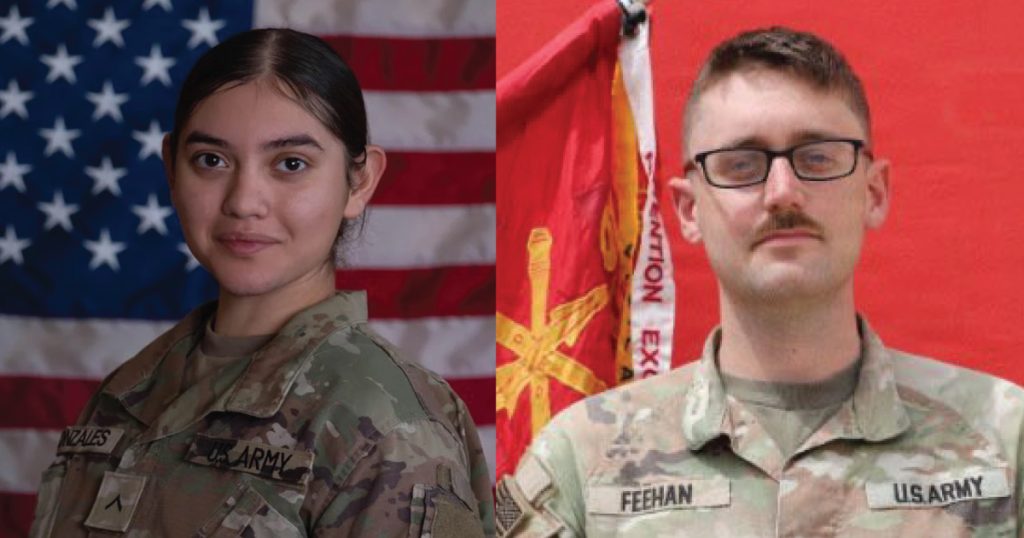
CENTCOM reported that Iranian ballistic missile and drone attacks targeted Muwaffaq Salti Air Base in Jordan on Friday and Saturday that resulted in the death of three American service members. The Pentagon released the names of two of the three casualties: First Lt. Tyler Feehan, 25, from Ewa Beach, Hawaii, and Pvt. Isabella Gonzales, 19, from Carrollton, Texas.
“Texas mourns the loss of Army Pvt. Isabella Gonzales of Carrollton, killed in action serving our nation in Jordan,” Texas Governor Greg Abbott wrote to X. “She was just 19 years old. Her courage and sacrifice represent the very best of Texas. Cecilia and I pray for her family, and for the family of 1st Lt. Tyler Feehan of Hawaii. Our nation is forever indebted to them both. God bless our fallen heroes, and God bless Texas.”




Feehan was assigned to 2nd Battalion, 55th Air Defense Artillery Regiment, 32nd Army Air Missile Defense Command, Fort Bragg, North Carolina. Gonzales was assigned to 1st Battalion, 57th Air Defense Artillery Regiment, 52nd Air Defense Artillery Brigade, 10th Army Air Missile Defense Command, Ansbach, Germany.

The remains of a third service member who was initially reported missing, was discovered on Sunday, July 19, at the site after a thorough search.


Four other American service members were medically evacuated to Jordanian hospitals and have since been discharged. Other personnel involved in the Jordanian attack by Iran, CENTCOM reports, were evaluated for minor injuries and have returned to duty.
Separately, a U.S. service member in northern Iraq was killed in action July 18 during a controlled detonation of unexploded ordnance from a downed Iranian one-way attack drone. A second service member was wounded and continues to receive medical treatment for a minor injury.
This is the first reported casualties of U.S. service members in Operation Epic Fury since March 2026 when 13 were killed. Those service members were:
- Maj. John A. Klinner, 33, U.S. Air Force – Auburn, Alabama
- Maj. Jeffrey R. O’Brien, 45, U.S. Army Reserve – Indianola, Iowa
- Capt. Ariana G. Savino, 31, U.S. Air Force – Covington, Washington
- Capt. Seth R. Koval, 38, U.S. Air Force – Mooresville, Indiana
- Capt. Curtis J. Angst, 30, U.S. Air Force – Wilmington, Ohio
- Capt. Cody A. Khork, 35, U.S. Army Reserve – Winter Haven, Florida
- Chief Warrant Officer 3 Robert M. Marzan, 54, U.S. Army Reserve – Sacramento, California
- Sgt. 1st Class Noah L. Tietjens, 42, U.S. Army Reserve – Bellevue, Nebraska
- Sgt. 1st Class Nicole M. Amor, 39, U.S. Army Reserve – White Bear Lake, Minnesota
- Sgt. Declan J. Coady, 20, U.S. Army Reserve – West Des Moines, Iowa
- Sgt. Benjamin N. Pennington, 26, U.S. Army – Glendale, Kentucky
- Tech. Sgt. Ashley B. Pruitt, 34, U.S. Air Force – Bardstown, Kentucky
- Tech. Sgt. Tyler H. Simmons, 28, U.S. Air Force – Columbus, Ohio
The new wave of attacks against Iran followed a violation of its ceasefire agreement with the U.S. when Iranian military force attacked commercial ships in the Strait of Hormuz in early July.

On July 14, the U.S. resumed blockading maritime traffic entering and exiting Iranian ports. The resumption of the U.S. blockade against Iran followed its initial implementation from April 13 to June 18 and paused during the agreed MOU.
President Trump announced fresh U.S. airstrikes on Iran overnight Sunday, stating they were conducted in honor of the fallen service members following Iran’s attack in Jordan.
Since July 7, the U.S. has conducted a sustained, multi-day air and naval campaign against the Iranian military to degrade Iran’s ability to attack commercial shipping and civilian mariners transiting the Strait of Hormuz.
U.S. forces systematically targeted Islamic Revolutionary Guard Corps (IRGC) forces:
- Air defense and coastal surveillance systems
- Missile and drone capabilities
- Naval and maritime forces
- Support infrastructure such as military logistics, ammunition storage, underground weapons storage, communication networks.
US Strikes Against Iran: July 7


CENTCOM forces hit over 80 targets with precision munitions as a response to Iran’s attacks on commercial vessels transiting the Strait of Hormuz—Marshall Islands-flagged M/T Al Rekayyat, Saudi Arabia-flagged M/T Wedyan, and Liberian-flagged M/T Cyprus Prosperity.
U.S. forces struck Iranian air defense systems, command and control networks, coastal radar sites, anti-ship missile capabilities, and more than 60 Islamic Revolutionary Guard Corps small boats in and near the strait to degrade Iran’s ability to continue attacking international commerce flowing through the international trade corridor.
US Strikes Against Iran: July 8
CENTCOM forces struck approximately 90 Iranian military targets including air defense systems, coastal surveillance assets, missile and drone storage sites, naval capabilities, and military logistics infrastructure along Iran’s coastline. The strikes were to further degrade Iran’s ability to attack commercial shipping and innocent civilian mariners in the Strait of Hormuz.
US Strikes Against Iran: July 11
U.S. forces hit approximately 140 Iranian military targets with precision munitions launched by land- and sea-based fighter aircraft, drones, and naval vessels. Targets included Iranian missile and drone sites, naval capabilities, ammunition storage facilities, communication networks, and coastal surveillance locations.
US Strikes Against Iran: July 12
CENTCOM forces struck Iranian military air-defense systems, coastal radar sites, missile and drone capabilities, and small boats using U.S. fighter aircraft, naval vessels, one-way attack aerial drones, and one-way attack sea drones for the first time.
US Strikes Against Iran: July 13
During a five-hour mission, U.S. forces successfully struck military targets across Iran including Bushehr, Chah Bahar, Jask, Konarak, Abu Musa, and Bandar Abbas to further degrade Iran’s ability to attack commercial shipping. CENTCOM forces employed precision munitions against Iranian coastal defense systems, missile and drone sites, and maritime capabilities.
US Strikes Against Iran: July 14
U.S. fighter aircraft, drones, and naval vessels launched precision munitions against Iranian missile and drone sites, naval capabilities, and coastal defense systems during a seven-hour wave to further degrade Iran’s ability to threaten commercial shipping and civilian crews, CENTCOM reports.
US Strikes Against Iran: July 15
U.S. forces struck Iranian command centers, air defense sites, missile and drone capabilities, and coastal surveillance facilities to further degrade Iran’s ability to threaten innocent mariners crewing commercial vessels transiting the Strait of Hormuz. CENTCOM used precision munitions to hit targets in multiple locations including Bandar Abbas.
US Strikes Against Iran: July 16
U.S. forces, including fighter jets, aerial drones, and warships, launched precision munitions that hit dozens of Iranian military targets such as coastal surveillance and air defense sites, military logistics infrastructure, and maritime capabilities. This was the sixth consecutive night of U.S. strikes against Iran.
US Strikes Against Iran: July 17
CENTCOM hit surveillance sites, military logistics infrastructure, underground weapons storage, and maritime capabilities. U.S. forces employed fighter aircraft, aerial drones, and warships in addition to other assets to carry out the operation.
US Strikes Against Iran: July 18
During the eighth consecutive night of U.S strikes, CENTCOM forces successfully hit Iranian military coastal surveillance and air defense facilities, maritime capabilities, and missile and drone storage sites to continue degrading Iranian military capabilities. American military assets also targeted Islamic Revolutionary Guard Corps forces that launched attacks against U.S. service members in Jordan on July 17 that killed three.
US Strikes Against Iran: July 19
CENTCOM assets targeted Iranian military command centers, air defense and coastal surveillance sites, maritime capabilities, missile and drone launch sites, and communications networks to further diminish Iran’s ability to attack commercial vessels and civilian mariners transiting the Strait of Hormuz.

Author: Mario Lotmore