

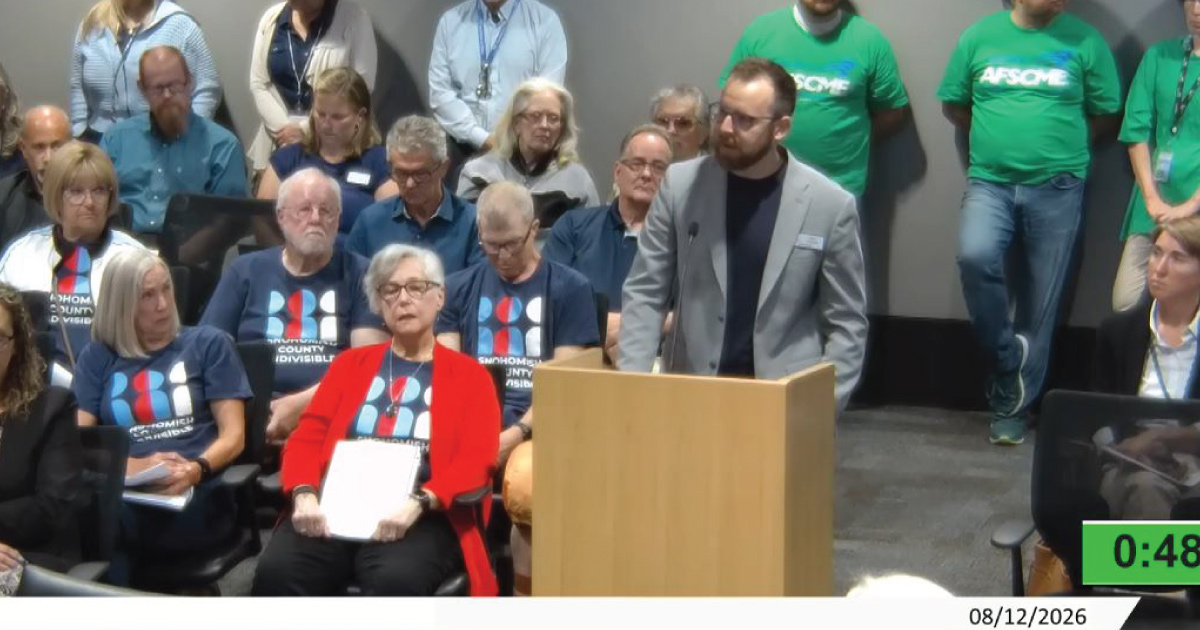
EVERETT—The Snohomish County Council voted 3-2 on Wednesday to approve a new 0.1% criminal-justice sales tax expected to generate nearly $24 million a year, a move supporters said was necessary to prevent the loss of roughly 50 sheriff’s deputies, 50 corrections officers, 25 prosecutors and dozens of other public-safety positions. Opponents called the timing premature, arguing the council should first complete a full budget review and respect the voters’ rejection of a 0.2% public-safety sales tax in 2024.
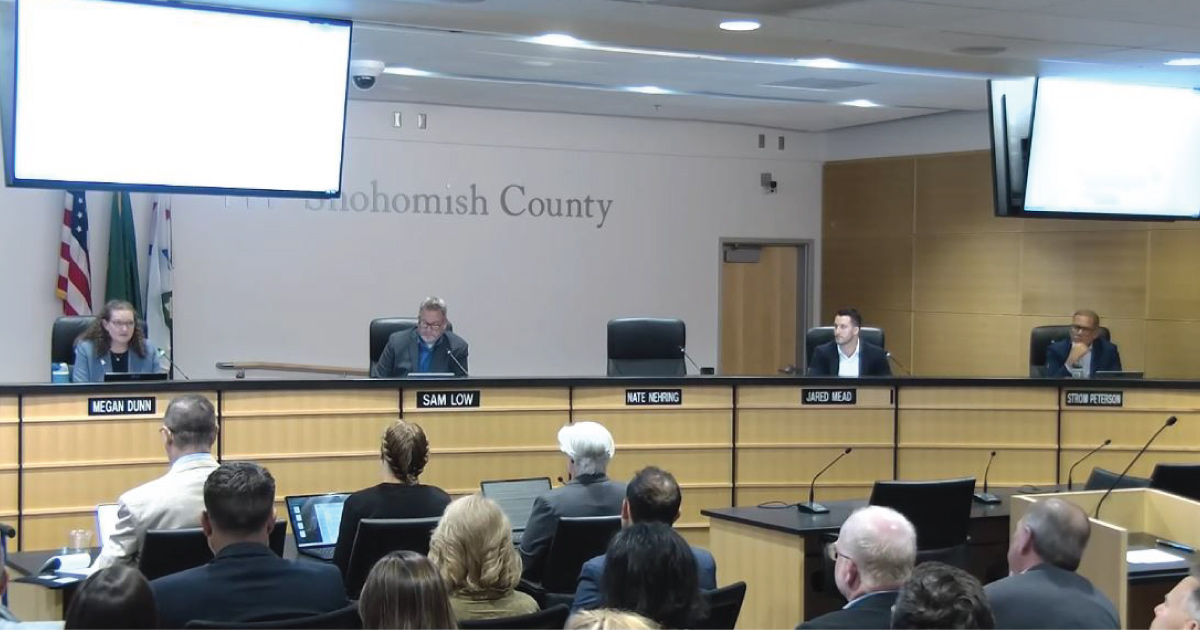
“Councilmembers spent weeks working closely with the Executive’s Office, our law and justice partners, labor, and community stakeholders to build support for this proposal, address concerns, and make clear what was at stake if we failed to act,” Council Chair Megan Dunn released in a statement. ”We heard directly from our justice partners that they are already operating with fewer staff while serving a much larger county, and that deeper cuts could mean furloughing deputies and corrections officers, eliminating prosecution units, and delaying justice…. The Council made the responsible choice today to maintain essential public safety services and to protect and serve residents facing the hardest moments of their lives.”


Ordinance 26-030, officially titled “Imposing an Additional Sales and Use Tax of One-Tenth of One Percent for Criminal Justice Purposes,” was approved incorporating Amendment No. 1 — Councilmembers Nate Nehring and Jared Mead dissented. The measure imposes a 0.1% sales and use tax under RCW 82.14.345, a 2025 state law that allows counties to enact the tax by councilmanic action with no public vote. The ordinance itself takes effect 10 days after signature by the county executive, while the new tax chapter takes effect January 1, 2027.
Amendment No. 1, proposed by Council Chair Megan Dunn and passed unanimously, inserts a new section titled “Reporting” that requires the county executive’s office to create and maintain a public website for the tax. The site must contain the annual reports submitted to the Washington State Association of Counties, a summary of annual revenues received, amounts appropriated, expended, and encumbered, plus any remaining fund balance, and a comparison to the prior year that includes any material changes in revenue, expenditures, program allocations, or funded priorities.




Two other amendments were considered but did not pass. Amendment No. 2, proposed by Councilman Nehring, would have required an 85-15 revenue split with the county retaining 0.0085% while directing 0.0015% into a new Jail Services and Law Enforcement Grant Program available to cities. Amendment No. 3, also proposed by Nehring, would have required a non-binding advisory special election vote of county voters on February 9, 2027, asking whether the council should enact the sales tax.


The sharpest exchange of the meeting was centered on whether the urgency for the tax was accurate and whether the council was acting with sufficient transparency.

“So, I would say we gain nothing by waiting and potentially furloughing 100 public safety positions, 10 to 20 positions with the clerks,” Council Chair Dunn replied after Councilman Jared Mead suggestion that the vote be delayed. “Entire divisions in our prosecuting attorney’s office not meeting requirements for our public defender caseload standards…. I believe all of our council members have heard over the last several years the increase in inflation costs and increase in in our collective bargaining agreements, the increase in costs for our health care needs. There is no status quo option before us. We have clearly heard the timeline and why we need to decide today on revenue. I know that this impacts families. It’s not an easy decision. We can disagree on taxes, and we frequently do, but we can’t disagree that there are serious consequences if this funding fails.”
Mead immediately challenged Dunn’s statements as inaccurate. He said the council still had until mid-October to pass the ordinance and still meet the January 1, 2027, collection date, and that the tax was being presented purely as status-quo maintenance rather than new programs.
“Just a couple of things, because it should be super clear to the public…. I asked our analyst intentionally… we don’t have to do this today. We could do this literally two months… and we could still collect the revenue by January. So that’s inaccurate,” Mead said.
Dunn replied that staff and elected officials had clearly communicated the need for immediate action because of collective-bargaining timelines and the practical time required for any layoff process. She then put Mead on the spot asking him, what would be gained by a two month delay?
“Information,” Mead replied. “We gain the budget… We don’t know. And you saying that we’ve heard from staff how important it is that we make the decision now, tell me which staff member… every staff member I’ve asked on the record today… has said we have until mid-October.”
Prior to this pointed exchange, Councilman Nehring advocated that the council should “respect the will of the voters rather than overriding their sentiment through a councilmanic vote.” He also shared his “disappointed in the lack of attention to spending reductions.”
“I think that a 3% cut spread across the county with no specific prioritization in mind is no way to budget,” Nehring said. “And so, until we’ve seen a serious proposal to reduce unnecessary spending, prioritizing things like unofficial offices and programs with no mandated function, high paid administrative staff and recent spending additions outside of the budget process. I don’t think we should be considering proposals to further increase the tax burden that our residents are facing.”
Councilman Strom Peterson, who supported the ordinance thanked staff and a full room of attendees.
“It is always difficult to vote to increase taxes, but this is money well spent,” Councilman Peterson said. “I think has been proven by the track record of Snohomish County over decades of working leanly and meanly… applaud, again, our county staff and what they’ve been able to accomplish.”
The plea for money
The current measure approved by council is different from the Public Safety Sales Tax rejected by voters in November 2024 in that the earlier proposal sought a higher 0.2% rate, required voter approval, and included revenue sharing with cities — a split of 60% to the county and 40% to cities. The new tax is councilmanic, focused solely on criminal justice and is half the rate at 0.1%— $16 million less than the rejected annual $40 million a year sales tax.
Revenue from the new sales tax must first be used to maintain or increase county staffing levels in the sheriff’s office, jail, prosecuting attorney’s office, office of public defense, clerk’s office, district court, and superior court. Any remaining funds may be used for other criminal justice purposes, including domestic violence services, community and legal advocates, diversion and reentry programs, efforts to reduce homelessness or improve behavioral health that lower interactions with the justice system, community placement of juvenile offenders, and alternative response or mental health crisis programs.
Snohomish County’s adopted 2025-2026 biennial budget totals approximately $3.22 billion, of which roughly $700 million is the General Fund. Approximately 76%, according to county officials, of the General Fund — about $530 million — supports the criminal justice system. That total is made up of roughly $454 million for the core law-and-justice departments such as the Sheriff’s Office, Corrections, Prosecuting Attorney, Office of Public Defense, Clerk, District Court, and Superior Court plus an additional $75 million in related costs from other departments such as the Medical Examiner, Emergency Management, etc.
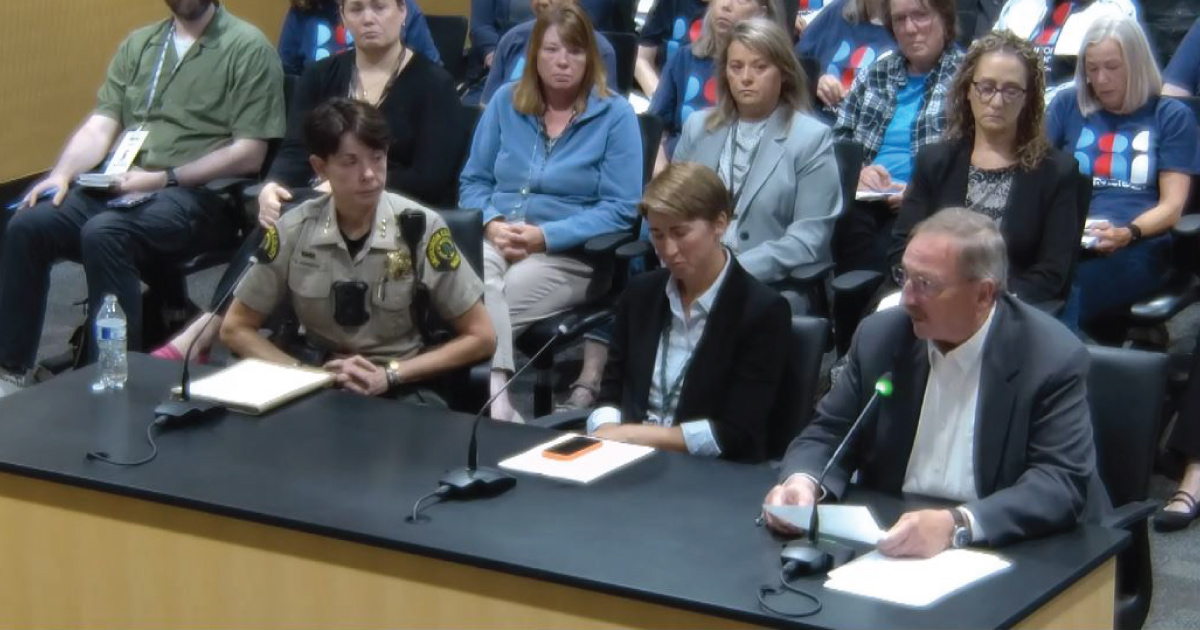
Without new ongoing revenue, county leaders said they will be unable to maintain current service levels for law enforcement, prosecution, public defense, courts, and the jail. Executive Dave Somers, Sheriff Susanna Johnson, and Prosecuting Attorney Jason Cummings all urged the council to pass the tax, describing it as essential to avoid deep cuts to core public-safety services.
Executive Somers shared that he has already directed departments to prepare a 3% spending reduction totaling about $22 million. Even with the new tax, some reductions are still expected he said; without it, deeper cuts to staffing and operations would be required.
“To be blunt, without the Justice Fund, Snohomish County will become insolvent or will have to lay off a significant percentage of our workforce,” Somers said.
He estimated that the tax would cost the average resident approximately $27 per year.
Sheriff Johnson warned that an 11% cut would eliminate approximately 50 deputy sheriff positions and 50 corrections deputy positions, lengthening response times and reducing the number of people the jail can safely house.
“There is no way we could take forecast cuts that would be approximately 50 deputy sheriff positions and 50 corrections deputy positions,” she said.
Prosecutor Cummings said his office would lose roughly 25 positions or about $2.76 million under an 11.7% cut. Even if the tax passes, he shared, every general-fund department will still take that 3% reduction, Somers mentioned earlier.
“These aren’t scare tactics. We’re just being honest,” Cummings told the council. “The sky fell a while ago and now, we’re just trying to deal with flashlights.”
Expected revenue and tax conditions
According to the staff report, the tax is projected to generate $23,839,850 annually for the general fund beginning in 2027. Over the four years from 2027 through 2030, total estimated revenue is $95,359,400. The Department of Revenue deadline for a January 1, 2027, start date of the sale tax rate is October 16, 2026.
The measure is considered a stackable tax, meaning both the county and cities within it may each impose their own independent 0.1% levy per RCW 82.14.345. So, for cities within Snohomish County that adopts (or adopted) the tax, the combined rate under this statute reaches 0.20%. Cities such as Lynnwood and Edmonds, that have already enacted their own 0.1% public safety tax versions; can now see an additional 0.1% to a 10.8% local sales tax — the highest in Washington state and one of the highest in the United States starting January 1, 2027. In other cities that meets the eligibility requirements but not enacted the tax retain the same authority and could impose their own 0.1% levy in addition to the newly imposed 0.1% countywide sales tax passed by the county council on Wednesday.
Before the county can collect the tax it just adopted, state law mandates it to demonstrate that it meets the eligibility criteria used for a separate state $100 million law-enforcement grant program administered by Criminal Justice Training Commission (CJTC) in accordance with RCW 43.101.540. Those criteria center on law-enforcement policies, training, data collection, and related practices.
Key eligibility requirements (showing a subset, see link above for full list) for both the public safety sales tax and grant include:
- Adoption of policies aligned with Attorney General guidance on citizenship status, duty to intervene, de-escalation, use of force, and police dogs
- Full participation in specified CJTC trainings (behavioral health, first aid, crisis intervention—at least 25% of officers—and gender-based violence—100% completion by required officers)
- Policies for court-ordered firearm relinquishment and volunteer supervision restrictions
- A CJTC-certified police chief with no disqualifying convictions
- Future compliance with statewide use-of-force data reporting
The $100 million grant program which expires June 30, 2028, is restricted to:
- Hiring and retaining new (non-lateral) officers and co-responders
- Training and certain broader public safety initiatives
- Maximum state contribution of 75% of salary + benefits, capped at $125,000 per position over three years (not annually).
The Snohomish County Sheriff’s Office filed its application with the CJTC on April 24, 2026; the CJTC identified deficiencies on June 8, 2026; and the county has until October 20, 2026, to submit supplemental materials and reach full compliance or risk a required $100,000 per month sales tax withholding penalty by the county treasurer’s office.
The state statute permits a county to authorize the 0.1% public safety sales tax while still working with the CJTC to become complaint, which the county has done with Wednesday’s vote.
Once the Sheriff’s Office brings the county into full compliance, two important benefits follow. First, the state treasurer will not withhold $100,000 per month from the new tax revenue. Second, the county becomes eligible to apply for and receive grants from the same CJTC program.
The City of Lynnwood provides a recent local example of both outcomes: the city passed an identical 0.1% public-safety sales tax under the same state statute in January 2026 and, after achieving compliance, was awarded a $2.5 million CJTC grant in 2026 to support jail safety, training, rapid-response equipment, and related public-safety priorities —the King County Sheriff’s Office received $15,000,000. As of July 2026, 21 recipients in Washington state have been awarded the ESHB 2015 / HB 2015 Public Safety Funding Program grant.

Author: Mario Lotmore